

Core Funds Are ‘Shifting Over’
Published October 25, 2019

Head of Equity Strategy
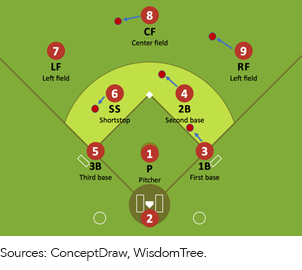
Grant me the use of a baseball strategy analogy for a phenomenon that we are witnessing in the fund management industry.
In figure 1, I added blue arrows and little red dots to show how to shift the team’s positioning for a batter who typically hits toward third base. In baseball, this is sometimes called “shifting over.”
Figure 1: “Shifting Over”
Now imagine a stock market that has not been dominated one way or another by growth or value stocks. This is an example of the style box image for a large cap blend fund you may be considering.
Figure 2: Hypothetical Large Cap Core Fund, Normal Environment
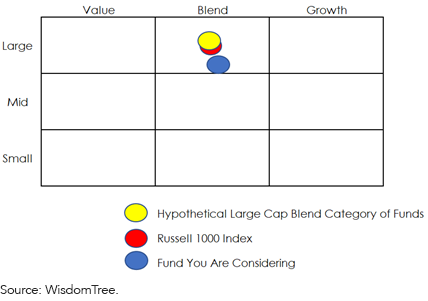
In figure 2, the yellow dot, representing a hypothetical basket of large cap blend funds, is dead center in the “large cap blend” square, as is the Russell 1000 Index of large cap stocks, as many of us would expect. Because a fund you are considering has a large blend mandate, the blue dot may fall anywhere within that square. I put it a little below the yellow and red dots at random (it could just as easily be above them, to the right, to the left, etc.).
Here’s a concern: In the real world right now, the yellow and red dots aren’t in the center. As we see in the following charts, they are “shifting.”
Figure 3 shows the Morningstar image for the WisdomTree U.S. LargeCap Fund (EPS), which “shifts over” toward the “Value” style box to its left while staying in the center column, “the core.” Now look at the yellow dot for the large cap blend category; it encompasses hundreds of funds that, “on net,” are all the way over on the border wall with “Growth.” In fact, the Russell 1000 Index is doing the same thing.
And this market has melted so high that all three dots are pushing above the nine style box squares, into the gray squares at the top—the “Mega Cap” zone that lies above Large Caps.
Figure 3: Large Cap Core? Try Mega-Cap Closet Growth
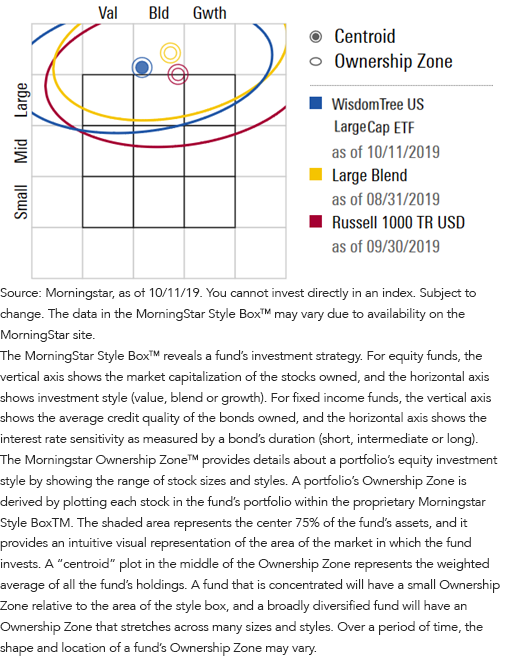
Figure 4 shows one reason money managers can be tempted to drift toward growth: performance chasing.
Figure 4: 5-Year Returns through 9/30/19
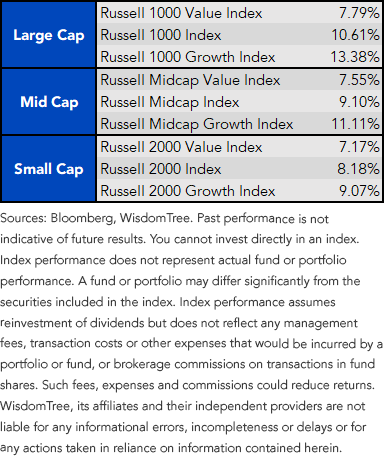
For definitions of Indexes in the chart, please visit our glossary.
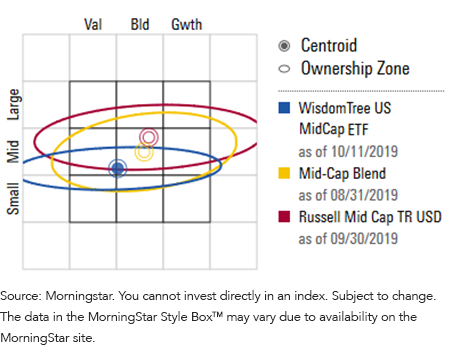
This is what I get for WisdomTree U.S. MidCap ETF (EZM), which I chose because Morningstar categorizes it as a Mid Cap Blend. One more surge upward in this stock market and the Russell “Mid” Cap could end up in Large Cap territory, while small caps could end up in the Mid Cap boxes.
Figure 5: Russell Midcap Index Is Shifting Upward and Rightward
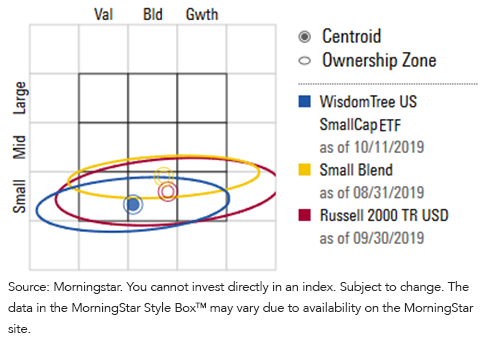
Small caps can be particularly egregious. The WisdomTree U.S. SmallCap Fund (EES) “shifts toward” pure small company exposure and value. But one may think the Law of Large Numbers, which says that an experiment conducted enough times will converge to the expected value, might put the small cap blend industry as a collective into the center of the blend square. However, in figure 6, the Small Blend category (the yellow dot) has an appearance of Small/Mid (SMID).
Figure 6: Small-Cap Core or ‘SMID’ Growth-Lite?
“Shifting over” to growth investing sometimes works fine—like when growth stocks outperform. And, in recent years, they have. But what happens if value investing comes back?
Unless otherwise stated, all data from Morningstar, as of 10/11/19.
Important Risks Related to this Article
There are risks associated with investing, including possible loss of principal. Funds focusing their investments on certain sectors increase their vulnerability to any single economic or regulatory development. This may result in greater share price volatility. Please read each Funds' prospectus for specific details regarding the Fund’s risk profile.
Categories
About the contributor

Head of Equity Strategy
Jeff Weniger, CFA, has been with WisdomTree since 2017 and serves as the Head of Equities. He shapes the firm’s market outlook through a combination of macroeconomic and fundamental analysis. With more than two decades in investment strategy, Jeff is known for his work on market cycles and valuations. Before joining WisdomTree, Jeff was with BMO Private Bank and BMO Global Asset Management for 11 years. At BMO, he sat on the firm’s Asset Allocation Committee and co-managed ETF model portfolios across the U.S. and Canada. In 2013, at age 32, he became the youngest member of BMO’s Global Investment Forum. When he left BMO to come to WisdomTree, his final role was Director, Senior Strategist in the Office of the CIO in 2017.
Jeff is a frequent television guest on networks such as CNBC, Bloomberg, and Schwab, with regular print appearances in The Wall Street Journal, Barron’s and Reuters. He also appears weekly on the Behind the Markets podcast and is a regular on SiriusXM’s The Business Briefing. On X, Jeff has developed one of the larger followings in financial media. He earned a B.S. in Finance from the University of Florida and an MBA from the University of Notre Dame. He has held the CFA charter since 2006.