

Boosting Portfolio Efficiency via Our 90/60 Approach
Published August 8, 2018

U.S. Head of Research
In an earlier post, we highlighted the mechanics of why we believe the WisdomTree 90/60 U.S. Balanced Fund (NTSX) can be a powerful tool to enhance capital efficiency in traditional asset allocation. Similarly, we also believe that gaining exposure to fixed income via a Treasury futures overlay can meaningfully improve after-tax total returns in the current market environment. Additionally, we believe owning equities via an exchange-traded fund (ETF) can also potentially boost long-term tax efficiency. In this piece, we explain the assumptions for our rationale and then attempt to quantify these trade-offs using historical market returns.
Fixed Income: U.S. Taxes 101
For U.S. investors, fixed income total returns are primarily driven by interest income. If they’re held in taxable accounts, any income distributions are typically subject to withholding tax rates of up to 39.6%. By comparison, capital gains on Treasury futures contracts are taxed at 60% long-term, 40% short-term capital gains rates. We believe this tax advantage could be particularly important during periods of rising rates.
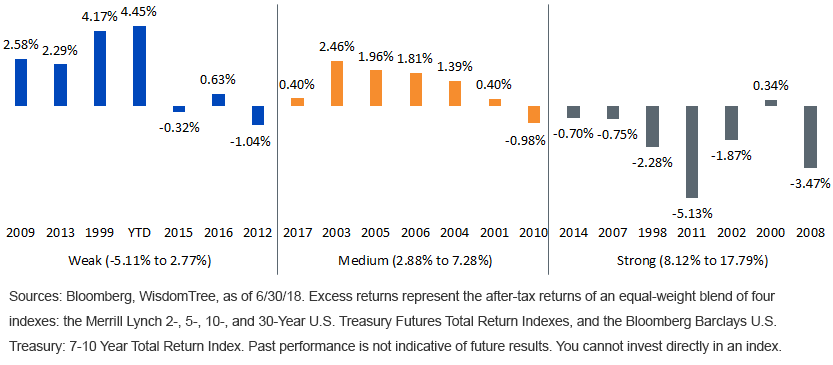
To illustrate this point, we compare the excess return of Treasury futures versus 7–10-Year bonds across different rate environments. During periods of weak (low or negative) bond returns, cash bond investors would continue to be subject to income tax rates on distributions (via interest income) despite unrealized losses on their principal. Paying taxes at ordinary income rates when your holding period returns are negative can be problematic, to say the least. Using Treasury futures, all profits and losses usually will be dealt with at the end of the fiscal year; in the case of a negative return year, losses can be carried forward to offset potential future gains. With U.S. interest rates still low by historical standards, we believe gaining exposure to fixed income via futures could potentially boost tax efficiency compared with investing in cash bonds in certain market environments.
U.S. Treasury Futures (After Tax) Excess Returns over 7-10 Year Cash Bonds (After Tax) during Different Rate Enviroments
What About Equities?
When we were thinking about how to get exposure to equities in NTSX, we also considered gaining exposure to equities via futures. However, over the short to medium term, total returns from equities are generally driven by price changes (as opposed to dividends). In our view, one of the primary advantages of the ETF structure is the potential to defer capital gains over time. Historically, many U.S. equity ETFs have been able to limit capital gains distributions (i.e., realized gains in a fund) via the ETF creation/redemption mechanism. When a redemption occurs, high-cost-basis-securities generally are exchanged for fund shares, which can decrease the total cost basis of the fund. Since funds are not required to sell securities to fund the redemption, no taxable gains would be generated. While investors ultimately may owe capital gains on their holdings when they sell their shares of a fund, the ability to defer taxes can result in a powerful advantage via compounding compared with futures.
Conclusion
We believe that NTSX can be a powerful tool for boosting the efficiency of core portfolios. In our research, we have found that overlay strategies can provide meaningful enhancements to traditional 60/40 portfolios both in terms of exposure as well as tax efficiency in the current environment.
Important Risks Related to this Article
Neither WisdomTree Investments, Inc., nor its affiliates, nor Foreside Fund Services, LLC, or its affiliates provide tax advice. All references to tax matters or information provided on this site are for illustrative purposes only and should not be considered tax advice and cannot be used for the purpose of avoiding tax penalties. Investors seeking tax advice should consult an independent tax advisor.
There are risks associated with investing, including possible loss of principal. While the Fund is actively managed, the Fund’s investment process is expected to be heavily dependent on quantitative models, and the models may not perform as intended. Equity securities, such as common stocks, are subject to market, economic and business risks that may cause their prices to fluctuate. The Fund invests in derivatives to gain exposure to U.S. Treasuries. The return on a derivative instrument may not correlate with the return of its underlying reference asset. The Fund’s use of derivatives will give rise to leverage and derivatives can be volatile and may be less liquid than other securities. As a result, the value of an investment in the Fund may change quickly and without warning and you may lose money. Interest rate risk is the risk that fixed income securities, and financial instruments related to fixed income securities, will decline in value because of an increase in interest rates and changes to other factors, such as perception of an issuer’s creditworthiness. Please read the Fund’s prospectus for specific details regarding the Fund’s risk profile.
Categories
About the contributor

U.S. Head of Research
Bradley Krom joined WisdomTree as a member of the research team in December 2010. He is involved in creating and communicating WisdomTree’s thoughts on global markets, as well as analyzing existing and new fund strategies. Prior to joining WisdomTree, Bradley served as a senior trader on a proprietary trading desk at TransMarket Group. Bradley is a graduate of the Wharton School, University of Pennsylvania.