

Are You Taking On Too Much Risk in Your Small Cap Allocations?
Published July 7, 2015

Global Head of Research
Prior to the popularization of currency-hedged equity strategies, equity investments outside the United States included two trades:
1. The equities, which in most cases were the primary focus2. The currency, which was a secondary exposure, which some investors were unaware of One of the most widely held rationales for owning international currencies was the diversification potential, namely how currency volatility, when combined with the rest of the assets in a portfolio, would actually lead to lower overall volatility. How Global Small-Cap Allocations Reduced Risk of the Russell 2000 Starting from a base of the Russell 2000 Index, a common benchmark for U.S. small-cap equity performance, we added developed international equities in 10% increments to the picture to see what would happen. Two primary questions warranted testing: 1. Did adding international exposure improve the risk/return profile?2. Did adding international equity exposure combined with currency further improve the risk/return profile as compared to adding international equities alone?Adding International Small Caps to U.S. Small Cap Allocations- Last Ten Years (4/30/2005-4/30/2015)
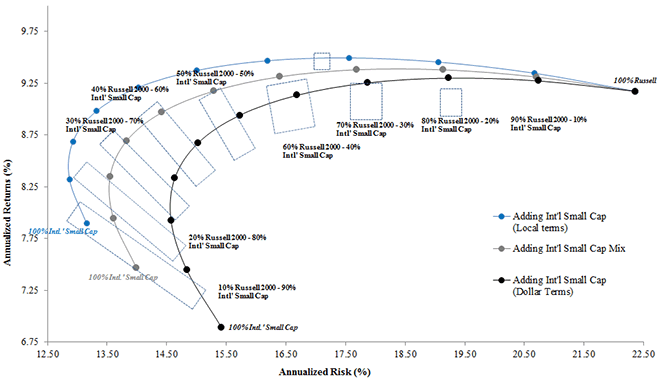
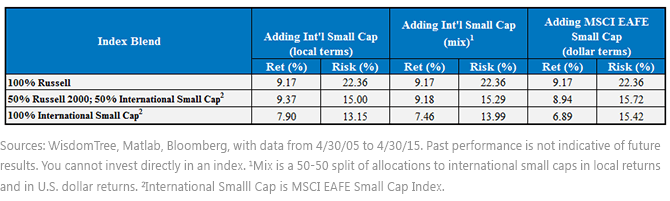
• Northwest Is Best: Within the chart, anything that pulls the data points upwards and to the left (in other words, “northwest”) is offering a greater risk/return trade-off compared to anything positioned further downwards and to the right. Adding international small caps in local terms consistently pulled the data points the furthest toward the northwest corner over the examined period. • Lower Risk Than the Russell 2000 Index: Over the 10-year period shown, the Russell 2000 Index had average annual volatility of about 22.4%. International small caps with currency risk had 15.4%, or 7% less, average annual volatility over the same period. Taking away the currency risk brought the average annual volatility to 13.2%—more than 9% below that of the Russell 2000 Index. • The 50–50 Foreign–U.S. Blend: The U.S. represents just 50% of the global equity opportunity set1. A 50–50 U.S.–foreign allocation, regardless of whether one hedged currency risk, had significant risk-reduction properties. Volatilities of the 50–50 U.S.–foreign blends ranged from 15.0% to 15.7%, down from 22.36% for just the Russell 2000 by itself. The lowest risk profile of these three 50–50 blends was having international wholly represented by small caps without the currency risk. • Importance of the International Small-Cap Mix: We recognize that currencies tend to move in waves and that this 10-year period might be one in which foreign currency exposures faced a particular headwind. Therefore, an interesting baseline could involve looking at mixes of international small-cap exposure that were 50% in local terms (without currency) and 50% in U.S. dollar terms (with currency). This would minimize the risk of being fully exposed or unexposed to fluctuating exchange rates, given that there is no way to know precisely how they might behave in the future. 1Source: Bloomberg; refers to the MSCI ACWI Index universe, with data measured as of 5/22/15.
Important Risks Related to this Article
Investments focusing on certain sectors and/or smaller companies increase their vulnerability to any single economic or regulatory development.
Categories
About the contributor

Global Head of Research
Christopher Gannatti began at WisdomTree as a Research Analyst in December 2010, working directly with Jeremy Schwartz, CFA®, Director of Research. In January of 2014, he was promoted to Associate Director of Research where he was responsible to lead different groups of analysts and strategists within the broader Research team at WisdomTree. In February of 2018, Christopher was promoted to Head of Research, Europe, where he was based out of WisdomTree’s London office and was responsible for the full WisdomTree research effort within the European market, as well as supporting the UCITs platform globally. In November 2021, Christopher was promoted to Global Head of Research, now responsible for numerous communications on investment strategy globally, particularly in the thematic equity space. Christopher came to WisdomTree from Lord Abbett, where he worked for four and a half years as a Regional Consultant. He received his MBA in Quantitative Finance, Accounting, and Economics from NYU’s Stern School of Business in 2010, and he received his bachelor’s degree from Colgate University in Economics in 2006. Christopher is a holder of the Chartered Financial Analyst Designation.