

Ain’t No Cure for the Summertime Blues
Published July 11, 2017

Head of Investment and Fixed Income Strategy
Since Election Day, the focus in the U.S. Treasury (UST) market has been essentially domestic-driven. In other words, market participants have been setting their sights on potential fiscal policy developments and, of course, the latest actions from the Federal Reserve (Fed). However, as the calendar turned to summer, investors were greeted with a new twist for Treasuries—more-hawkish-than-expected rhetoric coming from other developed markets’ central banks, elevating global bond yields in the process. The question that lies ahead on the rate front is whether words become deeds; if so, the fixed income arena could be in for a case of summertime blues.
Two of the more noteworthy developments from the global central bank perspective involved the European Central Bank (ECB) and the Bank of Canada (BOC), each occurring in just the last few weeks. The genesis was at an ECB forum in Sintra, Portugal, where President Draghi made remarks that the bond market viewed as being on the hawkish side. Although the ECB tried to walk back the comments, stating they were misinterpreted, the damage was done, and yields nevertheless finished higher. Interestingly, the FOMC minutes released last week were a nonevent, but the ECB minutes were a different story, as the headlines stated that policy makers “discussed removing the easing biases in their policy communication,” specifically on their Quantitative Easing (QE) program. These news events were accompanied by earlier comments from BOC president Poloz that intimated that Canadian policy makers may be considering a rate hike at one of their upcoming meetings.
U.S. 10-Year vs. 10-Year German Bund
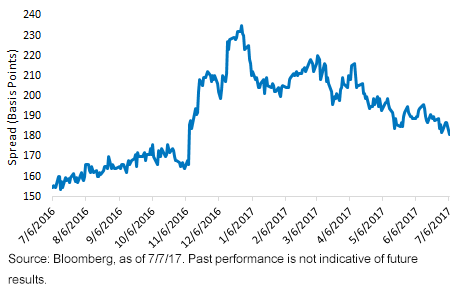
Needless to say, the shift in tone was not expected in the global bond markets. In the eurozone, 10-Year German bund yields have risen more than 30 basis points (bps) since June 26 and are now at their highest levels since January 2016. From a technical perspective, as of this writing, the 10-Year bund was just 1 bp below its one-year 100% retracement level. Along the same lines, UK and French 10-Year yields were also up at least 30 bps during this time frame, with Italian 10-Year rates posting an increase of nearly 45 bps. On this side of the Atlantic, CAD 10-Year yields now reside at two-year highs, and the implied probability for a rate hike at tomorrow’s policy meeting has risen to 94.7% versus 34.9% on June 26.
So, what does that mean for the UST market? Well, utilizing the same period, the 10-Year yield has risen by just under 25 bps. Even though both bund and UST 10-Year yields have moved higher, the spread between the two has continued to narrow from its post-election high-water mark, as the increase in German rates has outpaced its U.S. counterpart. Thus, much like the spread widening to its highest readings since 1989 was viewed as Treasury supportive, it would seem logical to reason that this narrowing trend to pre-election levels could represent a negative development for Treasuries, if it is sustained.
Conclusion
The bottom-line message is that developed countries’ government bond markets had become too complacent and were not priced for any “counter” news. So, what we’re seeing are adjustments, especially from a potential monetary policy perspective. News stories that the “bond bulls” are capitulating and that higher yields are in the offing are already circulating. In my opinion, for the UST 10-Year, we’ve already seen well-established resistance once we get to the 2.64% mark, so barring any surprises, in the near term that would seem to still represent a top, but things look like they’re going to be fluid as we get deeper into summer. Against this backdrop, fixed income investors may wish to consider shortening duration in their portfolios in order to mitigate the potential risk for higher rates.
Unless otherwise noted, data source is the Federal Reserve, as of July 7, 2017.
Important Risks Related to this Article
Fixed income investments are subject to interest rate risk; their value will normally decline as interest rates rise. In addition, when interest rates fall, income may decline. Fixed income investments are also subject to credit risk, the risk that the issuer of a bond will fail to pay interest and principal in a timely manner or that negative perceptions of the issuer’s ability to make such payments will cause the price of that bond to decline.
Categories
About the contributor

Head of Investment and Fixed Income Strategy
Kevin serves as the Head of Investment and Fixed Income Strategy. In this role, he writes macro and fixed income-related content and works closely with the sales, research and marketing teams. In addition, Kevin conducts client-facing webinars and meetings, providing expertise on WisdomTree’s existing and future bond ETFs. Prior to joining WisdomTree, Kevin spent 30 years at Morgan Stanley, where he was Managing Director and Chief Fixed Income Strategist for Wealth Management. He was responsible for tactical and strategic recommendations and created asset allocation models for fixed income securities. He was a contributor to the Morgan Stanley Wealth Management Global Investment Committee, primary author of Morgan Stanley Wealth Management’s monthly and weekly fixed income publications, and collaborated with the firm’s Research and Consulting Group Divisions to build ETF and fund manager asset allocation models. Kevin has an MBA from Pace University’s Lubin Graduate School of Business, and a B.S. in Finance from Fairfield University.