

A Relative Value Rebalance Case Study
Published January 7, 2015

Director, Research
With market capitalization-weighted indexes, when constituents increase in price compared to other stocks, they gain greater weight and impact on the performance of the index. WisdomTree Indexes employ a rules-based rebalancing mechanism that adjusts relative weights based on underlying dividend trends. During the rebalancing process, which occurs once per year for each Index, the relationship between price change and dividend growth is measured. • WisdomTree Dividend Index rebalance process typically is driven by both: 1. Dividend growth: Faster dividend growers see weight increased 2. Relative performance: - Underperformers typically see weight increased - Outperformers often see weight decreased In what follows, we outline how the annual screening impacted the sector composition of the WisdomTree Equity Income Index (WTHYE). Sector Changes for the WisdomTree Equity Income Index
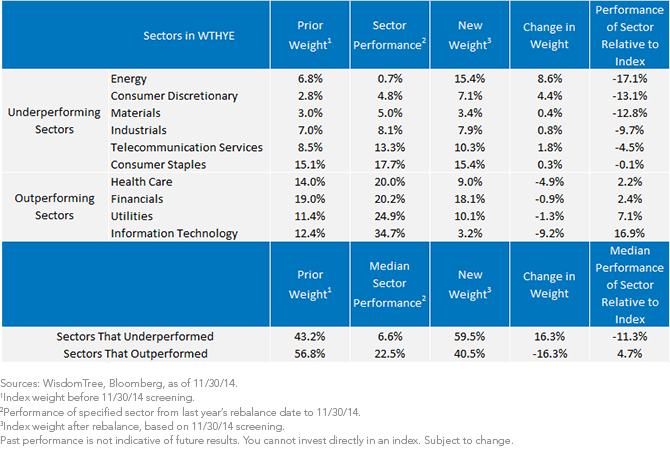
• The Energy sector deserves special note within WTHYE, because it added more than 8.6% to its weight as of the November 30, 2014, Index screening and became the third-largest sector represented. The mechanism driving this change was average sector dividend growth, coupled with below-average performance over the period, improving the relationship between dividends and price. Exxon Mobil Corp. was a noticeable addition to the Index with a maximum weight of 5.0%. Between annual screening dates, Exxon’s price declined 3.2%, but its dividends per share increased 9.5%, which increased its dividend yield 35 basis points (bps), from 2.63% to 2.98%1. Dividend yield is relevant to WTHYE because the Index first ranks eligible securities by dividend yields to screen the top 30% of the universe for inclusion before weighting them by their dividends. • The Information Technology sector also saw a significant change within WTHYE; its weight was lowered by 9.2%. The sector saw significant outperformance over the period but exhibited below-average dividend growth, weakening the relationship between dividends and price. Two noticeable deletions from the Index were Microsoft and Intel, representing decreases of 5.4% and 2.9%, respectively. Between annual screening dates, Microsoft’s dividends per share increased 10.7%, but its price increased 25.4%, lowering its dividend yield by 14 bps. Intel’s dividends per share increased by 6.7%, but its price increased by 56.3%, lowering its dividend yield by 135 bps2. Conclusion The WisdomTree annual rebalance is a key element of the added value of WisdomTree’s Index methodology. It is at each rebalance when WisdomTree engages in a disciplined process to adjust weight based on changes in relative value as well as in the relationship between dividend growth and price growth. This process was clearly exhibited within WTHYE’s rebalance as weight shifted from the best-performing sector, Information Technology, which exhibited below-average dividend growth, toward the worst-performing sector, Energy, which displayed higher dividend growth. For current holdings of the WisdomTree Equity Income Index, click here. 1Source: Bloomberg, from 11/30/13–11/30/14. 2Source: Bloomberg, from 11/30/13–11/30/14.
Categories
About the contributor
