

A Case for India’s Multiple-Year Bull Market – Part 1
Published June 13, 2019

Associate Director, Asset Allocation and Modern Alpha
India just completed an election of mammoth proportions. Nearly 1 billion eligible voters made this the largest democratic exercise ever held. With Prime Minister Modi reelected for a second term, it is time to analyze the election’s implications for investing in India. There are structural economic changes from Modi’s first term that I believe are propelling India toward a multiple-year bull market.
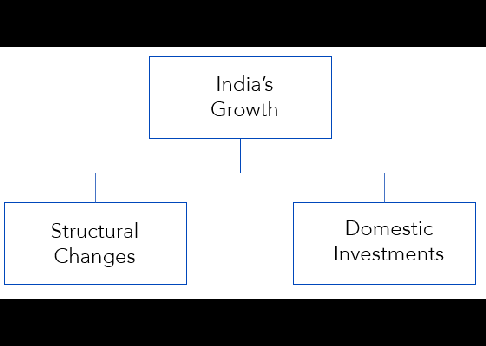
Top Structural Shifts with Long-Term Benefits
In Modi’s first term, India’s economy was massively transformed.
- Indirect Taxation Overhaul – Goods and Services Tax Bill (GST)
- This is one of the biggest tax overhauls conducted by any nation and it will have a far-reaching impact on the Indian economy.
- Under the federal taxation structure, businesses in India previously had to keep track of a laundry list of taxes as they moved from state to state. This meant serious inefficiencies in the system and encouraged tax evasions, especially by smaller businesses that found evading easier than reporting.
- In July 2017, India brought all of its 29 states and seven union territories on board and implemented what it called the “GST.” In simpler terms, this is a unification of taxation regime that taxes all goods and services under just two jurisdictions: State and Central.
- This easier tax policy has led to higher tax reporting and revenue collection.
- I believe India’s economic expansion can go up by 1-2% due to this increased efficiency in the system.
- Digitization Everywhere
- One of the biggest hurdles to India’s growth has been an untracked informal economy that constitutes roughly 85% of its $2.7 trillion GDP. We live in the age of data, so a lack of data implies a lack of ways to improve an existing system.
- India issued a unique identifier (UID) called “Aadhaar” that is based on digital biometric data (retinal scan and fingerprint). This UID is now linked to an individual’s cell phone and bank accounts, thus connecting that individual to the larger network of the overall economy in every possible manner.
- For a country with 1.2 billion people, this means zillions of data points over the next few years for machine learning algorithms, making India a diamond mine for data analytics and technology providers.
- This also means a much more targeted response by the government, from directing subsidies to the needy to catching the corrupt.
- In addition, a push for digitization in the governance of banking has led to a cleaner and more transparent working of the public as well as private sectors.
- Financial Sector Reforms
- India has also been liberalizing its economy at large by opening it up more to foreign investors and engaging in other reforms. The financial sector deserves special attention.
- The Modi government has applied a host of reforms in the financial sector, including implementing a bankruptcy code, merging foreign direct investment (FDI) and foreign institutional investment (FII), initializing a mandatory banking program and cleaning up bank balance sheets.
- While each of these deserves a research paper of its own, their higher level accomplishments are:
- Bankruptcy Code – By enabling a faster restructuring of bad loans (both old and new), banks have newfound confidence to increase lending, so I expect credit growth to expand.
- Merging FDI and FII – By merging individual caps for FDI and FII in banks into a composite cap, there is more space for foreign investors to invest in India—whether directly or in public markets.
- Mandatory Banking – Called “Jan Dhan Yojana” in local lingo, this is a push by the Modi government to gather everyone in India under a formal banking system. As of the last data, about 400 million new accounts were opened, flushing India’s banks with Rs 810 billion (approximately $13 billion) of liquidity.
- Balance Sheet Cleanup – The Reserve Bank of India (RBI) has been working actively with banks to stress test, identify and restructure bad assets, making India’s banks healthier.
Conclusion
What is important to notice is that each of the above steps indicates a fundamental shift from the way the Indian economy has behaved in the past. These structural changes are going to be propellers accelerating India’s economic engine, which has just started to warm up.
If India grew 6-7% for the last decade with a mere 3% of its employable population paying taxes, 85% of the economy untracked, banks having no hopes of recovering assets gone bad and more than half of the population having no bank account, it is not difficult to guess how much it could grow after all of those parameters change positively.
Investors who share our bullish view on India should consider the WisdomTree India Earnings Fund (EPI).
Categories
About the contributor
