


2024 Superconvergence BioRevolution Series: A New Therapy for Diabetes?
Published October 15, 2024

Christopher Gannatti, CFA
Global Head of Research
Key Takeaways
- Breakthrough stem cell transplants for diabetes have allowed patients to produce their own insulin, offering hope for a transformative new treatment without the need for immunosuppressants.
- While these pioneering therapies show promise for long-term glycemic control, their scalability and commercialization challenges highlight the need for more trials and research.
- Biotech stocks, especially in the stem cell space, may gain momentum as falling interest rates in late 2024 provide a more favorable environment for speculative investments despite earlier market volatility.
At WisdomTree, we work with Dr. Jamie Metzl on a strategy that we term “the BioRevolution.” We believe that we are on the precipice of a remarkable period that could last a few decades, where we challenge and ultimately evolve how we do such things as:
- Handle human health care.
- Consider growing food for an expanding global population.
- Generate novel materials, chemicals and energy from biological sources.
- Think about storing massive amounts of data with higher density and fidelity than we have in the past.
Dr. Metzl recently published the book Superconvergence: How the Genetics, Biotech, and AI Revolutions Will Transform Our Lives, Work, and World. We aim to publish a series of blog posts that draw attention to some of the ideas presented in the book.
The bottom line: Thematic investing, in a sense, is about storytelling. Superconvergence does a great job conveying the narrative behind the WisdomTree BioRevolution Index, which is tracked, after fees and expenses, by the WisdomTree BioRevolution Fund (WDNA).
Stem Cells Offer Possible Avenue of Treatment for Diabetes1
A 25-year-old woman with type 1 diabetes in Tianjin became the first person to produce her own insulin after receiving a transplant of reprogrammed stem cells from her own body. This breakthrough allowed her to enjoy foods like sugar and hot pot without needing insulin injections. The surgery, led by Deng Hongkui at Peking University, involved injecting 1.5 million islets into her abdominal muscles, a new site for such transplants. This method allowed for better monitoring and potential removal of the cells if needed.
James Shapiro from the University of Alberta praised the results, noting the complete reversal of diabetes in the patient. The study, published in Cell, follows another successful transplant in Shanghai, where a 59-year-old man with type 2 diabetes also stopped needing insulin after receiving islets derived from his own reprogrammed stem cells.
These pioneering trials using stem cells to treat diabetes offer hope for a limitless source of pancreatic tissue, potentially eliminating the need for immune-suppressing drugs. However, the procedures are challenging to scale up and commercialize. Researchers are also exploring the use of donor stem cells for islet transplants, with promising preliminary results from trials led by Vertex Pharmaceuticals and others.
The results are promising, but more trials and long-term studies are needed to confirm the effectiveness and safety of these treatments.
- Traditional islet transplants have shown significant therapeutic benefits, allowing patients to discontinue exogenous insulin and avoid complications. However, patients still require immunotherapy, and there is a shortage of donor organs.2
To offer a broader historical grounding, we can see a timeline of some of the major milestones in diabetes treatment5:
- 1921: Discovery of Insulin – Frederick Banting and Charles Best discovered insulin, which became a life-saving treatment for people with diabetes.
- 1950s: Development of Oral Medications – The first oral medications for type 2 diabetes, such as sulfonylureas, were introduced.
- 1970s: Introduction of Blood Glucose Meters – Portable blood glucose meters allowed people with diabetes to monitor their blood sugar levels at home.
- 1980s: Insulin Pumps – The development of insulin pumps provided a more flexible and precise way to deliver insulin.
- 1990s: Continuous Glucose Monitors (CGMs) – CGMs allowed for real-time monitoring of blood glucose levels, improving diabetes management.
- 2000s: Artificial Pancreas Systems – These systems combined insulin pumps and CGMs to automate insulin delivery based on glucose levels.
- 2010s: Advances in Stem Cell Research – Researchers began exploring the use of stem cells to generate insulin-producing cells for transplantation.
- 2020s: Breakthroughs in Stem Cell Transplants – Successful transplants of reprogrammed stem cells from patients’ own bodies showed promise in treating diabetes without the need for immunosuppressants.
Overall, while traditional islet transplants have been effective, the new stem cell-based method offers several advantages, including a potentially limitless source of islet cells, reduced need for immunosuppressants and better long-term outcomes. However, more research and long-term studies are needed to fully evaluate the effectiveness and safety of the new method.
How Is Our Biotech Prediction for 2024 Doing, Roughly Three Quarters in?
On December 5, 2023, we published: “Is it Time for Biotech?”
The cornerstone of our thesis was that the companies included in this grouping had been largely underperforming the broader market for the better part of three years. Investors, and really the world, get excited about possible innovations in biotechnology, but it can be difficult to have the patience to wait for investment returns.
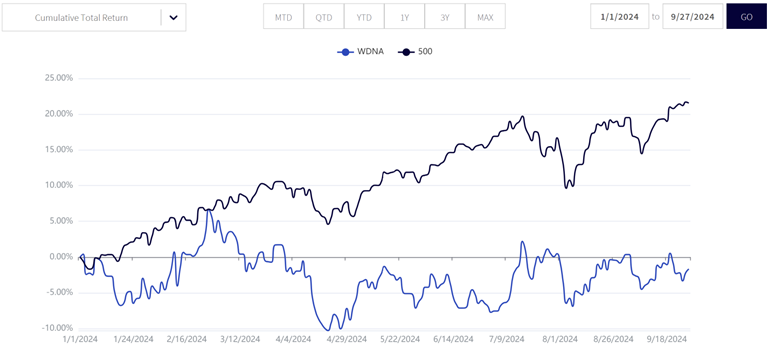
If we look at the performance of WDNA through basically the first three quarters of 2024, we see in figure 2:
- WDNA has been volatile for the majority of the first three quarters of 2024. After some up and down moves, the ending point looks slightly into negative territory.
- Many might be comparing this to the broader S&P 500 Index and thinking that the prediction that 2024 could be a stronger year for biotechnology stocks is not yet working.
- If there has been a brighter spot, it has been the companies able to showcase a strategy and deliverable product in the GLP-1 market. While WDNA does include these companies, it does not push exposure in that direction to any significant degree that is greater than any other direction.
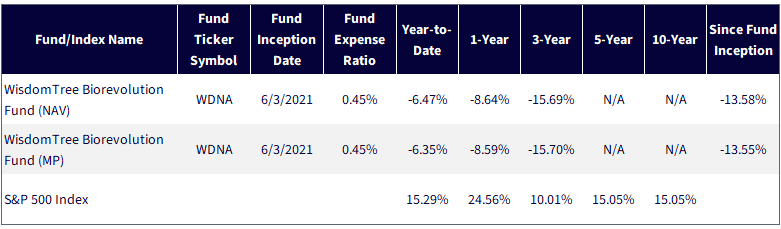
Figure 1: Standardized Performance
Source: WisdomTree; specifically, data is from the PATH Fund Comparison Tool, accessed as of 9/28/24. NAV denotes total return performance at net
asset value. MP denotes market price performance. Past performance is not indicative of future results. Investment return and principal value of
an investment will fluctuate so that an investor’s shares, when redeemed, may be worth more or less than their original cost. Current
performance may be lower or higher than the performance data quoted. For the most recent month-end and standardized performance, click
here.
Figure 2: WDNA vs. S&P 500 Index in 2024
Source: WisdomTree; specifically, data is from the PATH Fund Comparison Tool, accessed as of 9/28/24. NAV denotes total return performance at
net asset value. MP denotes market price performance. Past performance is not indicative of future results. Investment return and principal
value of an investment will fluctuate so that an investor’s shares, when redeemed, may be worth more or less than their original cost. Current
performance may be lower or higher than the performance data quoted. For the most recent month-end and standardized performance, click
here.
Conclusion: Might Falling Interest Rates Represent a Catalyst?
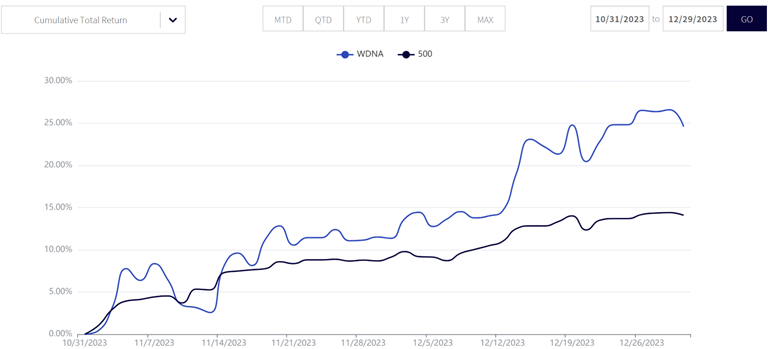
One of the biggest topics occurring from September 2024 to the end of the year is the shift in policy at the U.S. Federal Reserve, with the policy rate actually being lowered. Toward the end of 2023, we saw what happened when a broad swath of market participants believed that rates would be cut early in 2024. Figure 3 showcases this period of about two months:
- A past period does not necessarily allow us to extrapolate directly to a future period, but falling rates and a lower overall level of interest rates may allow for an easier environment for many of these more speculative companies.
Figure 3: Falling Interest Rate Expectations Did Impact Relative Performance in a Past Period
Source: WisdomTree; specifically, data is from the PATH Fund Comparison Tool, accessed as of 9/28/24. NAV denotes total return performance at
net asset value. MP denotes market price performance. Past performance is not indicative of future results. Investment return and principal
value of an investment will fluctuate so that an investor’s shares, when redeemed, may be worth more or less than their original cost. Current
performance may be lower or higher than the performance data quoted. For the most recent month-end and standardized performance, click
here.
1 Source: Smriti Mallapaty, “Stem cells reverse woman’s diabetes—a world first,” Nature, 9/26/24. Summary includes text from Microsoft Copilot.
2 Source: https://www.frontiersin.org/journals/immunology/articles/10.3389/fimmu.2024.1391504/full
3 Source: https://www.nature.com/articles/s41574-022-00790-4
4 Source: https://www.medicalnewstoday.com/articles/islet-cell-transplant
5 Source: Microsoft Copilot-based timeline.
Important Risks Related to this Article
For current holdings of WDNA, please click here. Holdings are subject to risk and change.
There are risks associated with investing, including the possible loss of principal. The Fund invests in BioRevolution companies, which are companies significantly transformed by advancements in genetics and biotechnology. BioRevolution companies face intense competition and potentially rapid product obsolescence. These companies may be adversely affected by the loss or impairment of intellectual property rights and other proprietary information or changes in government regulations or policies. Additionally, BioRevolution companies may be subject to risks associated with genetic analysis. The Fund invests in the securities included in, or representative of, its Index regardless of their investment merit, and the Fund does not attempt to outperform its Index or take defensive positions in declining markets. The composition of the Index is governed by an Index Committee, and the Index may not perform as intended. Please read the Fund’s prospectus for specific details regarding the Fund’s risk profile.
Categories
About the contributor

Christopher Gannatti, CFA
Global Head of Research
Christopher Gannatti began at WisdomTree as a Research Analyst in December 2010, working directly with Jeremy Schwartz, CFA®, Director of Research. In January of 2014, he was promoted to Associate Director of Research where he was responsible to lead different groups of analysts and strategists within the broader Research team at WisdomTree. In February of 2018, Christopher was promoted to Head of Research, Europe, where he was based out of WisdomTree’s London office and was responsible for the full WisdomTree research effort within the European market, as well as supporting the UCITs platform globally. In November 2021, Christopher was promoted to Global Head of Research, now responsible for numerous communications on investment strategy globally, particularly in the thematic equity space. Christopher came to WisdomTree from Lord Abbett, where he worked for four and a half years as a Regional Consultant. He received his MBA in Quantitative Finance, Accounting, and Economics from NYU’s Stern School of Business in 2010, and he received his bachelor’s degree from Colgate University in Economics in 2006. Christopher is a holder of the Chartered Financial Analyst Designation.