

Yellen to the Markets: Come To Me
Published September 22, 2014

U.S. Head of Research
By most accounts, the Federal Open Market Committee (FOMC) statement released September 17 failed to break much new ground in terms of changes to policy or language. The Federal Reserve (Fed) met expectations with another measured step in its tapering process, by trimming $5 billion of Treasury and $5 billion of mortgage-backed securities purchases from its asset purchase program.1 While some analysts were looking for removal of the “considerable time” language from the statement, the Fed chose to tweak more innocuous, less market-moving verbiage. At this meeting, however, investors did receive an update to growth and inflation projections as well as the Fed “dots,” also referred to as the staff’s Summary of Economic Projections, for the first time since June. In this report, economists noted a modest drift higher in the dots for 2015 and 2016, implying a marginally higher forecast for the Federal Funds Rate. Also, the Fed provided rate forecasts through 2017 for the first time. As we discuss below, we believe that chairman Janet Yellen may be uncomfortable with the current disconnect between Fed projections and market implied rates. Over the next several weeks, we may begin to see an increase in rhetoric to condition market rates higher before a formal change is made to the FOMC statement. In our view, Yellen is waiting for the markets to come to her. Fed Futures vs. Federal Reserve Estimates (Dots)
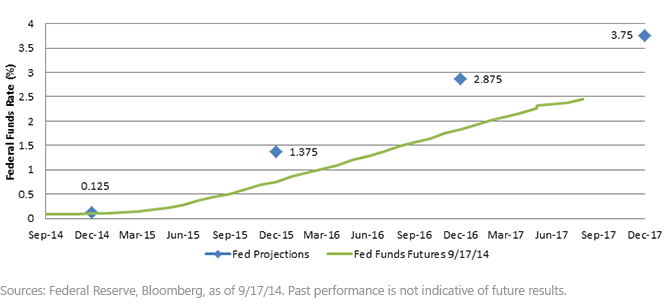
For definitions of terms and Indexes in the chart, visit our glossary. On this view, we are in good company. In a paper released September 8 by the Federal Reserve Bank of San Francisco, researchers compared the market’s estimate of future interest rates with the Fed’s own projections.2 In their analysis, the authors explain the notable disconnect between market implied measures and the Fed’s dots. At current levels, the market appears to expect a more accommodative monetary policy than the Fed’s projections suggest. While the researchers don’t necessarily provide a cause, we believe the Fed will likely need to check two boxes before raising rates: 1) A high degree of confidence that the economy has reached “escape velocity” and will be able to function properly without the Fed accommodation 2) That market expectations about interest rates begin to move in the direction of the Fed’s projections so as not to catch financial markets off guard While the Fed has been steadfast in saying that any change in policy will be data dependent, we believe this is focused on satisfying checkbox one. The last thing the Fed wants to do is to start hiking interest rates, to then pause or reverse course when the economy starts to sputter. The prospect of a “failure to launch” scenario may be why the market remains more sanguine than the Fed on how and to what level short rates might rise. After nearly seven years of accommodation, this may be the biggest risk the Fed hopes to avoid. In the case of part two, this was likely what forward rate guidance was designed to accomplish. By having the Fed “clearly” telegraphing its intentions, the hope was that the market would look to these cues and be able to reflect the Fed’s position in financial markets. This could have the effect of reducing market volatility when the Fed shifts policy. Unfortunately, the market is betting that the Fed’s views are too aggressive. In response, should we continue to see an improvement in economic data in coming weeks, we believe the Fed is likely to be more vocal in its discussion of the future path of rates. While the market has shrugged off this signal initially, we believe stronger economic data can break down this resistance. Additionally, likely changes to statements at the Fed’s next meeting October 29 could reinforce this trend. As we noted in a previous discussion of her first Fed meeting, when the chairman talks, the markets listen. As a result, we believe that interest rates at the short end of the yield curve may be poised to rise in the coming weeks in response to positive economic data. While our thesis may not materialize immediately, we believe now may represent a prudent time to reduce interest rate risk in advance of a future change in policy. 1Source: Press release, Board of Governors of the Federal Reserve System, 9/17/14. 2Jens H.E. Christensen and Simon Kwan, “Assessing Expectations of Monetary Policy,” Federal Reserve Bank of San Francisco, 9/8/14.
About the contributor

U.S. Head of Research
Bradley Krom joined WisdomTree as a member of the research team in December 2010. He is involved in creating and communicating WisdomTree’s thoughts on global markets, as well as analyzing existing and new fund strategies. Prior to joining WisdomTree, Bradley served as a senior trader on a proprietary trading desk at TransMarket Group. Bradley is a graduate of the Wharton School, University of Pennsylvania.