

What Do the Fed and BBQ Have in Common?
Published October 26, 2015

Chief Investment Officer, Fixed Income and Model Portfolios
The phrase “low and slow” commonly refers to the proper method for cooking barbecue. Cooking over low heat for a long, long time is the pathway to BBQ bliss. These days it feels like the Fed is applying the same philosophy to normalizing rates—the terminal rate being lower and the process taking much longer. So what are fixed income investors to do while the Fed simmers? Search for yield. As long as weakness abroad is counterbalanced by improvement domestically, Treasury rates are likely to trade stepwise within ranges. Additionally, the credit cycle will be extended. Corporate credit spreads should provide value, and even though they may be less attractive on a valuation basis, residential and commercial mortgage-backed securities (MBS and CMBS) should supplement the income offered by Treasuries. Corporate credit spreads have recently been pushed higher by liquidity and growth concerns to attractive levels, in our view. As shown by the graph below, yield spreads over Treasuries have risen to levels typical for a recession; at quarter-end, current 10-year Baa spreads ranked in the 92nd percentile relative to their history since 1986. While this is a concern, we would argue that a recession is not imminent. The domestic economy as a whole has been more resilient, and global leaders are willing to initiate policies to reduce financial distress and volatility. Baa rated Corporate Bonds over 10-Year Treasuries
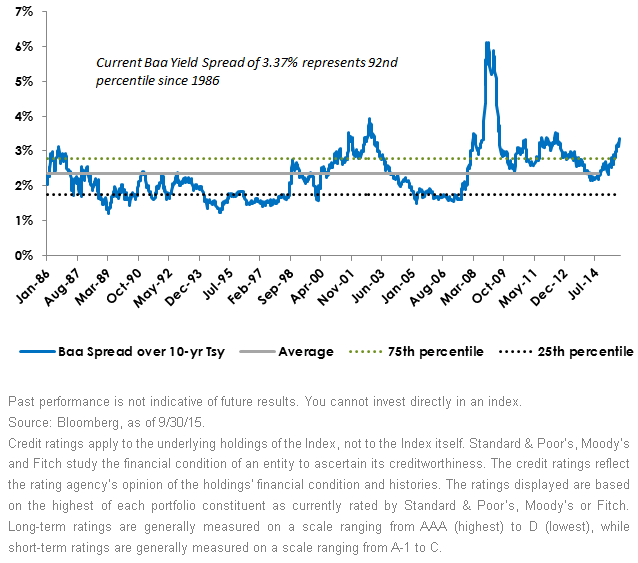
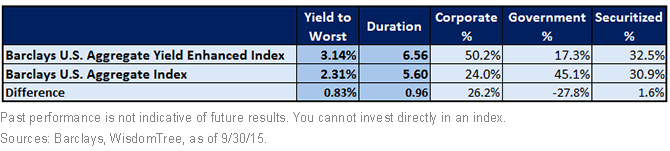
Given this view, the recent sell-off in corporates seems overdone; we expect this sector of the fixed income market to outperform. In particular, clipping Treasury coupons seems less attractive when some investment-grade corporates are currently offering over twice the income. But back to our low and slow analogy: The world is still a little fragile, and blindly grabbing yield could still be risky. A more prudent approach may be to add yield gradually. At each step, investors should consider if the increase in income potential is going to materially alter their portfolio’s risk profile. The Barclays U.S. Aggregate Enhanced Yield Index (Agg Enhanced Yield) takes this very approach in altering the composition of the Barclays U.S. Aggregate Index (Aggregate). The index first decomposes the Aggregate into 20 different buckets stratified across sector, credit quality, and maturity. It then reassembles the pieces to maximize yield within specified tracking error limits and bands on relative duration and sector exposures. Through this approach, the portfolio remains 100% investment grade but enhances the income potential of the portfolio. In most environments, this methodology will lead to allocations that have more credit exposure than the composition of the Aggregate. The guardrails ensure that the approach to adding corporate risk is measured. For example, each major asset sector cannot exceed a variance of 20% to its weight in the Aggregate. Thus exposure to credit-sensitive bonds is capped at 50%, roughly 20% above its current weight in the Aggregate. As we show below, the Agg Enhanced Yield provides an 82 basis point pickup in yield compared to the Aggregate. The credit allocation increases to 50% (against the 30% currently in the Aggregate), while exposure to U.S. Treasuries is reduced. In our view, this shift in positioning makes intuitive sense in the current environment. Index Statistics as of September 30, 2015
For the last seven years, we have bumped along in this low-rate environment. If concerns about global conditions keep the Fed lower and slower, increasing your corporate exposure with your core portfolio may tide you over until the BBQ is ready (so to speak.)
Important Risks Related to this Article
Fixed income investments are subject to interest rate risk; their value will normally decline as interest rates rise. Fixed income investments are also subject to credit risk, the risk that the issuer of a bond will fail to pay interest and principal in a timely manner or that negative perceptions of the issuer’s ability to make such payments will cause the price of that bond to decline. Investing in mortgage- and asset-backed securities involves interest rate, credit, valuation, extension and liquidity risks and the risk that payments on the underlying assets are delayed, prepaid, subordinated or defaulted on.
Categories
About the contributor

Chief Investment Officer, Fixed Income and Model Portfolios
Rick Harper serves as the Chief Investment Officer, Fixed Income and Model Portfolios at WisdomTree Asset Management, where he oversees the firm’s suite of fixed income and currency exchange-traded funds. He is also a voting member of the WisdomTree Model Portfolio Investment Committee and takes a leading role in the management and oversight of the fixed income model allocations. He plays an active role in risk management and oversight within the firm.
Rick has over 29 years investment experience in strategy and portfolio management positions at prominent investment firms. Prior to joining WisdomTree in 2007, Rick held senior level strategist roles with RBC Dain Rauscher, Bank One Capital Markets, ETF Advisors, and Nuveen Investments. At ETF Advisors, he was the portfolio manager and developer of some of the first fixed income exchange-traded funds. His research has been featured in leading periodicals including the Journal of Portfolio Management and the Journal of Indexes. He graduated from Emory University and earned his MBA at Indiana University.