

U.S. Treasuries: Brexit Meets Grexit
Published June 22, 2016

Head of Investment and Fixed Income Strategy
Without a doubt, thus far the month of June has been a rather grand one for the U.S. Treasury (UST) market. Indeed, the jobs report and last week’s FOMC meeting have provided fundamental fuel to an engine where safe-haven demand has now taken center stage as investors await the result of tomorrow’s Brexit vote. The last time the UST 10-Year yield was trading around recent levels was February 11 of this year. As is the case this time around as well, the same four key factors have been at work pushing the yield to readings last seen in 2012: U.S./global growth concerns, repricing the Federal Reserve (Fed) rate hike expectations, favorable developed world sovereign debt rate differentials and flight to quality. The economic growth and Fed aspects have been discussed quite a bit already (a roughly one-third implied probability of just one increase by year-end according to Federal Funds futures), so we are going to turn our attention to the remaining two factors, which are interrelated to some extent. The sovereign rate differential continues to remain a powerful force in the UST market, specifically focusing on the 10-year maturity. Last week the 10-year German bund dropped below zero, at one point falling to -0.2%, joining Japan and Switzerland in the rather inauspicious negative rate club. Needless to say, this disparity works in favor of Treasuries, as the only countries in the eurozone with higher yields than the UST 10-Year are Portugal and Greece. As polls regarding the Brexit vote shifted from “no” (not leaving the European Union) to “yes” (leaving the European Union), the uncertainty quotient was dialed up significantly. This led to a global flight-to-quality trade. Obviously, this safe-haven demand also worked in the UST market’s favor, but the German bund market also benefitted, only adding to the rate differential advantage for Treasuries.
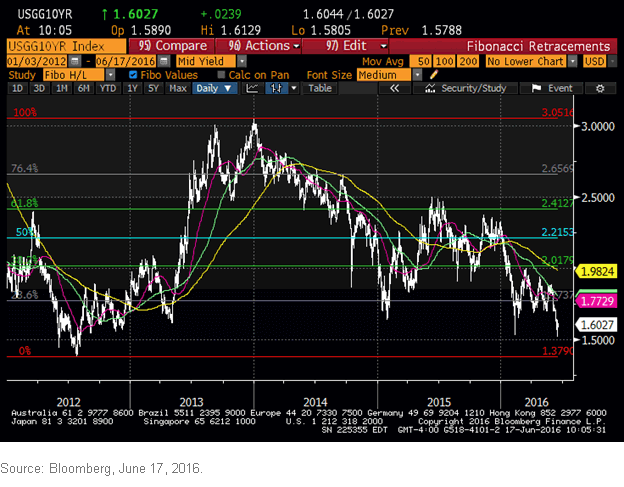
Given the yield level for the UST 10-Year note and the time of year on the calendar, we couldn’t help but think back to four years ago, when a different “exit” was influencing the financial markets: Grexit. As a refresher, during the June/July period of 2012, investors were faced with a great deal of uncertainty as well, as a key vote loomed in Greece centering on whether the nation would vote “yes” to austerity measures that would lead to aid from creditors such as the EU, International Monetary Fund (IMF) and the European Central Bank (ECB). A “no” vote ensued and was viewed as a potential referendum that Greece could leave the eurozone, triggering a global flight-to-quality trade that ultimately pushed the UST 10-Year yield down to its all-time low of 1.39% (on a closing basis). So here we are, four years later, with another key European-related vote hanging in the balance, and with it, the potential for further safe-haven demand in the wake of a “yes” Brexit vote. In fact, these heightened anxieties reached somewhat of a zenith last week when, looking at technicals, the UST 10-Year yield broke briefly through the Fibonacci intraday low point of 1.5286% of Feb 11, down to 1.5159%. Conclusion If tomorrow’s Brexit vote results in a “yes,” and the UST 10-Year yield breaks to the downside, technical analysis suggests it could ultimately put the aforementioned all-time low into play. However, this does not necessarily mean rates stay this low, or even lower, in the longer term. In the summer of 2012, once the knee-jerk reaction of the Grexit vote was over, the UST market actually rose more than 40 basis points (bps) in a little more than three weeks. There is no way to predict what will occur this time around, but Treasuries have an awful lot of good news and safe-haven flows already priced in, and oftentimes, once uncertainty such as the Brexit vote gets removed, the focus turns back toward the fundamentals. Against this backdrop, a “no” Brexit vote could serve as a catalyst for the UST 10-Year yield to snap back to the upside, placing it back within its prior range-bound status. Unless otherwise noted, data source is Bloomberg.
Important Risks Related to this Article
Fixed income investments are subject to interest rate risk; their value will normally decline as interest rates rise. In addition, when interest rates fall, income may decline. Fixed income investments are also subject to credit risk, the risk that the issuer of a bond will fail to pay interest and principal in a timely manner or that negative perceptions of the issuer’s ability to make such payments will cause the price of that bond to decline.
About the contributor

Head of Investment and Fixed Income Strategy
Kevin serves as the Head of Investment and Fixed Income Strategy. In this role, he writes macro and fixed income-related content and works closely with the sales, research and marketing teams. In addition, Kevin conducts client-facing webinars and meetings, providing expertise on WisdomTree’s existing and future bond ETFs. Prior to joining WisdomTree, Kevin spent 30 years at Morgan Stanley, where he was Managing Director and Chief Fixed Income Strategist for Wealth Management. He was responsible for tactical and strategic recommendations and created asset allocation models for fixed income securities. He was a contributor to the Morgan Stanley Wealth Management Global Investment Committee, primary author of Morgan Stanley Wealth Management’s monthly and weekly fixed income publications, and collaborated with the firm’s Research and Consulting Group Divisions to build ETF and fund manager asset allocation models. Kevin has an MBA from Pace University’s Lubin Graduate School of Business, and a B.S. in Finance from Fairfield University.