

India’s Reform One Year Later
Published July 14, 2015

Associate Director, Asset Allocation and Modern Alpha
In May of 2014, India's Prime Minister Modi came into office with sky-high investor expectations. Now, approximately one year later, it is time to evaluate the progress that has been made. Long-Term Potential Is Exciting What is fueling India’s long-term potential?
• Reform agenda of current investor-friendly government• Fiscal discipline supported by lower crude oil prices1• High gross domestic product (GDP) growth compared to other markets• Favorable demographicsThe Reform Effort Is Making Progress—‘Made in India’ Reforms have been at the very core of the current Indian government. With an eye on a revival of the manufacturing sector, one of the first projects Modi kick-started was ‘Made in India’. Under its foreign trade policy, the commerce ministry recently unveiled a raft of procedural and tax incentives for domestic manufacturing services. The key goal: double India’s annual exports to $900 billion by 2020 from its current level of around $470 billion.2Mission Critical: Removal of Key Impediments Many discussions of India’s progress and potential come down to infrastructure. India needs increased investment in this area, but under the current policy it is not a simple matter to start projects quickly. Currently, acquiring land for setting up industries or infrastructure is a big hassle, and government has proposed sweeping changes to current law, including removal of the consent clause, where the government can compensate and acquire private land without approval if a project falls in one of a few particular categories. The bill has been passed by the lower house of Parliament but is pending review in the upper house, where it faces severe pushback from opposition parties. It remains to be seen what happens; however, if the bill is passed it will be a big boost to urbanization and infrastructural growth in India. The importance of the fact that attempts are being made in this—very politically charged—area in India cannot be overstated. Anyone interested in India should be paying attention to developments on this front. Oil Prices Have Given India a Raise On the fiscal side, a slide in oil prices from well over $100 a barrel to about $60 a barrel has been a windfall for oil importers like India. About a year ago, crude oil imports accounted for roughly 34% of India’s $451 billion total imports, now they account for roughly 25%,3 which means an extra 9% in the government’s kitty. This has helped cool inflation, and as a result, the Reserve Bank of India (RBI) cut repurchase (repo) rates for the third time in a row on June 2, 2015. GDP & Demographic as a One-Two Punch In its last meeting on June 2, aside from cutting rates, the Reserve Bank of India also revised its GDP growth outlook from 7.8% to 7.6%.4Though a downward revision, 7.6% would still not only well surpass China’s GDP growth rate but would in all likelihood make India the world’s fastest-growing economy. A factor that plays a critical role in this rockstar growth is India’s demographic. India is the world’s largest democracy and home to 1.25 bilion people, with a vast majority (over 65%) below the age of 35.5 With one of the world’s largest pools of skilled labor, India’s labor force grows by 1.4% to 1.6% annually.6RBI as an Equity Performance Catalyst? One of the bottom lines when discussing India is that there is a lot of potential, but it is very difficult to know when that potential will translate into equities. One thing to note: the RBI has lowered interest rates three consecutive times. We’ve mentioned this analysis once before. WisdomTree India Earnings Index Reacting Positively to Rate Cuts
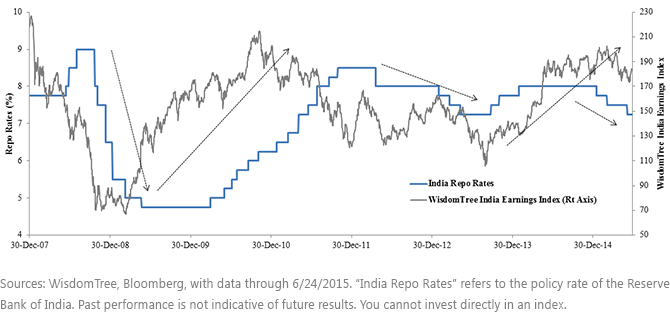
While past behavior can never predict the future with certainty, it is worth noting that:
• When the RBI lowered rates from October 2008 to May 2009, the performance of the WisdomTree India Earnings Index over the following one-year period was 24.5%• When the RBI lowered rates from April 2012 to May 2013, the performance of the WisdomTree India Earnings Index over the following one-year period was 23.27% When we last referenced these data points, what we didn’t have were the most recent rate cuts, occuring from January 2015 to the present. While we can never know for sure, it’s interesting to consider this action as a potential key through which some of India’s potential may flow through to equities. 1Source: Bloomberg, with data measured 6/27/14–6/26/15 for Brent crude oil. 2Source: “Narendra Modi govt unveils its first trade policy, targets doubling of exports at $900 bn,” The Financial Express, 4/1/15. 3Source: Anupama Airy & Gaurav Choudhury, “Oil Price Slide Set to Bring Down Subsidy Bill,” Hindustan Times, 1/21/15. 4Source: “RBI Lowers GDP Growth Forecast to 7.6% for FY16,” The Economic Times, 6/2/15. 5Source: Priya Virmani, “Note to India’s Leaders: Your 150m Young People Are Calling for Change,” The Guardian, 4/8/14. 6Source: Planning Commission Reports on Labour & Employment, Economica India Info-Services, 2002.
Important Risks Related to this Article
Investments in emerging, offshore or frontier markets are generally less liquid and less efficient than investments in developed markets and are subject to additional risks, such as risks of adverse governmental regulation and intervention or political developments. Investments focused in India increase the impact of events and developments associated with the region, which can adversely affect performance.
About the contributor
