

The Strategic Metals Underpinning Our Modern Technologies
Published May 7, 2026

Global Head of Research
Key Takeaways
- As electrification, AI infrastructure and defense technologies rapidly scale, demand for copper, lithium and rare earths is surging, positioning strategies like the WisdomTree Efficient Rare Earth Plus Strategic Metals Fund (WDIG) to capture both near-term price momentum and long-term structural growth.
- Despite accelerating demand, highly concentrated supply chains, particularly China’s dominance in rare earth processing and rising geopolitical tensions are creating potential supply shocks that could tighten markets and elevate the strategic value of diversified metals exposure through WDIG.
- With mining projects facing decade-long development timelines and governments and corporations racing to secure upstream assets, investors can access this emerging supply-demand imbalance through WDIG's combined exposure to metals futures and strategically positioned mining equities.
If you want to understand where the next geopolitical competition is unfolding, you shouldn’t start with semiconductors or artificial intelligence.
Start with a mine.
Across deserts in Western Australia, mountain ranges in Nevada and refining plants in Malaysia, a quiet global race is underway to secure the materials that power the modern technological economy. These materials, often grouped under the umbrella of strategic metals and rare earth elements, are becoming essential inputs for everything from electric vehicles and wind turbines to advanced defense systems and artificial intelligence infrastructure.
Increasingly, governments are treating them as strategic assets.
For most of the past century, the global economy revolved around energy resources like oil and natural gas. But in the electrified, digital and AI-driven economy that is emerging, control over critical minerals may matter just as much as control over energy once did.
The result is a growing realization among policymakers and investors alike: the next industrial race may not be about who builds the best technologies, but about who controls the materials those technologies require. This growing reliance on metals across next-generation technologies is precisely why the WisdomTree Efficient Rare Earth Plus Strategic Metals Fund (WDIG) was developed—aiming to provide investors with targeted exposure to the materials and companies at the center of this structural shift.
A Technology Revolution Built on Metals
The modern economy is becoming dramatically more metal-intensive.
- Electric vehicles require far more copper wiring than traditional combustion engines. While a typical internal combustion vehicle contains roughly 20–25 kilograms of copper, a battery-electric vehicle can require 80–90 kilograms—roughly three to four times as much—reflecting the extensive copper needed for electric motors, batteries and high-voltage wiring systems that power the vehicle.1
- Wind turbines rely on rare earth permanent magnets to generate electricity efficiently. A modern 3-megawatt direct-drive turbine can contain roughly two tonnes of rare earth–based magnets, primarily made from elements such as neodymium and dysprosium that enable compact, high-efficiency generators.2
- Large-scale batteries require lithium, nickel and cobalt. A typical electric-vehicle battery pack can contain roughly 8–10 kilograms of lithium, 30–40 kilograms of nickel and 10–15 kilograms of cobalt, depending on the battery chemistry and vehicle size, illustrating how electrification directly translates into rising demand for critical minerals.3
- Data centers supporting artificial intelligence demand enormous electrical infrastructure. Modern hyperscale AI facilities often require more than 100 megawatts of continuous power, with some next-generation campuses now planned at gigawatt scale—comparable to the output of a large power plant—driving substantial demand for copper, aluminum and other conductive materials across power distribution, cooling and transmission systems.4
- Advanced autonomous systems—from submarines and drones to humanoid robots—are built on a foundation of critical minerals. Rare earth elements such as neodymium, dysprosium and praseodymium are essential for high-performance permanent magnets used in electric motors, actuators and guidance systems. Modern defense and robotics platforms may require hundreds to thousands of such components, each relying on these materials to deliver compact size, efficiency and extreme reliability. As embodied AI scales across industries and militaries deploy increasingly autonomous systems, the demand for rare earth elements and specialized materials embedded in motors, sensors and power systems is likely to grow significantly.5
In other words, the technologies shaping the future economy share a common foundation: they all depend on metals.
There is significant focus on building data centers in 2026. We were able to construct an infographic to convey the point more clearly, so that every time you might hear ‘X GW construction’ of a given data center, you can develop a rough sense of what this may mean by way of metals.
Figure 1: The Concept of a Data Center Expressed as a Mixture of Important Metals
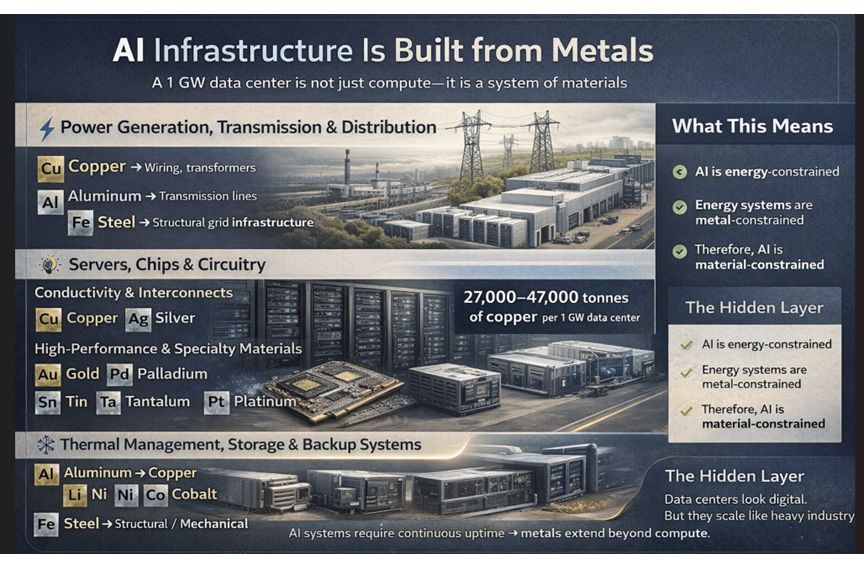
Source: Adapted from Visual Capitalist (2025), “Data Centers & Critical Minerals” [infographic]. Visual Capitalist. The graphic was generated by WisdomTree using AI-assisted design tools.
This has created a structural shift in global demand. Electrification, digital infrastructure and renewable energy are not short-term economic cycles—they are long-duration industrial transformations that may unfold over decades.
And each one requires large volumes of specialized materials.
The Supply Chain Reality
Demand growth alone rarely reshapes geopolitics, but supply chains do.
Today, the global supply chain for many critical minerals is remarkably concentrated.
China dominates large portions of the rare earth ecosystem, particularly the refining and processing stages required to convert mined materials into usable industrial inputs. In fact, China controls the overwhelming majority of rare earth processing capacity worldwide.
That concentration has transformed strategic metals into geopolitical leverage.
Over the past several years, Beijing has implemented export restrictions on a variety of critical materials, including gallium, germanium and several rare earth elements used in semiconductors, electronics and military technologies.
In 2025, China expanded export controls on several heavy rare earth elements in response to escalating trade tensions with the United States, highlighting how quickly supply chains can become entangled in geopolitical competition.6
Although some restrictions were later temporarily eased as part of diplomatic negotiations, the broader message was clear: access to strategic materials is no longer guaranteed.
For governments and industries dependent on these inputs, that realization has triggered a global scramble to build alternative supply chains.
When Governments Start Buying Mines
One of the clearest signs of how important this issue has become is the increasing involvement of governments themselves.
In 2025, the U.S. Department of War took an extraordinary step: it purchased a $400 million equity stake in MP Materials,7 the company operating the Mountain Pass rare earth mine in California. The investment made the Pentagon the company’s largest shareholder and helped finance new processing facilities aimed at rebuilding a domestic rare earth supply chain.
This kind of direct government involvement in mining companies would have seemed unusual a decade ago. Today it is becoming part of a broader strategy.
Washington has increasingly supported the development of domestic critical-mineral supply chains. In 2024, the U.S. Department of Energy announced a $2.26 billion loan to Lithium Americas to finance lithium-processing facilities at the Thacker Pass project in Nevada, aimed at producing battery-grade lithium carbonate for electric-vehicle supply chains.8
At the same time, the European Union has introduced industrial policies designed to expand domestic mining and refining capacity for strategic materials. The European Critical Raw Materials Act and subsequent initiatives identify projects across Europe to increase extraction, processing and recycling of materials such as lithium and rare earth elements to reduce dependence on concentrated foreign supply chains.9
These initiatives are part of a broader effort across Western economies—including Australia and Canada—to develop alternative supply networks for critical minerals that underpin modern energy systems, advanced electronics and defense technologies.
Even corporate players are stepping in. Technology companies, automotive manufacturers and defense contractors are increasingly forming direct partnerships with mining firms to secure long-term access to critical minerals. For example, Tesla signed a 10-year agreement with Piedmont Lithium to supply up to 50,000 metric tons of lithium annually for electric-vehicle batteries, strengthening its domestic raw-materials supply chain.10
Similarly, General Motors has signed multiple agreements with companies such as MP Materials, VAC and Noveon Magnetics to secure rare-earth magnets used in EV motors, while Apple announced a $500 million agreement with MP Materials to source recycled rare-earth magnets for electronics manufacturing.11
Together, these partnerships reflect a broader trend in which technology and industrial companies are moving upstream into mining and materials supply chains to secure the inputs essential for advanced manufacturing.
The Miners Behind the Modern Economy
All of this attention is starting to shift the way investors think about the metals and mining sector.
For much of the past decade, mining companies often sat on the sidelines of investor enthusiasm. Technology companies captured most of the excitement, while commodity producers were often viewed as cyclical businesses tied to economic growth.
But the emerging strategic metals story reframes the industry.
A lithium project today is not just a mining operation, but may be part of the global electric vehicle supply chain. A rare earth processing facility can become an essential input for defense systems or renewable energy technologies. Copper production increasingly underpins the electrification of entire economies.
In many ways, the mining industry is becoming the upstream layer of the modern technology ecosystem.
That shift has begun to reshape how investors view the sector.
Instead of seeing metals producers purely through the lens of commodity cycles, investors are increasingly viewing them as participants in a structural industrial transformation.
A Potential Supply Gap
If demand continues to accelerate while supply chains remain constrained, the next logical question is whether shortages could emerge.
Mining projects often take ten years or more to move from exploration to full-scale production. Environmental permitting, infrastructure development and capital investment all create long lead times.
Meanwhile, demand drivers—from electrification to artificial intelligence—are advancing rapidly.
Copper is often described as the “metal of electrification” because of its role in power systems and digital infrastructure. Rare earth elements such as neodymium and praseodymium are essential components of permanent magnets used in electric vehicles and wind turbines.
In many cases, supply chains remain heavily dependent on a small number of producers.
That combination—rapidly rising demand and concentrated supply—has led many analysts and policymakers to warn that several strategic metals markets could face tightening conditions in the coming decade. The International Energy Agency (IEA), for example, notes that demand for critical minerals such as lithium, nickel, cobalt and rare earth elements could increase several-fold as electrification and clean-energy technologies scale globally, while new mining projects often require 10–20 years to move from discovery to production. At the same time, refining capacity for key materials remains heavily concentrated in a small number of countries, particularly China. These structural constraints raise the possibility that supply growth may struggle to keep pace with accelerating technological demand.12
If that happens, both the commodities themselves and the companies producing them could play increasingly important roles in global markets.
Investing Across the Strategic Metals Ecosystem
For investors interested in the strategic metals theme, exposure can take several forms.
One path is through the commodities themselves. Metals futures markets allow investors to access price movements in materials like copper, aluminum and other industrial metals that underpin global infrastructure.
Another path is through the companies responsible for producing those metals. Mining companies often provide leveraged exposure to commodity prices because increases in metal prices can translate directly into improved margins and profitability.
Each approach captures a different dimension of the opportunity.
Commodities reflect the underlying supply and demand dynamics shaping metals markets. Mining equities capture the operational side of the industry—production growth, resource discoveries and project development.
Combining both perspectives may provide a broader way to access the theme.
A New Strategy for the Strategic Metals Era
The WisdomTree Efficient Rare Earth Plus Strategic Metals Fund (WDIG) offers just this type of investment avenue, eliminating the need to choose between metals exposure and mining equity exposure. For each hypothetical $100 invested:
- $90 is exposed to a diversified basket of metals mining equities.
- $90 is notional exposure to a diversified basket of liquid futures contracts, where key strategic metals essential to building the future are the underlying assets.
- $10 is exposed to short-term U.S. Treasury futures to serve as the collateral for the futures.
Mining Company Exposure
The equity portfolio construction begins with companies deriving at least 10% of revenue from strategic metals or rare earths, ensuring direct exposure to critical supply chains. Selection then emphasizes strategic relevance, resource quality, growth potential and geopolitical positioning. Weighting blends market capitalization with a strategic overlay, overweighting companies tied to the most critical materials.
Metals Futures Exposure
Exposure is anchored in metals most directly tied to electrification, industrial scale and energy systems. Copper and aluminum serve as core positions, reflecting their central role in power, transmission and infrastructure buildout. Copper exposure is split across the London Metal Exchange (LME) and Chicago Mercantile Exchange (CME) to capture both global fundamentals and U.S.-specific dynamics. Surrounding these are complementary metals—nickel, silver, platinum, zinc, tin and lead—each contributing to batteries, connectivity and industrial processes, creating a diversified but system-focused materials portfolio.
The idea is straightforward: if the modern economy is increasingly built on critical minerals, investors may want access not only to the metals themselves, but also to the companies bringing those materials to the surface. WisdomTree’s capital efficient construction takes away the need to choose only one or the other.
- Source: International Copper Association. (2024). Electrification and energy efficiency: Copper’s role in the EV revolution. Copper Development Association.
- Sources: Lynas Rare Earths Ltd. (n.d.). How are rare earths used in wind turbines?; Farmonaut. (2025). Rare earths in wind turbine generators: 2025 challenges.
- Sources: International Energy Agency. (2023). The role of critical minerals in clean energy transitions. International Energy Agency; U.S. Geological Survey. (2024). Mineral commodity summaries 2024. U.S. Department of the Interior.
- Sources: International Energy Agency. (2025). Energy and AI. International Energy Agency; Data Center Knowledge. (2025). From megawatts to gigawatts: How AI is forcing a rethink of data-center power.
- Source: Jonas, A., Tackett, W., Zhong, S., Percoco, A., Nowak, B., Woodring, E., Salvatore, A., Liwag, K., Hsiao, T., Shanker, R., De Alba, C., Moore, J., Titchmarsh, K., Kim, S., Haigian, D., & Yu, G. (2025). The robot almanac: Vol. 5—Space & defense. Morgan Stanley Research.
- Sources: Ministry of Commerce of the People’s Republic of China & General Administration of Customs of the People’s Republic of China. (2023, July 3). Announcement on the implementation of export control of gallium and germanium-related items (Announcement No. 23 [2023]). Beijing, China; International Energy Agency. (2024). Critical minerals and energy security: Global supply chain risks. International Energy Agency.
- Source: MP Materials Corp. (2025, July 10). MP Materials announces transformational public-private partnership with the U.S. Department of Defense to accelerate U.S. rare earth magnet independence.
- Source: U.S. Department of Energy. (2024). Loan Programs Office announces $2.26 billion loan for the Thacker Pass lithium processing project.
- Source: European Commission. (2023). Proposal for a regulation establishing a framework for ensuring a secure and sustainable supply of critical raw materials (Critical Raw Materials Act).
- Source: Piedmont Lithium Inc. (2025). Tesla secures 10-year lithium supply agreement with Piedmont Lithium.
- Source: Rare Earth Exchanges. (2025). Contracts linking automakers and technology companies with rare earth magnet suppliers (2020–2025).
- Source: International Energy Agency. (2024). Global critical minerals outlook 2024. International Energy Agency.
Source: International Copper Association. (2024). Electrification and energy efficiency: Copper’s role in the EV revolution. Copper Development Association.
Sources: Lynas Rare Earths Ltd. (n.d.). How are rare earths used in wind turbines?; Farmonaut. (2025). Rare earths in wind turbine generators: 2025 challenges.
Sources: International Energy Agency. (2023). The role of critical minerals in clean energy transitions. International Energy Agency; U.S. Geological Survey. (2024). Mineral commodity summaries 2024. U.S. Department of the Interior.
Sources: International Energy Agency. (2025). Energy and AI. International Energy Agency; Data Center Knowledge. (2025). From megawatts to gigawatts: How AI is forcing a rethink of data-center power.
Source: Jonas, A., Tackett, W., Zhong, S., Percoco, A., Nowak, B., Woodring, E., Salvatore, A., Liwag, K., Hsiao, T., Shanker, R., De Alba, C., Moore, J., Titchmarsh, K., Kim, S., Haigian, D., & Yu, G. (2025). The robot almanac: Vol. 5—Space & defense. Morgan Stanley Research.
Sources: Ministry of Commerce of the People’s Republic of China & General Administration of Customs of the People’s Republic of China. (2023, July 3). Announcement on the implementation of export control of gallium and germanium-related items (Announcement No. 23 [2023]). Beijing, China; International Energy Agency. (2024). Critical minerals and energy security: Global supply chain risks. International Energy Agency.
Source: MP Materials Corp. (2025, July 10). MP Materials announces transformational public-private partnership with the U.S. Department of Defense to accelerate U.S. rare earth magnet independence.
Source: U.S. Department of Energy. (2024). Loan Programs Office announces $2.26 billion loan for the Thacker Pass lithium processing project.
Source: European Commission. (2023). Proposal for a regulation establishing a framework for ensuring a secure and sustainable supply of critical raw materials (Critical Raw Materials Act).
Source: Piedmont Lithium Inc. (2025). Tesla secures 10-year lithium supply agreement with Piedmont Lithium.
Source: Rare Earth Exchanges. (2025). Contracts linking automakers and technology companies with rare earth magnet suppliers (2020–2025).
Source: International Energy Agency. (2024). Global critical minerals outlook 2024. International Energy Agency.
Important Risks Related to this Article
There are risks associated with investing, including possible loss of principal. The Fund is actively managed and invests in commodity metals futures contracts from an eligible exchange, and equity securities issued by global companies primarily involved in strategic metals and rare earths mining activities.
The value of metal commodities, such as various mined metals and commodity-linked derivative instruments, such as commodity metals futures contracts, typically is based upon the price movements of the physical commodity or an economic variable linked to such price movements. Price movements in metals and commodity metals futures contracts may fluctuate quickly and dramatically, have a historically low correlation with the returns of the stock and bond markets, and may not correlate to price movements in other asset classes. By investing in the equity securities of metal miners, the Fund may be susceptible to financial, economic, political, or market events that impact the metal mining industry. Derivatives are used by the Fund to gain exposure to strategic metals and rare earth mining activities. Derivative investments can be volatile and may be less liquid than other investments. As a result, the value of an investment in the Fund may change quickly and without warning you may lose money. A fund that has a portfolio that is concentrated in the securities of issuers in a particular industry or group of related industries, may be adversely affected by the performance of those securities, and more susceptible to adverse economic, market, political, or regulatory occurrences affecting that industry or group of related industries.
While the Fund is actively managed, the Fund’s investment process is heavily dependent on quantitative models and the models may not perform as intended. Please read the Fund’s prospectus for specific details regarding the Fund’s risk profile.
Categories
About the contributor

Global Head of Research
Christopher Gannatti began at WisdomTree as a Research Analyst in December 2010, working directly with Jeremy Schwartz, CFA®, Director of Research. In January of 2014, he was promoted to Associate Director of Research where he was responsible to lead different groups of analysts and strategists within the broader Research team at WisdomTree. In February of 2018, Christopher was promoted to Head of Research, Europe, where he was based out of WisdomTree’s London office and was responsible for the full WisdomTree research effort within the European market, as well as supporting the UCITs platform globally. In November 2021, Christopher was promoted to Global Head of Research, now responsible for numerous communications on investment strategy globally, particularly in the thematic equity space. Christopher came to WisdomTree from Lord Abbett, where he worked for four and a half years as a Regional Consultant. He received his MBA in Quantitative Finance, Accounting, and Economics from NYU’s Stern School of Business in 2010, and he received his bachelor’s degree from Colgate University in Economics in 2006. Christopher is a holder of the Chartered Financial Analyst Designation.