
WIMA
International Adaptive Moving Average Fund

Published March 12, 2026

Director, Quantitative Research

Head of Indexes, U.S.
Equity investing rewards patience but surviving major drawdowns is often what determines long-term outcomes. Over the past 25 years, investors have experienced multiple severe equity market declines: the Dot-Com bust, the Global Financial Crisis, the COVID-19 shock, the 2018 correction and the 2022 inflation-driven selloff. In each case, losses were swift, deep and challenging to mitigate.
The Adaptive Moving Average framework was built to address that reality: participate in sustained uptrends while seeking to reduce exposure during prolonged downturns.
Below, we examine how the U.S. Adaptive Moving Average and International Adaptive Moving Average Indexes are designed.
The U.S. and International indexes use a moving average crossover applied to the WisdomTree 500 and WisdomTree International LargeCap Indexes respectively.
The ±1% buffer and two-day confirmation are designed to reduce whipsaw trades around the long-term trend.
To enhance responsiveness during market stress, a breadth overlay is incorporated.
This measure tracks the percentage of index constituents trading above their own 200-day SMAs.
As seen in the figures below, the 200 day SMA indicator effectively captures the long term uptrends and downtrends. The signal is effective in identifying market regimes helping the strategy pivot accordingly. The daily signal review helps the strategy react to market events quicker, making the strategy agile and better suited for volatile markets.
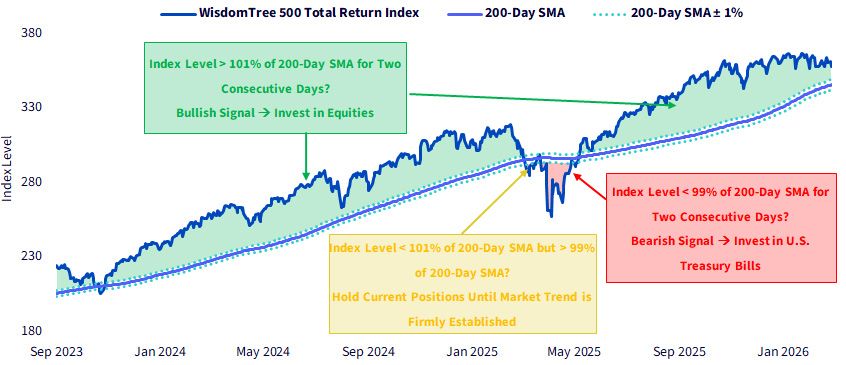
Sources: WisdomTree, FactSet. Returns from 9/5/2023 to 3/3/2026. Past performance is not indicative of future results. You cannot invest directly in an index.
Figure 2: Adaptive Moving Strategy in Practice: WisdomTree International 500 Total Return Index
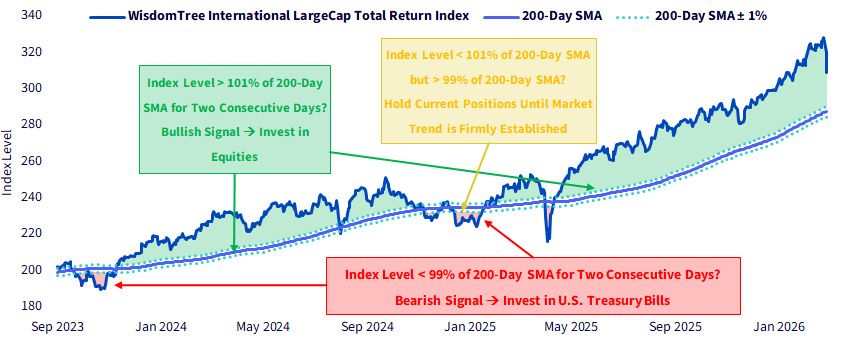
Sources: WisdomTree, FactSet. Returns from 2/10/2022 to 3/3/2026. Past performance is not indicative of future results. You cannot invest directly in an index.
Inherently the 200 day SMA can be slow moving in times of quicker recovery leading to investors missing out on the crucial recovery period. In order to mitigate this, the WisdomTree adaptive moving average strategies deploy the breadth overlay allowing greater participation in market recoveries.
WisdomTree is introducing two new ETFs that leverage the above strategies within an ETF wrapper.
Markets will continue to cycle through expansion and contraction. What matters is how portfolios respond.
The Adaptive Moving Average Funds seek to:
For investors seeking equity exposure that adapts to broader market trends, this rules-based approach offers a transparent and repeatable framework designed to balance participation and downside mitigation across market cycles.

Director, Quantitative Research
Ayush Babel is the Director of Quantitative Research in WisdomTree's multi-asset quantitative research and index teams. In this role, he focuses on developing innovative quantitative strategies across various asset classes while supporting WisdomTree's diverse range of products. His expertise spans factor exploration, portfolio construction and optimization, quantitative investment research, and product development.
With over a decade of experience in the financial services industry, Ayush has held investment research roles at J.P. Morgan and Franklin Templeton. At these institutions, he was responsible for developing and managing equity and fixed income smart beta products, as well as cross-asset risk premia solutions for global institutional and retail clients. His experience covers a broad spectrum of asset classes and investment styles.
Ayush holds a bachelor's in Engineering Physics and a master’s degree in Nanoscience from the Indian Institute of Technology, Bombay.

Head of Indexes, U.S.
Alejandro Saltiel joined WisdomTree in May 2017 as part of the Quantitative Research team. Alejandro oversees the firm’s Equity indexes and actively managed ETFs. He is also involved in the design and analysis of new and existing strategies. Alejandro leads the quantitative analysis efforts across equities and alternatives and contributes to the firm’s website tools and model portfolio infrastructure. Prior to joining WisdomTree, Alejandro worked at HSBC Asset Management’s Mexico City office as Portfolio Manager for multi-asset mutual funds. Alejandro received his Master’s in Financial Engineering degree from Columbia University in 2017 and a Bachelor’s in Engineering degree from the Instituto Tecnológico Autónomo de México (ITAM) in 2010. He is a holder of the Chartered Financial Analyst designation.