


Putting a Steeper Yield Curve to the Test
Published January 14, 2026

Kevin Flanagan
Head of Investment and Fixed Income Strategy
Key Takeaways
- With the Fed potentially nearing the end of its rate-cutting cycle, 2026 is likely to bring continued steepening of the Treasury yield curve, reinforcing caution on long-duration bonds.
- A horizon analysis shows that ultra-short to intermediate-term maturities may offer positive returns, while longer-dated bonds risk underperformance amid rising back-end yields.
- Investors may find the most compelling opportunities in ultra-short strategies such as Treasury Floating Rates, which are well positioned in a flattening-to-steepening curve environment.
Within the fixed income arena, there have been three key issues that I have continually focused on over the last year or so: 1) yields returned to historically normal levels; 2) chasing duration has been a fleeting strategy; and 3) the path of least resistance is for the yield curve to steepen. For 2026, all three dynamics are likely to play out again in the money and bond markets. However, for this blog, I wanted to highlight what points #2 and #3 actually look like when put to the test.
What do I mean by ‘test’? A horizon analysis. For those not familiar with that term, in bond-land, a horizon analysis is a way to ‘shock’ a fixed income portfolio from an interest rate perspective. The analysis can be geared to scenarios in which yields fall, rise, remain flattish or reflect a combination of these outcomes. Remember, money and bond market yields along the maturity spectrum do not always move by the same magnitude in either a rising or falling rate setting, and in fact, may not even move in the same direction at all.
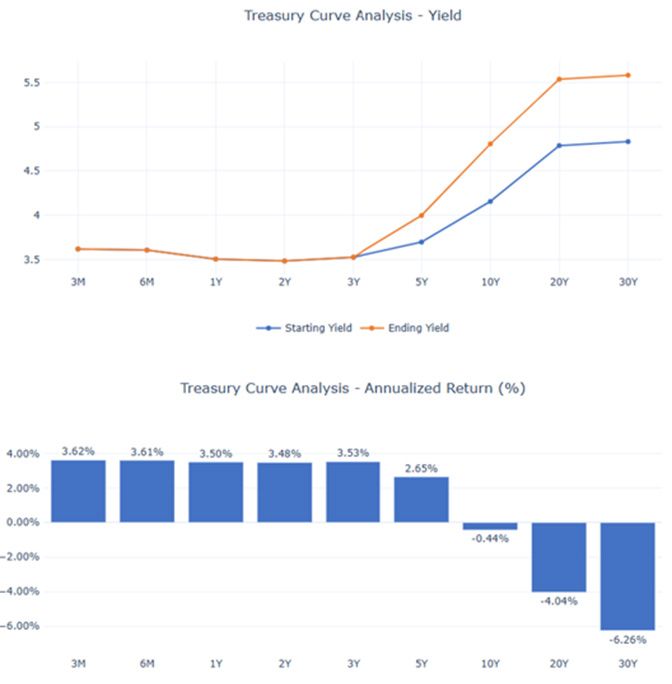
Source: WisdomTree, as of 12/31/25
For the horizon analysis in this blog, I utilized what could be a likely scenario for rates and the attendant yield curve, based upon WisdomTree’s 2026 Economic and Market Outlook.
Macro & Fed Assumptions
- Despite a ‘no hire, no fire’ labor market, the underlying economy remains in relatively good shape, with potential tailwinds from the One Big Beautiful Bill.
- While fears of tariff-induced price pressures have been reduced, inflation remains ‘sticky’ and above the Fed’s 2% target
- Fed policy is still skewed towards further easing, but we could be nearing, or at, the end of this rate cut cycle
Treasury Yield Assumptions
- Ultra-short- and short-term rates will be flat to moderately lower, reflecting Fed policy
- Intermediate to longer-term rates could experience upward pressure with any potential increases being more visible at the back-end of the curve
- The Treasury yield curve will more than likely continue to steepen
The Horizon Analysis
For the horizon analysis outlined here, I kept T-bill and short-term UST yields essentially unchanged while progressively increasing yields for the 5-year through 30-year maturities higher. As shown, the result is a yield curve that visibly steepens from its starting point The most important aspect of this exercise is what happens to annualized returns (the bottom bar chart). While the 3-month through 5-year maturities all produce positive results, the 10-year to 30-year part of the curve comes in on the negative side of the ledger.
Conclusion
The anticipated rate and yield curve scenario argues against extending duration. In fact, ultra-short options, such as Treasury Floating Rates, would potentially have the best positive return since they are referenced to the 3-month T-bill.
Categories

About the contributor

Kevin Flanagan
Head of Investment and Fixed Income Strategy
Kevin serves as the Head of Investment and Fixed Income Strategy. In this role, he writes macro and fixed income-related content and works closely with the sales, research and marketing teams. In addition, Kevin conducts client-facing webinars and meetings, providing expertise on WisdomTree’s existing and future bond ETFs. Prior to joining WisdomTree, Kevin spent 30 years at Morgan Stanley, where he was Managing Director and Chief Fixed Income Strategist for Wealth Management. He was responsible for tactical and strategic recommendations and created asset allocation models for fixed income securities. He was a contributor to the Morgan Stanley Wealth Management Global Investment Committee, primary author of Morgan Stanley Wealth Management’s monthly and weekly fixed income publications, and collaborated with the firm’s Research and Consulting Group Divisions to build ETF and fund manager asset allocation models. Kevin has an MBA from Pace University’s Lubin Graduate School of Business, and a B.S. in Finance from Fairfield University.