

The Advantageous Risks of GeoAlpha
Published July 8, 2025

Macro Strategist, Model Portfolios

Global Head of Research
Key Takeaways
- Geopolitical risks should be advantageous to investors.
- The shift from “Freeish Trade” to “Friends Trade” is in its early stages, while “Don’t fight the Fed” has shifted to “Don’t fight the policy.”
- The new WisdomTree GeoAlpha Opportunities Fund (GEOA) is designed to help investors navigate volatility by targeting the winners of global realignment and the fiscal forces reshaping markets.
May You Invest in Interesting Times
Today's markets are dominated by geopolitical risk, the retreat from globalization, state-chosen winners and losers, and the scale and focus of modern fiscal bazookas. Individually, it appears to be chaos. Parsed properly, it is advantageous.
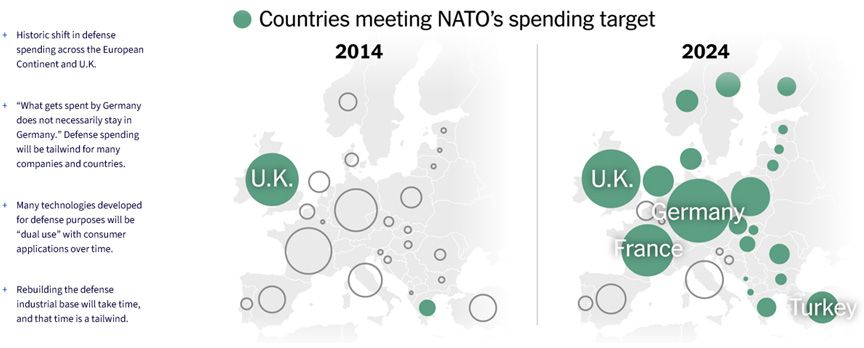
Conflicts in once-stable regions, abrupt shifts in trade policy and fiscal programs measured in the trillions are beginning to reshape the global economic landscape. For investors, the temptation is to retreat until the dust settles. GeoAlpha takes a different approach. Periods of upheaval are typically portrayed as an unmitigated disaster for portfolios. That does not need to be the case. When national security and crises strike, government checkbooks open in ways that conventional business cycles rarely match.
In Europe, procurement backlogs for military hardware, secure communications satellites and specialized cyberdefense software already stretch well beyond the current decade. Consumer demand may evaporate in a downturn, but state-sponsored demand seldom fades. And these revenues can correlate positively with geopolitical uncertainty—or even be accentuated by it.
Defense budgets get the headlines. But the reworking of global trade should not be shrugged off. For roughly three decades, supply chains answered a single question—where can we manufacture at the lowest marginal cost? That is no longer the case. Supply chains are increasingly being built around total cost—part of that cost being the potential for trade restrictions and tariffs.
Figure 1: The Return of Stimulus
Sources: The New York Times, WisdomTree.
Trade volatility is expensive and must be incorporated into investment decisions. Production is relocating to politically trusted territories, even when labor or energy expenses, or both, are higher. This Friends Trade is a powerful thing. It is not simply building products in places that are currently politically friendly. Everyone already knows about friend-shoring. The Friends Trade is deeper. It requires understanding and guessing how the structure of trade is going to evolve. Few companies suspected the relationship with China would fracture as quickly and deeply as it did. The companies that built out redundancies following the first supply chain shock (Trump's first trade war) or the second (COVID) or the third (Russia's invasion of Ukraine) are the winners.
This transition will require infrastructure that does not exist. You do not build railroad, power grids and ports overnight. China wasn't built overnight (although it was quick). The process will be measured in years rather than quarters. Early entrants into the Friends Trade will enjoy a competitive advantage and moats around their businesses as competitors struggle to build out supply chain resilience. The rules of engagement have changed. In the present environment, the distance between the two cohorts is widening. A more intentional allocation, informed by the direction of policy and the geography of supply chains, is essential for capturing dispersion rather than succumbing to it.
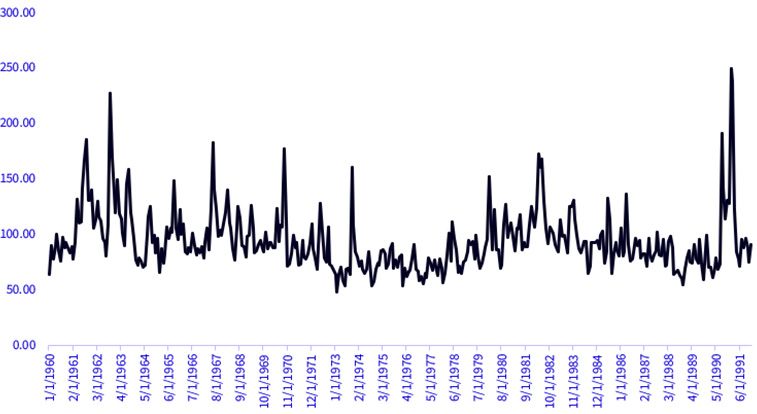
Figure 2: Geopolitical Risk Is Elevated Relative to History…Much Like the Cold War
Sources: Dario Caldara and Matteo Iacoviello, "Measuring Geopolitical Risk," (working paper) Board of Governors of the Federal Reserve Board, November 2021.
The resurgence of fiscal and industrial policy as prime movers of capital has caught markets off guard. Monetary policy dominated the beginning of the 21st century. It is a fiscal world now. It is not overly enjoyable to scrutinize legislative texts with the rigor once reserved for central bank minutes and press conferences. But such is the post-FOMC-ruled world. Tariffs and trade are now the regulators of addressable markets and production profitability. What was once Powell's world now belongs to the policy makers. Understanding this is pivotal to investors to understand the shifts in the investment landscape.
The world has weathered geopolitical turbulence before. What makes today unique? Past episodes of re-armament or trade realignment were often regional or narrowly sectoral. Today's shifts encompass defense, technology and supply-chain security all at once. Not to mention, it is global. The breadth of the transformation widens the opportunity set for investors who are prepared, just as it raises the penalty for complacency. Many companies are beneficiaries of the emphasis on national security and supply-chain integrity and supportive fiscal policy. Investors can position portfolios not merely to endure volatility but to prosper because of it. The world may refuse to sit still, but capital that adapts to its motion will find abundant paths to growth. Geopolitical risk can be advantageous. Geopolitical risk can be monetized.
A New Framework for ETFs: The Opportunities
This mentality led to the creation of the WisdomTree GeoAlpha Opportunities Fund (GEOA), which is designed to take advantage of the geopolitical landscape by allocating to companies and regions that our team believes will benefit from the ongoing shifts in trade and technology. This approach is essential to navigating a landscape that is rapidly and continually evolving.
Figure 3: GeoAlpha Themes and Allocation Framework
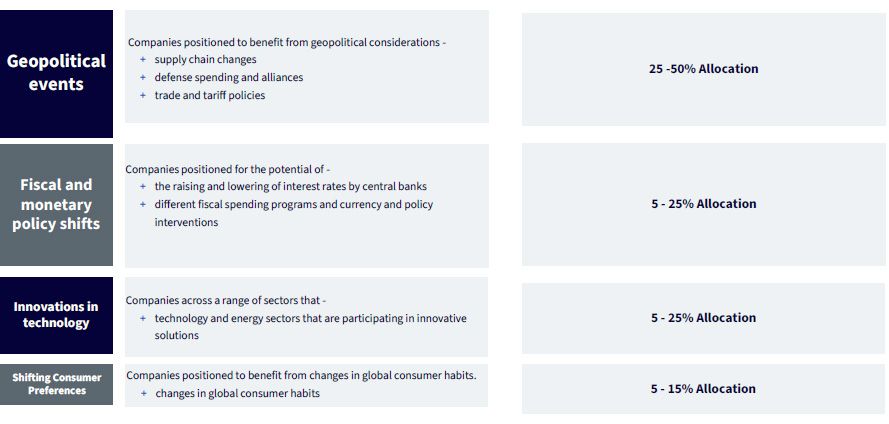
By taking a view that shifts will be good for some countries, regions and companies, GEOA leans toward the opportunities, instead of shying away. Considering the necessity of pivoting around numerous long-term structural shifts to the global economy, the Fund is allocated toward friends and allies and away from strategic competitors and foes.
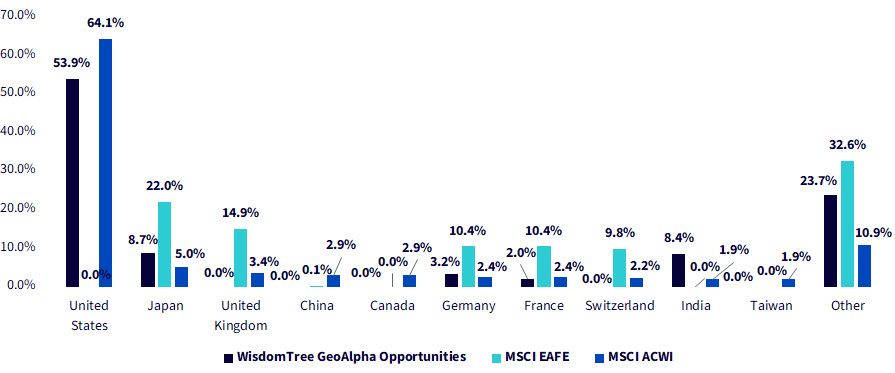
Figure 4: Country Exposures
Sources: WisdomTree, FactSet, MSCI. You cannot directly invest in an index.
Geopolitical risks are here to stay. GEOA is over-weight in partners of the U.S. and under-weight in—or excludes entirely—countries that are more vulnerable to shifts in trade. GEOA takes advantage of the new regime and does not fret about the future.
GEOA takes the reality of today's investment environment and combines it with an outlook for the future of the global economy. It is time to consider taking advantage of the risks. It is time to consider GeoAlpha.
Important Risks Related to this Article
There are risks associated with investing, including the possible loss of principal. Some countries and regions in which the Fund invests may have and may continue to experience security concerns, war, aggression and/or conflict, economic uncertainty, sanctions or the threat of sanctions, natural and environmental disasters, and widespread disease or other public health issues. Foreign investing involves special risks, such as risk of loss from currency fluctuation or political or economic uncertainty. Investments in non-U.S. securities involve political, regulatory and economic risks that may not be present in investments in U.S. securities. To the extent the Fund invests a significant portion of its assets in a single country or region, it is more likely to be impacted by events affecting that country or region. Please read the Fund’s prospectus for specific details regarding the Fund’s risk profile.
About the contributors

Macro Strategist, Model Portfolios
Samuel Rines is a Macro Strategist at WisdomTree, where he extends the firm's custom model portfolio management capabilities. Before joining WisdomTree in 2024, he was the Managing Director at CORBU, LLC, leading the PolyMacro advisory product. With over a decade of experience in economics and finance, Samuel has held significant roles such as Chief Economist at Avalon Investment & Advisory and Economist and Portfolio Manager at Chilton Capital Management LLC. He is also the author of "After Normal: Making Sense of the Global Economy," and holds a Master’s degree in Economics from the UNH Peter T. Paul College of Business and Economics, as well as having studied Economics at the University of Oxford.

Global Head of Research
Christopher Gannatti began at WisdomTree as a Research Analyst in December 2010, working directly with Jeremy Schwartz, CFA®, Director of Research. In January of 2014, he was promoted to Associate Director of Research where he was responsible to lead different groups of analysts and strategists within the broader Research team at WisdomTree. In February of 2018, Christopher was promoted to Head of Research, Europe, where he was based out of WisdomTree’s London office and was responsible for the full WisdomTree research effort within the European market, as well as supporting the UCITs platform globally. In November 2021, Christopher was promoted to Global Head of Research, now responsible for numerous communications on investment strategy globally, particularly in the thematic equity space. Christopher came to WisdomTree from Lord Abbett, where he worked for four and a half years as a Regional Consultant. He received his MBA in Quantitative Finance, Accounting, and Economics from NYU’s Stern School of Business in 2010, and he received his bachelor’s degree from Colgate University in Economics in 2006. Christopher is a holder of the Chartered Financial Analyst Designation.