
DGRW
U.S. Quality Dividend Growth Fund

Published June 26, 2025

Senior Associate, Capital Markets
ETFs have become the go-to vehicle for modern investing, driven by their efficiency, flexibility and tax advantages. In part 1 of our three-part series, “The Inner Workings of ETFs,” we break down the ETF wrapper itself—the structural foundation that enables intraday liquidity, transparency and cost-effective access to a wide range of asset classes.
An ETF wrapper refers to the structure of an exchange-traded fund (ETF), which packages underlying assets—stocks, bonds, commodities or even other funds—inside a single, exchange-traded security. By “wrapping” the holdings this way, the ETF delivers key advantages, such as tax efficiency, intraday liquidity and lower costs.
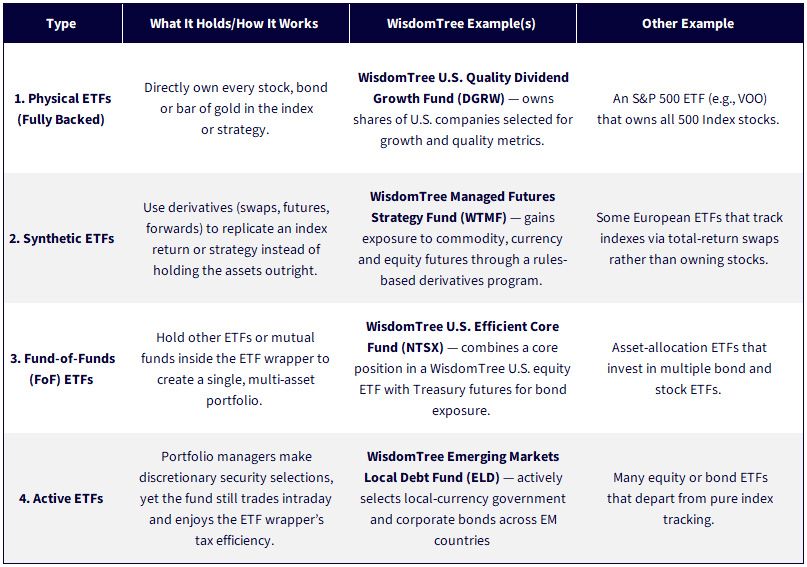
The ETF wrapper is simply the paper and ribbon that neatly package many underlying assets into one tradable share. Whether the wrapper holds physical securities (DGRW), synthetic exposures (WTMF), a capital-efficient fund-of-funds blend (NTSX) or an actively managed bond strategy (ELD), the result is the same: a versatile, low-friction vehicle that offers tax advantages, cost savings and intraday tradability for investors of all sizes.
With ETF structures in place, the next layer of insight lies in how those vehicles are managed. In part 2, we examine how passive and active strategies operate within the ETF wrapper—and when each might serve a portfolio best.
For more on the basics of ETFs, how they work and the risks and benefits to investors, visit our ETF Education page.
Neither WisdomTree nor its affiliates, nor Foreside Fund Services, LLC, or its affiliates provide tax advice. All references to tax matters or information provided in this material are for illustrative purposes only and should not be considered tax advice and cannot be used for the purpose of avoiding tax penalties. Investors seeking tax advice should consult an independent tax advisor.


