

Why the Iran Situation Is a Valuable Lesson
Published June 18, 2025

Macro Strategist, Model Portfolios
Key Takeaways
- There are “short-term shocks” and “long-tailed risks” from geopolitical events.
- Understanding the difference between the two leads to better decisions around allocations and recommendations.
- Iran and Ukraine are fundamentally different.
- The current risks are likely to dissipate and provide an advantageous opportunity.
Geopolitical risk comes at you fast. But it also tends to fade quickly. Particularly when those risks are not existential to the current economic environment. The initial reactions tend to be violent in their own right—from equities to commodities to currencies—and they do not tend to have staying power in a meaningful way. There is a difference between short-term shocks and long-tailed risks, and the recent events in the Middle East are an example of the first. The invasion of Ukraine is an example of the second. Most geopolitical events are headline-grabbing, not fundamental movers of the economic outlook.
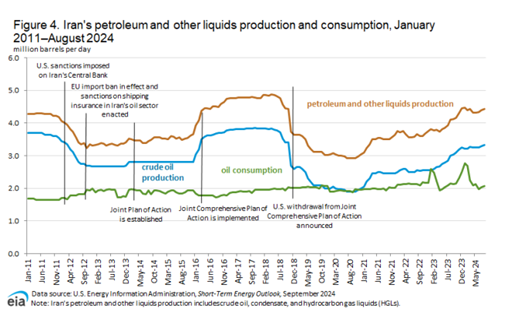
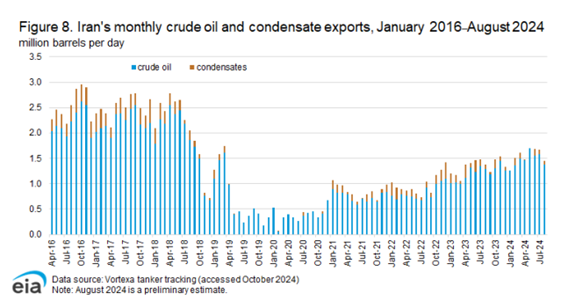
Beginning decades ago, Iran was sanctioned out of the Western world. Iran is not integrated in a meaningful way to Western markets despite its oil wealth. Much of the roughly 1.5 million barrels of its exported oil goes to China, and a disruption in that supply could cause issues for that economy.
But a disruption in Iranian crude exports (even if taken to zero) would not be overly difficult to compensate for across markets.
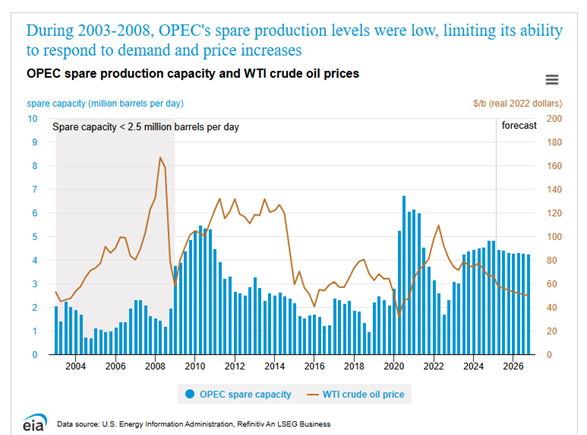
During other periods of elevated geopolitical risk, oil was relatively scarce. There was little spare capacity. Fast-forward to the present, and U.S. shale has solved that problem. OPEC has plenty of spare capacity amounting to about 2.5 times Iranian exports. Not to mention, Iran’s oil infrastructure has not been hit (at least, so far). Conspicuously, the U.S. position has typically been to implicitly support military action so long as energy infrastructure is not targeted.
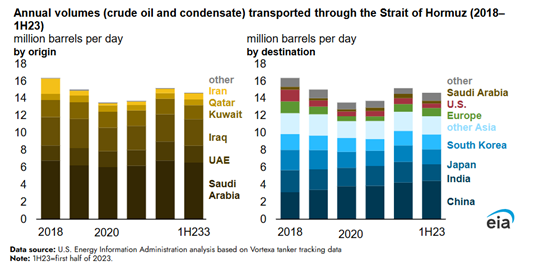
If the oil side of the equation is largely moot, what exactly is the longer-term potential risk asset impact? The closure of the Strait of Hormuz comes up frequently as a potential retaliatory action. That is HIGHLY unlikely.
There are a number of reasons for this being an overblown threat. In no particular order:
- Iran already at war with Israel. It does not want a Saudi problem too. It is worth remembering that Saudi Arabia and Iran are NOT friendly. In fact, the list of regional allies for Iran is rather short, as in non-existent.
- It would predominately hurt China. China is the largest importer of oil through the Strait, and—given the current economic environment—would not be overly willing to “take the economic pain.”
- Naval capabilities are not capable of doing so for any prolonged time period. Harassing boats? Yes. Closing the Strait? Probably not.
- Iran already at war with Israel. It does not want a Saudi problem too. It is worth remembering that Saudi Arabia and Iran are NOT friendly. In fact, the list of regional allies for Iran is rather short, as in non-existent.
- It would predominately hurt China. China is the largest importer of oil through the Strait, and—given the current economic environment—would not be overly willing to “take the economic pain.”
- Naval capabilities are not capable of doing so for any prolonged time period. Harassing boats? Yes. Closing the Strait? Probably not.
Simply, there little to nothing Iran is capable of doing that would be broadly disruptive to markets for any notable period of time. Cyberattacks? Maybe. Kinetic retaliation? Likely, but limited. Shutting the Strait of Hormuz? Not going to happen. That leads to the conclusion it is most likely to be a short-term shock, not something more sinister.
Taken together, the market fading the risk makes sense. There are very few channels for the conflict to have a lasting negative effect on earnings or inflation. Elevated oil prices would create some inflation pressure in the U.S. (that might be why traders are pushing yields up a bit). But that would be transitory.
This is fundamentally different from the invasion of Ukraine. Russia was not an economically sanctioned outsider nor a country with little to no economic influence on the rest of the world. Europe was heavily reliant on Russian natural gas (cheap and pipeline-delivered). Following the invasion, Russia used that reliance as a tool to steer European policy and resolve around Ukraine.
That was effective until the U.S. (and others) replaced the supply. But that took the better part of 18 months, and the interim was highly disruptive to the European economy. Electricity prices spiked, causing consumers to feel pain and industry to throttle back.
Not to mention, coordinated sanctions and the advent of the “Price Cap Coalition” removed Russian oil exports from Western markets rapidly. Russia is not equivalent to Iran on the oil front, either. Russia produces roughly as much oil as Saudi Arabia, or three times that of Iran. It took time to reconfigure global energy markets both on the gas front and the oil front. Hence, the “long-tailed” reaction of risk asset markets.
The differences matter, and should not be ignored. The situation in the Middle East is far from ideal. But nothing really changes for the global economy as a result of the current developments. There will be saber rattling and threats. Commentators will continue to cite the Strait of Hormuz as a potential issue. That has never happened, and it is not going to this time around either. Simply, there are few options for Iran and none of them appear to be a meaningful threat to the global economy.
Categories
About the contributor

Macro Strategist, Model Portfolios
Samuel Rines is a Macro Strategist at WisdomTree, where he extends the firm's custom model portfolio management capabilities. Before joining WisdomTree in 2024, he was the Managing Director at CORBU, LLC, leading the PolyMacro advisory product. With over a decade of experience in economics and finance, Samuel has held significant roles such as Chief Economist at Avalon Investment & Advisory and Economist and Portfolio Manager at Chilton Capital Management LLC. He is also the author of "After Normal: Making Sense of the Global Economy," and holds a Master’s degree in Economics from the UNH Peter T. Paul College of Business and Economics, as well as having studied Economics at the University of Oxford.