
USDU
Bloomberg U.S. Dollar Bullish Fund

Published February 20, 2025

Director, Model Portfolios

Director, Model Portfolios
Director, Model Portfolios
Investors are facing a volatile and uncertain landscape so far in 2025. A new administration is moving swiftly to implement its key policy priorities, reshaping trade, regulation and economic strategy, all while markets contend with uncertainty around the future of the AI trade, geopolitical tensions and the potential for escalating tariffs.
In this environment, portfolio diversification is more critical than ever. Some traditional hedges, like bonds, have been less reliable in recent years. But one asset has stepped up as a powerful diversifier: the U.S. dollar.
The U.S. dollar has proven to be one of the most effective portfolio diversifiers in recent years. Figure 1 demonstrates that over the past three years, its correlation to the S&P 500 Index has been -0.56, offering better diversification than traditional hedge assets such as gold (0.18), core fixed income (0.40) and even Treasuries (0.28).
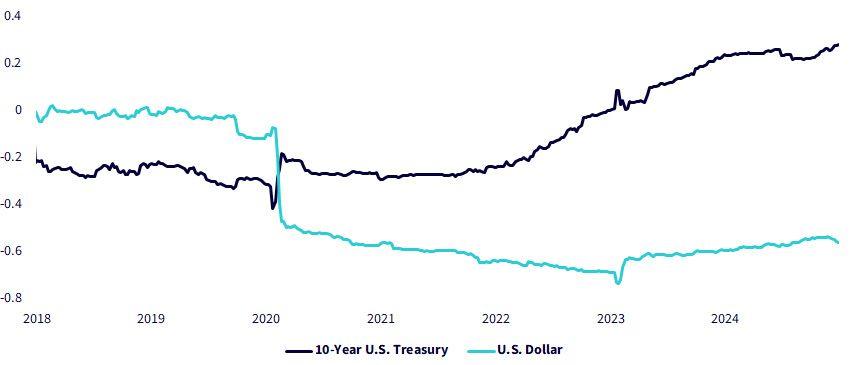
Sources: WisdomTree, FactSet, as of 1/31/25. Calculated as trailing three years of weekly correlations of the S&P 500 Index relative to the Bloomberg US Treasury Bellwether 10Y Index and the Bloomberg Dollar Total Return Index. Past performance is not indicative of future results. You cannot invest directly in an index.
During periods of market turmoil, investors frequently turn to the dollar as a safe-haven asset, further enhancing its role in reducing portfolio risk.
One of the most capital-efficient ways to gain long dollar exposure is through currency-hedged international equity strategies. These strategies not only help reduce portfolio volatility by eliminating unhedged currency risk but also introduce a long-dollar tilt, providing an effective tool for diversifying equity beta.
Unhedged currency exposure on top of equity exposure has historically introduced significant volatility while providing minimal—if any—contribution to excess returns. Moreover, volatility in local international stock markets has consistently been lower than that of the S&P 500 Index, as seen in figure 2.
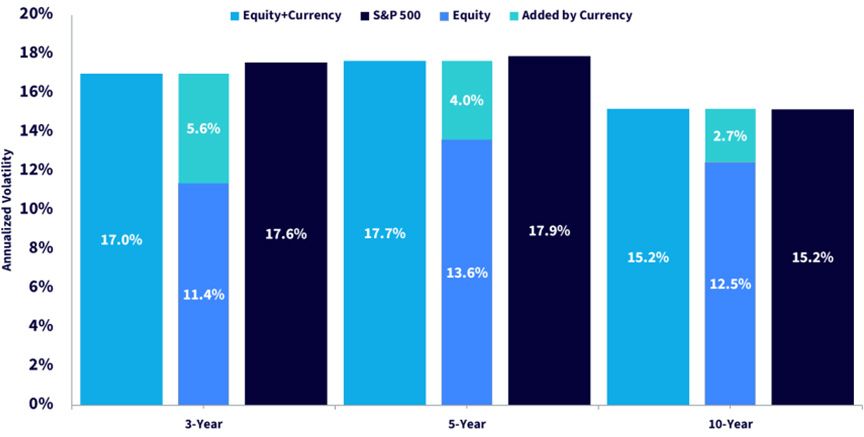
Sources: WisdomTree, MSCI, S&P, as of 9/30/24. Equity + Currency represented by the net returns of the MSCI EAFE (USD) Index. Equity represented by the net returns of the MSCI EAFE (Local) Index. Currency represented by the difference between the net returns of the MSCI EAFE (USD) and MSCI EAFE (Local) indexes. Past performance is not indicative of future results. You cannot invest directly in an index.
Yet, unhedged equity investments inherently assume that the dollar will weaken against international currencies—a view that many investors do not actively hold. This leads to a key question: if one does not have high conviction about currency movements, why invest in an asset that carries an uncertain return but a certain risk? In the WisdomTree Core Equity Model Portfolio, we mitigate this by hedging a significant portion of the currency risk within the international developed market equity allocation.
Additionally, a common misconception is that currency hedging is expensive. However, in the current environment, long U.S. dollar exposure may actually offer a return advantage through positive carry, which is a function of the interest rate differentials between the U.S. and developed international markets.
Outside of currency hedged equities, another way to express a long dollar view is through outright exposure to the dollar itself. For example, we incorporate the WisdomTree Bloomberg U.S. Dollar Bullish Fund (USDU) in the WisdomTree Liquid Alternatives Model Portfolio, which provides direct exposure to the dollar versus a basket of foreign currencies in an ETF structure.
Additionally, trend-following strategies such as managed futures may capitalize on prevailing price trends across currencies, offering a more dynamic approach to currency risk management.
Beyond the strategic rationale, we also see a compelling near-term case for dollar strength. Recent price action has been supportive, with the dollar having broken out to more than two-year highs to start 2025. Several short-term technical indicators such as the Moving Average Convergence Divergence (MACD) and stochastic oscillators also suggest a potential buying opportunity for more tactical investors.
In our view, the dollar has emerged as a resilient hedge against equity risk, providing stability when markets need it most. With traditional hedges like bonds proving less reliable in recent years, incorporating long dollar exposure may provide an effective tool for risk management.
Whether through currency-hedged international equities, direct dollar exposure or alternative strategies such as managed futures, investors have multiple avenues to capitalize on the dollar’s defensive qualities and potential return benefits.
There are risks associated with investing, including the possible loss of principal. Foreign investing involves special risks, such as risk of loss from currency fluctuation or political or economic uncertainty. The Fund focuses its investments in specific regions or countries, thereby increasing the impact of events and developments associated with the region or country, which can adversely affect performance. Investments in emerging, offshore or frontier markets are generally less liquid and less efficient than developed markets and are subject to additional risks, such as risks of adverse governmental regulation and intervention or political developments.
Investments in currency involve additional special risks, such as credit risk and interest rate fluctuations. Derivative investments can be volatile, and these investments may be less liquid than other securities and more sensitive to the effect of varied economic conditions. While the Fund attempts to limit credit and counterparty exposure, the value of an investment in the Fund may change quickly and without warning in response to issuer or counterparty defaults and changes in the credit ratings of the Fund’s portfolio investments. The Fund’s investment in repurchase agreements may be subject to market and credit risk with respect to the collateral securing the repurchase agreements and may decline prior to the expiration of the repurchase agreement term. As this Fund can have a high concentration in some issuers, the Fund can be adversely impacted by changes affecting such issuers. Unlike typical exchange-traded Funds, there are no indexes that the Fund attempts to track or replicate. Thus, the ability of the Fund to achieve its objectives will depend on the effectiveness of the portfolio. Due to the investment strategy of the Fund, it may make higher capital gain distributions than other ETFs. Although the Fund invests in very short-term, investment-grade instruments, the Fund is not a “money market” Fund, and it is not the objective of the Fund to maintain a constant share price. Please read the Fund’s prospectus for specific details regarding the Fund’s risk profile.
Bloomberg U.S. Dollar Bullish Fund

Director, Model Portfolios
Andrew Okrongly joined WisdomTree in 2022 as a Director on the Model Portfolios Team. He is responsible for the design and ongoing management of model portfolios and custom solutions for portfolio managers and advisors. Andrew is also a member of the Model Portfolio Investment Committee. Prior to joining WisdomTree, Andrew was a Director on the Outsourced Chief Investment Officer (OCIO) team at Commonfund, where he was responsible for macro-economic analysis and advising institutional clients on strategic and tactical asset allocation. Andrew began his career at BlackRock where he held a variety of fixed income and multi-asset investment roles. Andrew received a BBA degree from the University of Michigan and is a holder of the Chartered Financial Analyst designation.

Director, Model Portfolios
Joe Tenaglia joined WisdomTree as Asset Allocation Strategist in 2016. He is responsible for building and managing WisdomTree’s CIO-managed and custom model portfolios. In this role he focuses on asset allocation, security selection, and portfolio construction for the firm’s open architecture models, with objectives ranging from strategic to tactical. Joe sits on WisdomTree’s Model Portfolio Investment Committee, which oversees the firm’s ETF models and helps shape and communicate WisdomTree’s thoughts on the markets. Prior to joining WisdomTree, he held roles at Emerging Global Advisors (acquired by Columbia Threadneedle) and BNY Mellon. Joe received his B.S. in Finance and Marketing from Boston College. He is a holder of both the Chartered Financial Analyst designation and Chartered Market Technician designation.
Director, Model Portfolios
Joe Tenaglia joined WisdomTree as Asset Allocation Strategist in 2016. He is responsible for building and managing WisdomTree’s CIO-managed and custom model portfolios. In this role he focuses on asset allocation, security selection, and portfolio construction for the firm’s open architecture models, with objectives ranging from strategic to tactical. Joe sits on WisdomTree’s Model Portfolio Investment Committee, which oversees the firm’s ETF models and helps shape and communicate WisdomTree’s thoughts on the markets. Prior to joining WisdomTree, he held roles at Emerging Global Advisors (acquired by Columbia Threadneedle) and BNY Mellon. Joe received his B.S. in Finance and Marketing from Boston College. He is a holder of both the Chartered Financial Analyst designation and Chartered Market Technician designation.