


Modi Wins Key State Elections Instilling Confidence in the Indian Stock Market
Published November 26, 2024

Ayush Babel
Director, Quantitative Research

Jeremy Schwartz, CFA
Global Chief Investment Officer
Key Takeaways
- The National Democratic Alliance’s (NDA) recent wins in key state elections has bolstered investor confidence, driving the Sensex and Nifty 50 indexes higher and strengthening the coalition’s legislative power in India.
- India’s stock markets, up over 12% year-to-date, remain expensive but attractive, with WisdomTree’s earnings-weighted strategy offering a valuation-conscious approach to accessing this growth.
- India’s political stability and structural reforms continue to fuel its outperformance in emerging markets, positioning it as a key long-term growth story against global competitors like China.
Listen to the blog post below:
The national election results earlier in the year surprised many as the National Democratic Alliance (NDA) managed to secure a thinner-than-expected majority. The results led to a volatile week in the Indian stock markets with a massive drop on results day. The markets, however, recovered fully by the end of the week as alliance members came ahead and provided support. In India, unlike the U.S., every state/group of states has a different five-year cycle, and we see a few states going to elections every year. India has witnessed some key state elections following the national election earlier in the year, with the most economically significant state, Maharashtra, going to election on November 20, 2024. As results came in on November 23, 2024, NDA quickly managed to secure a much bigger win than many opinion/exit polls had predicted. Markets were already pricing in the exit polls, which led to a gain of more than 2.54% on the BSE Sensex and 2.39% on the NSE Nifty 50 on Friday, November 22. The indexes rose by a further 1.25% and 1.32%, respectively, on the following Monday.
NDA has kept a strong momentum in state elections, helping it retain two key states, Haryana and Maharashtra. This has instilled confidence in the market, and also helped strengthen NDA's majority in the Upper House of parliament, the Rajya Sabha, making it easier to pass bills.
Turning to the markets, India has continued its stellar performance for a better part of the year, putting some brakes in the last couple of months. Some reversal of foreign investor funds to China, the strengthening dollar and weak global trends have contributed to the recent weak performance. Overall, Sensex is up 12.33% and Nifty 50 is up 12.92% year-to-date, as of November 25, 2024.
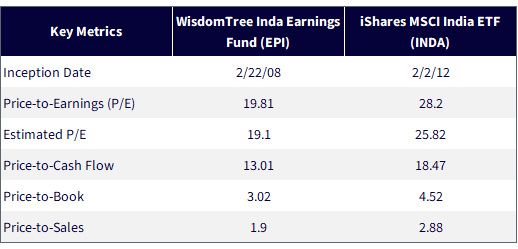
Indian markets are often touted as among the most expensive markets globally, which can be a deterrent for some investors. WisdomTree India Earnings Fund (EPI) navigates this trait by taking a valuation-conscious approach, only selecting profitable companies in the index and weighting them by their earnings instead of market capitalization. This approach allows the overall expensiveness of the portfolio to come down considerably relative to market capitalization-weighted alternatives.
For instance, INDA, which is the largest ETF in the U.S. tracking Indian equities, tracks the total return performance of the MSCI India Index. This index weights stocks by their free float market capitalization, leaning more toward the largest companies. Comparing that to the valuation-conscious approach of EPI, we see a reduction in overall portfolio expensiveness across all major valuation metrics.
Figure 1: Key Metrics: WisdomTree India Earnings Fund vs. iShares MSCI India ETF
Sources: WisdomTree, FactSet, as of 10/31/24.
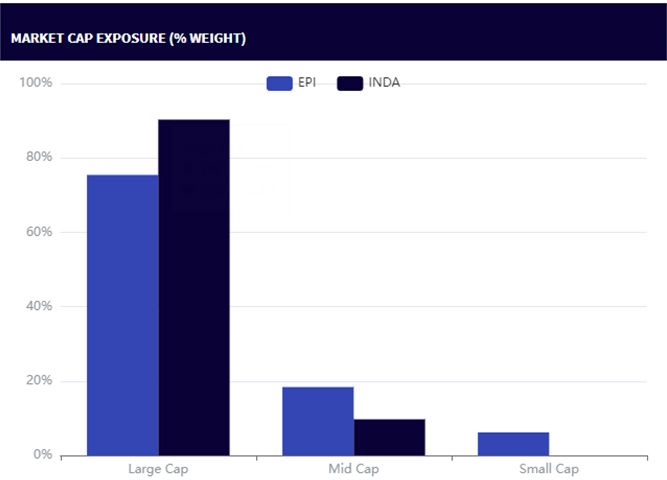
In addition to that, EPI takes a broad market approach by setting the market capitalization barrier for inclusion low at $200 million. This results in inclusion of profitable names from lower market-cap segments of the market, stocks that are often neglected by market capitalization-based approaches, as seen in figure 2.
Figure 2: Market Inclusion: EPI's Broad Market Approach
Sources: WisdomTree, FactSet, as of 10/31/24.
Conclusion
India has witnessed one of the best decades of political stability in its independent history of more than 70 years, and stock markets has rewarded this stability with stellar performance. It is a result of a motivated government that has actively pushed reforms on the ground from inception to execution. With the next five years secured for the Modi government, the continued momentum of state election wins will further help passing and implementation of key bills promised in the manifesto.
In recent years, India and the U.S. have significantly deepened their strategic partnership, particularly under the first terms of President Donald Trump and Prime Minister Narendra Modi. This collaboration spans defense, technology and geopolitics, driven by shared goals, such as countering China's growing influence. The Quadrilateral Security Dialogue (QUAD), the most formal military alliance between the two countries underscores this. With Trump back with a stronger mandate, we shall see further deepening of ties, potentially benefitting India's exports and services sector.
It is key that India continues to grab opportunities arising from the global trade reset and building upon its manufacturing capabilities. We have seen a turnaround in sectors like mobile phone manufacturing, defense and pharma where in some cases India has turned from net importer and to net exporter. While late to the scene in key evolving areas like semiconductor manufacturing, it is good to see the government actively promoting investments in emerging sectors.
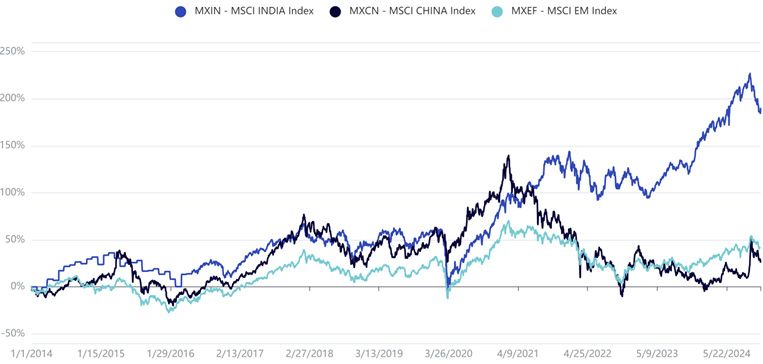
It is also notable that India's strong performance is a stark contrast to China's recent performance. In the last decade after Modi came into power, the MSCI India Index has returned an annualized 8.39%, outperforming the MSCI Emerging Markets Index by over 5% annualized. Over the same period, the MSCI China Index has just returned slightly north of 2% annualized, as of November 22, 2024, dragging the broad emerging markets index down. Boosted by long-term growth factors such as a young, skilled population, robust and growing digital infrastructure, and unlocked potential in logistics and transport—which we have gone into detail in our previous blog posts—we believe that this just the start of India's multi-decade growth story, quite reminiscent of China from three decades ago. India's stock market has significantly outperformed emerging markets and China over the past decade, driven by political stability and structural reforms, as shown in figure 3.
Figure 3:India's Outperformance overthe Last Decade vs. Emerging Markets and China
Sources: WisdomTree, FactSet, as of 11/22/24. Past performance is not indicative of future results. Investment return and principal value of an investment will fluctuate so that an investor's shares, when redeemed, may be worth more or less than their original cost. Current performance may be lower or higher than the performance data quoted. For the most recent month-end and standardized performance, click here.
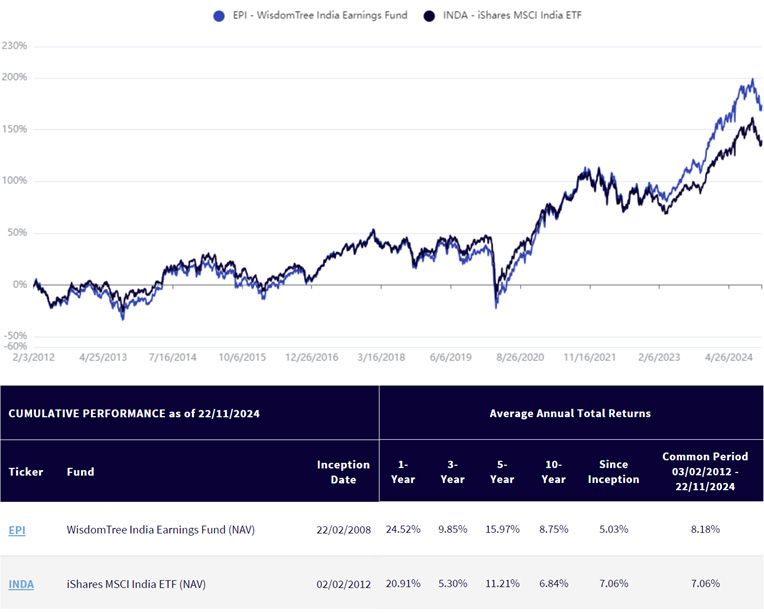
While we think India's expensiveness is justified by its long-term growth aspects, a prudent approach is required when investing in India. EPI has benefited with the valuations-conscious, earnings-based approach outperforming market capitalization-based INDA since common inception, and more convincingly so in the post-COVID-19 recovery, as seen in figure 4.
Figure 4:EPI Outperformance Post-COVID-19 Recovery
Important Risks Related to this Article
There are risks associated with investing, including the possible loss of principal. Foreign investing involves special risks, such as risk of loss from currency fluctuation or political or economic uncertainty. This Fund focuses its investments in India, thereby increasing the impact of events and developments associated with the region which can adversely affect performance. Investments in emerging, offshore or frontier markets such as India are generally less liquid and less efficient than investments in developed markets and are subject to additional risks, such as risks of adverse governmental regulation and intervention or political developments. As this Fund has a high concentration in some sectors, the Fund can be adversely affected by changes in those sectors. Due to the investment strategy of this Fund it may make higher capital gain distributions than other ETFs. Please read the Fund’s prospectus for specific details regarding the Fund’s risk profile.
All funds are managed differently and do not react the same to economic or market events. The investment objectives, strategies, policies or restrictions of other funds may differ and more information can be found in their respective prospectuses. Therefore, we generally do not believe it is possible to make direct fund-to-fund comparisons in an effort to highlight the benefits of a fund versus another similarly managed fund.
Categories
About the contributors

Ayush Babel
Director, Quantitative Research
Ayush Babel is the Director of Quantitative Research in WisdomTree's multi-asset quantitative research and index teams. In this role, he focuses on developing innovative quantitative strategies across various asset classes while supporting WisdomTree's diverse range of products. His expertise spans factor exploration, portfolio construction and optimization, quantitative investment research, and product development.
With over a decade of experience in the financial services industry, Ayush has held investment research roles at J.P. Morgan and Franklin Templeton. At these institutions, he was responsible for developing and managing equity and fixed income smart beta products, as well as cross-asset risk premia solutions for global institutional and retail clients. His experience covers a broad spectrum of asset classes and investment styles.
Ayush holds a bachelor's in Engineering Physics and a master’s degree in Nanoscience from the Indian Institute of Technology, Bombay.

Jeremy Schwartz, CFA
Global Chief Investment Officer
Jeremy Schwartz has served as Global Chief Investment Officer since November 2021 and leads WisdomTree’s investment strategy team in the construction of WisdomTree’s equity Indexes, quantitative active strategies and multi-asset Model Portfolios. Jeremy joined WisdomTree in May 2005 as a Senior Analyst, adding Deputy Director of Research to his responsibilities in February 2007. He served as Director of Research from October 2008 to October 2018 and as Global Head of Research from November 2018 to November 2021. Before joining WisdomTree, he was a head research assistant for Professor Jeremy Siegel and, in 2022, became his co-author on the sixth edition of the book Stocks for the Long Run. Jeremy is also co-author of the Financial Analysts Journal paper “What Happened to the Original Stocks in the S&P 500?” He received his B.S. in economics from The Wharton School of the University of Pennsylvania and hosts the Behind the Markets podcast. Jeremy is a member of the CFA Society of Philadelphia.