


Trump’s Victory Has Been Bullish for Bitcoin: Will it Continue?
Published November 15, 2024

Christopher Gannatti, CFA
Global Head of Research
Key Takeaways
- The approval of spot bitcoin ETFs in January 2024 catalyzed a surge in Bitcoin’s price to $70,000, but regulatory headwinds and profit-taking contributed to a period of consolidation through most of the year.
- President Trump’s victory spurred bitcoin to a new high even eclipsing $90,000, signaling potential for pro-crypto policy momentum under his administration.
- The proposed BITCOIN Act, aiming to establish a U.S. strategic Bitcoin reserve, could transform the market dynamics and regulatory landscape, though debates around its scale and fiscal impact persist.
Listen to the blog post below:
The past year has been eventful, when looking at developments around bitcoin.
In figure 1, we see the price action charted back to November 8, 2023. We know:
- On January 11, 2024, 11 different bitcoin exchange-traded products with exposure to bitcoin’s “spot” price were approved. We see this as a primary catalyst for the move from roughly $40,000 to roughly $70,000 by April 2024.
- From April 2024 until November 2024, we did not see bitcoin’s price appreciate back to this $70,000 level.
- President-elect Trump has voiced direct support to the bitcoin community and his decisive victory contributed to another short-term spike in bitcoin’s price, even touching $90,000.
Let’s review developments we’re monitoring to discern how these positive “hopes” can contribute to a fundamentally more permissive bitcoin environment in reality.
Figure 1: Bitcoin’s Price Action over the Past Year
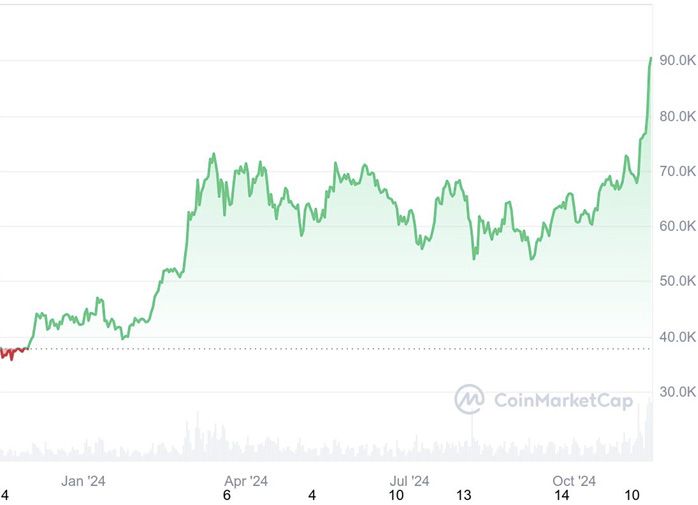
Source: https://coinmarketcap.com/currencies/bitcoin/. Past performance is not indicative of future results.
Dynamics Leading Up to the Trump Victory
Why was bitcoin’s price trend rather directionless from April 2024 to November 2024? Possible explanations include:
- Post-Halving Market Dynamics: The Bitcoin halving event in April 2024 reduced the mining reward from 6.25 to 3.125 Bitcoin per block, effectively decreasing the rate of new Bitcoin entering circulation. Historically, such halvings have led to price surges; however, the anticipated post-halving rally did not materialize. This deviation from historical pattern may have tempered investor enthusiasm, leading to a consolidation phase rather than a continued upward trajectory.1
- Profit-Taking and Market Sentiment: Following significant gains earlier in the year, investors engaged in profit-taking, leading to selling pressure that hindered further price appreciation. Additionally, waning enthusiasm post-halving and concerns over regulatory actions contributed to a bearish market sentiment, causing Bitcoin to trade below $64,500 by early May 2024.3
- Macroeconomic Factors: Anticipation of Federal Reserve interest rate decisions and a tougher rate outlook influenced investor behavior. The prospect of higher interest rates made risk assets like Bitcoin less attractive, leading to reduced investment inflows and contributing to a decline in Bitcoin's price to below $58,000 ahead of the Fed's decision in early May 2024.4
As bitcoin is open for trading 24 hours a day, 365 days per year, there can always be myriad factors influencing its price performance, but it is always useful to consider how different catalysts could be ebbing and flowing in their influence.
Other Policy Makers to Watch
To say that President-elect Trump will be busy is an understatement—he has discussed many promises on many topics throughout his time on the campaign trail. It makes sense to look at other pro-bitcoin policy makers whose policies may have paths to approval under a new Trump administration.
A prominent advocate for Bitcoin, Senator Lummis introduced the "Boosting Innovation, Technology, and Competitiveness through Optimized Investment Nationwide (BITCOIN) Act of 2024," proposing the establishment of a national Bitcoin reserve. The bill aims to bolster the U.S. dollar's position by incorporating Bitcoin into the nation's strategic reserves.5
To note some of the key provisions of the proposed act6:
1. Strategic Bitcoin Reserve (SBR):
- Establishes a decentralized network of secure storage facilities for Bitcoin across the U.S., managed by the Secretary of the Treasury.
- Designed to bolster national financial security by holding Bitcoin as a strategic asset, similar to gold reserves.
- Emphasizes geographic dispersion for security and resilience.
2. Bitcoin Purchase Program:
- Authorizes the purchase of up to 200,000 Bitcoins annually over five years, targeting a total of 1 million Bitcoins.
- The acquired Bitcoin must be held for a minimum of 20 years, with restrictions on selling or encumbering it, except to retire federal debt.
3. Transparency Measures:
- Implements a Proof of Reserve system with quarterly public reports and third-party audits to ensure oversight and public trust.
4. Consolidation of Government Holdings:
- Mandates that any Bitcoin held by federal agencies, including those from forfeitures, be transferred to the SBR.
5. Voluntary State Participation:
- Allows states to participate in storing their Bitcoin holdings in segregated accounts within the SBR, maintaining state ownership rights.
6. Funding Provisions:
- Utilizes discretionary funds and Federal Reserve remittances for program financing.
- Adjustments to the valuation of gold certificates to offset costs, reflecting modern market values.
7. Property Rights Protection:
- Ensures that the Act does not infringe upon the property rights of private Bitcoin holders, affirming individuals' rights to own, manage and self-custody their Bitcoin holdings.
No act is without controversy, so if we consider some of the possible issues in this version of the BITCOIN Act, we can see7:
1. Scale of Government Involvement:
- Critics may view the extensive federal purchase and storage of Bitcoin as market manipulation or government overreach in the private sector.
- The acquisition of 1 million Bitcoins could have significant impacts on market liquidity and global pricing, raising concerns over potential price distortions.
2. Public vs. Private Sector Tensions:
- The establishment of a federal Bitcoin reserve may lead to debates about the role of government in competing with private investors and companies in the crypto space.
3. Long-term Hold Mandate:
- The 20-year mandatory holding period, while aimed at ensuring long-term strategic stability, might be seen as limiting fiscal flexibility and tying up significant resources.
4. Transparency and Security:
- While the Act promotes transparency through public reports and third-party audits, concerns may arise over the sufficiency of these measures, especially regarding digital security and the protection of public trust.
5. Use of Federal Reserve Resources:
- The allocation of Federal Reserve funds and adjustments to the handling of gold certificates could spark debates on fiscal policy implications and potential impacts on other economic priorities.
6. State Participation Terms:
- The voluntary participation of states in the Strategic Bitcoin Reserve may lead to discussions on state versus federal control over digital assets and the terms under which states store their holdings.
Conclusion: We Have to Continually Monitor Communications
We don’t know whether either the BITCOIN Act discussed here—or something that looks substantially like it—will ever become policy. However, it is useful to consider potential policy through this type of lens as opposed to focusing too much on possible changes in different government personnel.
The mere fact that, on July 27, 2024, President-elect Trump took the stage at the Bitcoin 2024 Conference in Nashville, Tennessee, already made a statement.
We now wait for signals that indicate how this campaign trail activity will transform into government policies supportive to the Bitcoin community.
1 Source: Vicky Ge Huang, & Caitlin Ostroff, “Bitcoin Price Climbs after Supply ‘Halving,’” Wall Street Journal, 4/22/24.
2 Source: Clive McKeef, “Bitcoin Falls after DTCC Rules out Collateral for Bitcoin-Linked ETFs,” MarketWatch, 4/27/24.
3 Source: Jack Denton, “Bitcoin Languishes. Brace for More Declines as ‘People Got a Little Too Excited.’” Barron’s, 4/26/24.
4 Source: Amanda Cooper, “Crypto Washout Sends Bitcoin below $58,000 ahead of Fed Decision,” Reuters, 5/1/24.
5 Source: https://www.lummis.senate.gov/press-releases/lummis-introduces-strategic-bitcoin-reserve-legislation/
6 Source: https://www.lummis.senate.gov/wp-content/uploads/BITCOIN-Act-FINAL.pdf
7 Source: ChatGPT was used, taking the current text of the BITCOIN Act and pulling out potentially controversial areas.
Important Risks Related to this Article
Crypto assets, such as bitcoin and ether, are complex, generally exhibit extreme price volatility and unpredictability, and should be viewed as highly speculative assets. Crypto assets are frequently referred to as crypto “currencies,” but they typically operate without central authority or banks, are not backed by any government or issuing entity (i.e., no right of recourse), have no government or insurance protections, are not legal tender and have limited or no usability as compared to fiat currencies. Federal, state or foreign governments may restrict the use, transfer, exchange and value of crypto assets, and regulation in the U.S. and worldwide is still developing.
Crypto asset exchanges and/or settlement facilities may stop operating, permanently shut down or experience issues due to security breaches, fraud, insolvency, market manipulation, market surveillance, KYC/AML (know your customer/anti-money laundering) procedures, non-compliance with applicable rules and regulations, technical glitches, hackers, malware or other reasons, which could negatively impact the price of any cryptocurrency traded on such exchanges or reliant on a settlement facility or otherwise may prevent access or use of the crypto asset. Crypto assets can experience unique events, such as forks or airdrops, which can impact the value and functionality of the crypto asset. Crypto asset transactions are generally irreversible, which means that a crypto asset may be unrecoverable in instances where: (i) it is sent to an incorrect address, (ii) the incorrect amount is sent, or (iii) transactions are made fraudulently from an account. A crypto asset may decline in popularity, acceptance or use, thereby impairing its price, and the price of a crypto asset may also be impacted by the transactions of a small number of holders of such crypto asset. Crypto assets may be difficult to value and valuations, even for the same crypto asset, may differ significantly by pricing source or otherwise be suspect due to market fragmentation, illiquidity, volatility and the potential for manipulation. Crypto assets generally rely on blockchain technology and blockchain technology is a relatively new and untested technology that operates as a distributed ledger. Blockchain systems could be subject to internet connectivity disruptions, consensus failures or cybersecurity attacks, and the date or time that you initiate a transaction may be different then when it is recorded on the blockchain. Access to a given blockchain requires an individualized key, which, if compromised, could result in loss due to theft, destruction or inaccessibility. In addition, different crypto assets exhibit different characteristics, use cases and risk profiles. Information provided by WisdomTree regarding digital assets, crypto assets or blockchain networks should not be considered or relied upon as investment or other advice, as a recommendation from WisdomTree, including regarding the use or suitability of any particular digital asset, crypto asset, blockchain network or any particular strategy.
Categories

About the contributor

Christopher Gannatti, CFA
Global Head of Research
Christopher Gannatti began at WisdomTree as a Research Analyst in December 2010, working directly with Jeremy Schwartz, CFA®, Director of Research. In January of 2014, he was promoted to Associate Director of Research where he was responsible to lead different groups of analysts and strategists within the broader Research team at WisdomTree. In February of 2018, Christopher was promoted to Head of Research, Europe, where he was based out of WisdomTree’s London office and was responsible for the full WisdomTree research effort within the European market, as well as supporting the UCITs platform globally. In November 2021, Christopher was promoted to Global Head of Research, now responsible for numerous communications on investment strategy globally, particularly in the thematic equity space. Christopher came to WisdomTree from Lord Abbett, where he worked for four and a half years as a Regional Consultant. He received his MBA in Quantitative Finance, Accounting, and Economics from NYU’s Stern School of Business in 2010, and he received his bachelor’s degree from Colgate University in Economics in 2006. Christopher is a holder of the Chartered Financial Analyst Designation.