


The Yield Curve “Un-”Inverts, Well Sort of
Published September 10, 2024

Kevin Flanagan
Head of Investment and Fixed Income Strategy
Key Takeaways
- The UST 2-Year/10-Year yield curve recently moved into positive territory, due to relatively aggressive rate cut expectations following cooling labor market data.
- Despite the 2s/10s un-inversion, the UST 3-month/10-Year yield curve has further inverted, reflecting a gap between market speculation on rate cuts and current Fed Funds levels.
- A steepening trend for both yield curves is expected in the coming months, though the process may not follow a straight path.
Over the last couple of months, I’ve wanted to call attention to the likely future direction of the Treasury (UST) yield curve. This topic has gained increasing attention in both the media and bond market circles, so I thought some update was in order. And, sure enough, as I write this post, one of the two closely followed yield curve measures has in fact “un-”inverted, but another gauge remains deeply in negative territory.
First up, let’s address the construct that moved into positive territory, and that is the UST 2-Year/10-Year curve. As of this writing, the 2s/10s spread was registering at about 5 basis points (bps). I know, I know, that’s not necessarily a headline making number, but still, it is no longer inverted. In, fact, over the last few weeks, this spread had flirted in and out of negative and positive territory, only to return to slightly below the zero threshold by the end of the trading day.
U.S. Treasury Yield Curves
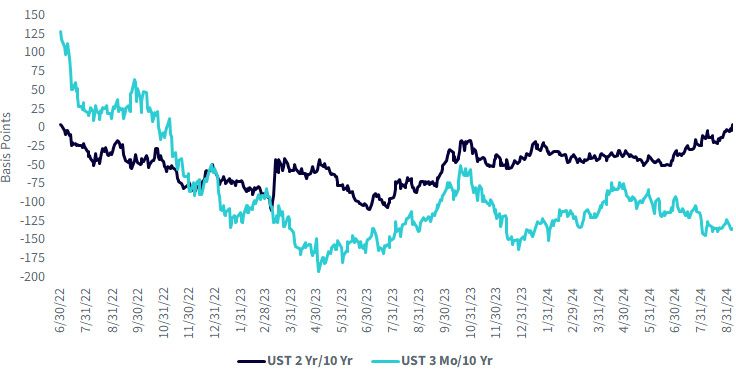
Source: Bloomberg, as of 9/6/24.
This time around, the un-inversion could be ready to stick. Why? Because of the latest employment report. While the most anticipated jobs report in quite some time did not concretely answer the debate over a 25-bps or 50-bps rate cut at next week’s FOMC meeting, it did confirm that, at a minimum, a 25-bps reduction in the Fed Funds trading range will occur. For the record, the numbers do suggest the labor market is cooling, but the question is whether it rises to the level of concern that a 50-bps rate cut is usually associated with. I would argue it doesn’t, at least at this stage of the game, but the rate cut cycle will finally get underway, nonetheless.
That takes us to the other closely watched yield curve, the UST 3-month/10-Year construct. Unlike the steepening witnessed for 2s/10s, the 3-mo./10Yr. curve has actually moved into more negative territory over the last three months or so. To provide some perspective, the inversion for this measure has increased by roughly 55 bps to move back toward -135 bps, as of this writing. Meanwhile, 2s/10s are in positive territory for the first time since June 2022 (see graph).
As I wrote in my August 21 blog post, this yield curve divergence has its genesis in speculation vs. current Fed Funds-related reality. The 2s/10s curve is based more on where the market (the UST 2-year note) is discounting where the fed funds range is ultimately headed while the 3-mo./10-yr. curve is based more on where fed funds (proxy being the three-month T bill) will be after the next FOMC meeting.
Presently, the UST 2-Year note is yielding just under 3.70%, or 125–150 bps below the current Fed Funds trading range. In other words, the 2-Year is now priced for at least six rate cuts (assuming 25 bps intervals). In contrast, the 3-month t-bill carries a yield of around 5.05%, representative of only one quarter-point Fed rate cut.
Conclusion
Needless to say, both the UST 2- and 10-Year notes have already priced in a lot of good news, that will need to be validated at some point. That being said, I do believe the trend for each of the yield curves mentioned here will be a steepening one in the months ahead. However, as we’ve been witnessing, the road to un-inverted territory may not necessarily be a straight line.
Categories
About the contributor

Kevin Flanagan
Head of Investment and Fixed Income Strategy
Kevin serves as the Head of Investment and Fixed Income Strategy. In this role, he writes macro and fixed income-related content and works closely with the sales, research and marketing teams. In addition, Kevin conducts client-facing webinars and meetings, providing expertise on WisdomTree’s existing and future bond ETFs. Prior to joining WisdomTree, Kevin spent 30 years at Morgan Stanley, where he was Managing Director and Chief Fixed Income Strategist for Wealth Management. He was responsible for tactical and strategic recommendations and created asset allocation models for fixed income securities. He was a contributor to the Morgan Stanley Wealth Management Global Investment Committee, primary author of Morgan Stanley Wealth Management’s monthly and weekly fixed income publications, and collaborated with the firm’s Research and Consulting Group Divisions to build ETF and fund manager asset allocation models. Kevin has an MBA from Pace University’s Lubin Graduate School of Business, and a B.S. in Finance from Fairfield University.