
WTAI
Artificial Intelligence and Innovation Fund

Published July 16, 2024

Global Head of Research
The world is telling us that we are in the midst of an AI revolution. We have been writing about this topic throughout 2024, and in light of AI Appreciation Day, we wanted to take an updated look at a few of our strategies and their track records in 2024:
Whether QGRW or WTAI is leading or lagging, performance-wise, at any given time can give us important insights into how investors are trading the AI topic. It can also allow us to monitor different types of performance attribution, meaning that in each strategy, one can think about something like “the exposure to Nvidia” and see how much of a given period’s return is based just on that company. Similarly, one can do the same thing with the group of stocks that we now call the “Magnificent 7.”
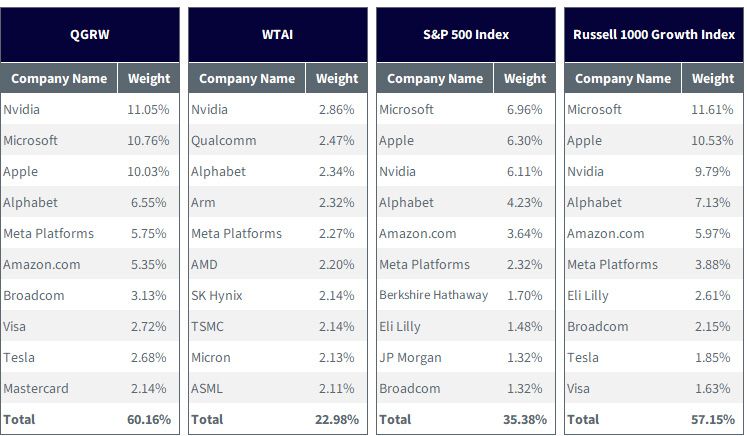
Figure 1 gives us a sense of the important “Nvidia Question,” at least in 2024, as well as the exposure to many of the world’s largest companies, whether we are still referencing them as the Magnificent 7 or that title has evolved into something else.
Bottom Line: No one knows with certainty exactly how different phases of the AI revolution will unfold. When looking at the top 10 of WTAI, Qualcomm, Arm and AMD stand out for not being in the top 10 of QGRW or either of the two benchmarks. These stocks may see stronger performance based on people purchasing new AI-enabled hardware, like laptops, tablets and smartphones. The biggest platform-oriented companies, like Microsoft, Alphabet and Meta, are pushing further and further with their different large language models. It may not be a question of either devices OR large language models, but we’d note that the market has been excited about large language models for some time at this point.
Source: WisdomTree; specifically, data is from the PATH Fund Comparison Tool, as of 5/31/24. Holdings are subject to change. You cannot
invest directly in an index.
Writing in July of 2024, we recognize two things:
We recognize that we do not know exactly how the equity market’s returns will unfold in the second half of 2024—we wish the crystal ball offered a clearer picture. However, we can think of a couple of different catalysts that could lead us down different paths.
Within AI, we think it is important to have “realistic expectations” for a given period. If investors are thinking about the second half of 2024 and the start of 2025, people and companies will have the opportunity to choose to buy new AI-enabled devices, and it is possible that the U.S. Federal Reserve might cut its policy rate. If people are trying to think about bigger possibilities, like AI helping uncover new drug therapies or cars actually driving themselves, these are far more difficult forecasts to make. Even large language models—it will take years for these to proliferate across most industries as company-level adoption and employee usage happen far more slowly than we might expect. The two catalysts we have noted, while certainly not guarantees, are things that plausibly could occur over the coming 12 months.
QGRW has significant exposure to many of the stocks that have delivered performance during this current phase of the AI revolution, which we could say started with the release of ChatGPT in November 2022. It has been clear that the market has been excited about 1) Nvidia’s capability to provide AI-accelerator chips and 2) the largest AI companies being able to create and deploy large language models to large bases of users.
The AI ecosystem is broader, however, than just the largest companies. We believe we are watching a revolution that will be playing out over the next 10 to 15 years, and investors will get excited about different types of companies along the way. WTAI is positioned to recognize that there will not be just one topic, like large language models, that remains exciting for the next decade.
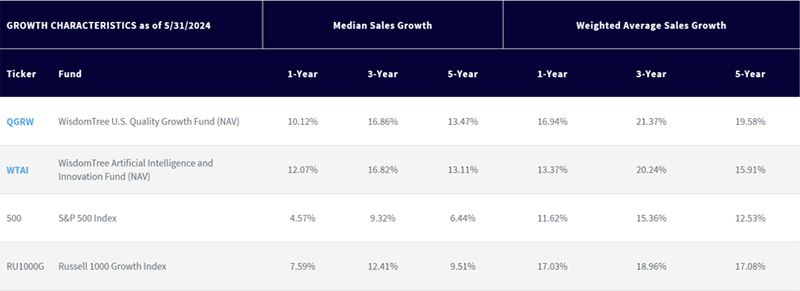
Figure 2 is something that we monitor, in the sense that at times like what we see in July 2024, we can look at recent share price performance and see that the largest companies are difficult to ignore. Why bother even thinking about the broader AI ecosystem? One answer, for us, lies in growth. If one thinks about Apple or Nvidia or Microsoft as three examples, these are some of the most widely followed and analyzed stocks in the world. Smaller, newer firms have the possibility to offer those positive (and negative) growth surprises to the market. Figure 2 gives a sense of the sales growth behavior over a few different time frames—one can see that WTAI is on par with QGRW and the benchmarks and, in some cases, even ahead.
Source: WisdomTree; specifically, data is from the PATH Fund Comparison Tool, as of 5/31/24. Holdings are subject to change. Past performance
is not indicative of future results. You cannot invest directly in an index.
There are risks associated with investing, including the possible loss of principal.
WTAI: The Fund invests in companies primarily involved in the investment theme of artificial intelligence (AI) and innovation. Companies engaged in AI typically face intense competition and potentially rapid product obsolescence. These companies are also heavily dependent on intellectual property rights and may be adversely affected by loss or impairment of those rights. Additionally, AI companies typically invest significant amounts of spending on research and development, and there is no guarantee that the products or services produced by these companies will be successful. Companies that are capitalizing on innovation and developing technologies to displace older technologies or create new markets may not be successful. The Fund invests in the securities included in, or representative of, its Index regardless of their investment merit, and the Fund does not attempt to outperform its Index or take defensive positions in declining markets. The composition of the Index is governed by an Index Committee, and the Index may not perform as intended. Please read the Fund’s prospectus for specific details regarding the Fund’s risk profile.
QGRW: Growth stocks, as a group, may be out of favor with the market and underperform value stocks or the overall equity market. Growth stocks are generally more sensitive to market movements than other types of stocks. The Fund is non-diversified; as a result, changes in the market value of a single security could cause greater fluctuations in the value of Fund shares than would occur in a diversified fund. The Fund invests in the securities included in, or representative of, its Index regardless of their investment merit. The Fund does not attempt to outperform its Index or take defensive positions in declining markets, and the Index may not perform as intended. Please read the Fund’s prospectus for specific details regarding the Fund’s risk profile.

Global Head of Research
Christopher Gannatti began at WisdomTree as a Research Analyst in December 2010, working directly with Jeremy Schwartz, CFA®, Director of Research. In January of 2014, he was promoted to Associate Director of Research where he was responsible to lead different groups of analysts and strategists within the broader Research team at WisdomTree. In February of 2018, Christopher was promoted to Head of Research, Europe, where he was based out of WisdomTree’s London office and was responsible for the full WisdomTree research effort within the European market, as well as supporting the UCITs platform globally. In November 2021, Christopher was promoted to Global Head of Research, now responsible for numerous communications on investment strategy globally, particularly in the thematic equity space. Christopher came to WisdomTree from Lord Abbett, where he worked for four and a half years as a Regional Consultant. He received his MBA in Quantitative Finance, Accounting, and Economics from NYU’s Stern School of Business in 2010, and he received his bachelor’s degree from Colgate University in Economics in 2006. Christopher is a holder of the Chartered Financial Analyst Designation.

