
EPI
India Earnings Fund

Published June 6, 2024

Director, Quantitative Research

Global Chief Investment Officer
Narendra Modi started the 2024 election campaign with an ambitious goal of exceeding the majority his party obtained in his prior two terms. The first exit polls suggested he would, but the reality turned out to be much slimmer. Yet Modi’s Bhartiya Janta Party (BJP) was still the single largest party with 240 seats. The BJP’s coalition, the National Democratic Alliance (NDA), scored 292 seats, thus comfortably beating the required majority of 272 seats to form a government. The opposing Indian National Congress (INC) won just 99 seats, making it a quite distant second.
It is clear the country voted largely for the incumbent government, even after two terms, a rare phenomenon in Indian politics.
Over the last decade, India emerged from being a “fragile 5” economy to become the fifth-largest economy of the world, driven by a continuous focus on development, a range of structural reforms and anti-corruption initiatives.
In his victory speech, Modi promised even bolder reforms in his third term and pledged to grow India to the third-largest economy in the world by the end of this decade. He has plans to turn India into a developed economy by 2047—the 100-year anniversary of India’s founding.
We expect to see Modi policies emphasizing the following areas:
One concern for the political compromise Modi must make to foster his new coalition government is to provide more fiscal support and spending, which bolsters consumption but could send bond yields higher. It is quite helpful that India will be a recipient of more passive flows to bonds as the country is being added to the JP Morgan global bond benchmark series in stages starting this June. After full inclusion over the next nine months, India’s weight is expected to reach 10% in the GBI-EM Global Diversified Index and 15% in the GBI-EM Global Diversified IG 15% Cap Index.
Modi rose to power from a relatively economic weaker background, and we expect continuation of these efforts to eradicate extreme poverty.
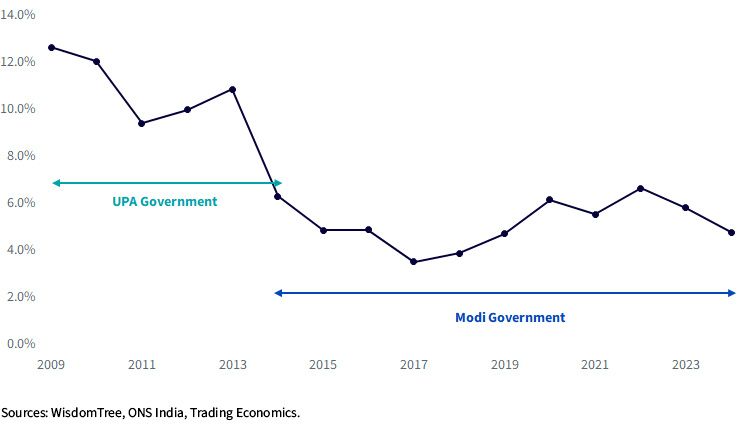
The markets experienced some volatility as the election results came in but recovered quickly as Modi’s party received letters of support from its alliance partners.
WisdomTree believes India remains one of the best growth stories of any major economy. Modi has ambitious growth targets, and we emphasize India would be one of our strategic over-weight allocations over the long term.
It is important to note that India has almost double the national road infrastructure than 10 years ago, has a booming technology industry that has supported the country’s digitization efforts and a much larger proportion of its population under the formal economy. Moreover, it has the best demographic profile of all major economies, with incomes set to catch up as it modernizes. India adapts some of the latest technologies to their advantage and one example is that around 50% of all digital transactions globally occur in India.1
We’ve seen India benefit from increased capital flows coming away from China, and supporting its equity markets could be rising incomes that get deployed into equity markets. Indian equity markets have delivered impressive returns since the Covid dip, rising almost three times (based on Sensex levels). With momentum on its side, India has a strong platform to accelerate growth on the back of political stability and geopolitical tailwinds (see figure 2).
WisdomTree has two solutions for India’s equity markets:
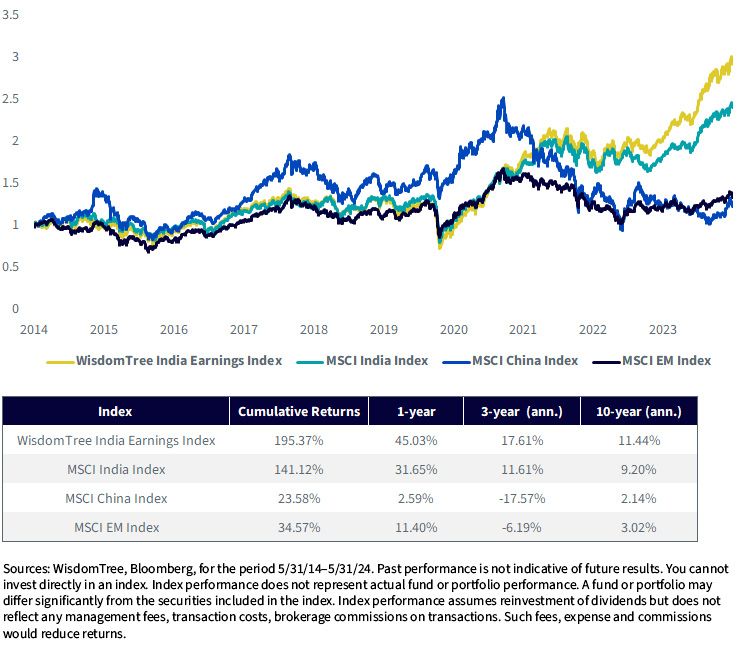
For definitions of indexes in the chart above, please visit the glossary.
1 Source: Babel, Ayush. “India for the Long Run.” WisdomTree, 21 Mar. 2024, www.wisdomtree.com/investments/blog/2024/03/21/india-for-the-long-run.
EPI/INDH: There are risks associated with investing, including the possible loss of principal. Foreign investing involves special risks, such as risk of loss from currency fluctuation or political or economic uncertainty. This Fund focuses its investments in India, thereby increasing the impact of events and developments associated with the region which can adversely affect performance. Investments in emerging, offshore or frontier markets such as India are generally less liquid and less efficient than investments in developed markets and are subject to additional risks, such as risks of adverse governmental regulation and intervention or political developments. As this Fund has a high concentration in some sectors, the Fund can be adversely affected by changes in those sectors. Due to the investment strategy of this Fund it may make higher capital gain distributions than other ETFs. Please read the Fund’s prospectus for specific details regarding the Fund’s risk profile.

Director, Quantitative Research
Ayush Babel is the Director of Quantitative Research in WisdomTree's multi-asset quantitative research and index teams. In this role, he focuses on developing innovative quantitative strategies across various asset classes while supporting WisdomTree's diverse range of products. His expertise spans factor exploration, portfolio construction and optimization, quantitative investment research, and product development.
With over a decade of experience in the financial services industry, Ayush has held investment research roles at J.P. Morgan and Franklin Templeton. At these institutions, he was responsible for developing and managing equity and fixed income smart beta products, as well as cross-asset risk premia solutions for global institutional and retail clients. His experience covers a broad spectrum of asset classes and investment styles.
Ayush holds a bachelor's in Engineering Physics and a master’s degree in Nanoscience from the Indian Institute of Technology, Bombay.

Global Chief Investment Officer
Jeremy Schwartz has served as Global Chief Investment Officer since November 2021 and leads WisdomTree’s investment strategy team in the construction of WisdomTree’s equity Indexes, quantitative active strategies and multi-asset Model Portfolios. Jeremy joined WisdomTree in May 2005 as a Senior Analyst, adding Deputy Director of Research to his responsibilities in February 2007. He served as Director of Research from October 2008 to October 2018 and as Global Head of Research from November 2018 to November 2021. Before joining WisdomTree, he was a head research assistant for Professor Jeremy Siegel and, in 2022, became his co-author on the sixth edition of the book Stocks for the Long Run. Jeremy is also co-author of the Financial Analysts Journal paper “What Happened to the Original Stocks in the S&P 500?” He received his B.S. in economics from The Wharton School of the University of Pennsylvania and hosts the Behind the Markets podcast. Jeremy is a member of the CFA Society of Philadelphia.


