
AGGY
Yield Enhanced U.S. Aggregate Bond Fund

Published May 30, 2024

Director, Fixed Income
There is no doubt that fixed income markets have had a challenging start to the year. As of May 10, 2024, the 10-Year Treasury rate stands at 4.49%, an increase of 61 basis points (bps) from the beginning of the year. This is mainly due to the markets’ rethinking of the timing and frequency of the cuts by the Fed in 2024. Sticky inflation, a strong job market and higher-than-expected GDP growth YTD have all had a role in this paradigm shift.
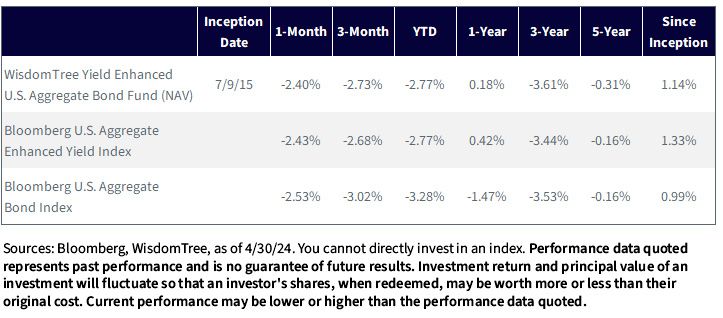
In the face of this environment, the Bloomberg US Aggregate Index (Agg) has posted a YTD return of -3.28% through the end of April. This result could have been even worse if not for resilient credit markets, with most asset classes’ spreads over Treasuries grinding lower and offsetting some of the price sensitivity to interest rate moves.
We wrote about the WisdomTree Yield Enhanced U.S. Aggregate Bond Fund (AGGY) at the end of February and explained how there could be changes made to plain-vanilla, core U.S. aggregate portfolios to benefit from valuations. Since then, AGGY has outperformed the Aggregate Index by 21 bps gross and 18 bps net of fees, respectively. However, the more eye-catching numbers are the YTD numbers. Since the beginning of the year, AGGY has outperformed the Aggregate Index by 56 bps gross and 51 bps net of fees, respectively (as of April 30, 2024). Over the last year, AGGY has outperformed by 1.80% gross of fees and 1.65% net of fees.
For the most recent standardized and month-end performance, please click here.
Looking forward, we still believe AGGY can continue to outperform the Aggregate Index. This is due to the fact that in addition to all the characteristics outlined in the first part of this blog series, and after almost a year and a half of having a lower duration compared to the Agg, AGGY now has a higher duration and can benefit in most environments in which rates don’t go materially higher from here.
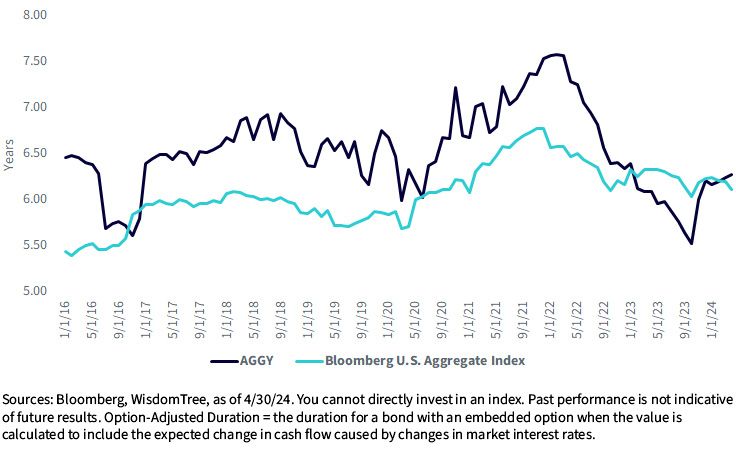
In response to the Federal Reserve’s policy tightening and the resulting inverted yield curve, our quantitative process shifted some of the allocation away from long-duration sectors, such as 30-year conventional mortgage-backed securities (MBS), toward shorter-term sectors, including 1- to 5-year corporate bonds. This reallocation caused the Fund to have a lower duration than Agg’s in the past year and a half. And, as rates rose during this period, the Fund was rewarded handsomely.
However, as corporate spreads have kept grinding lower, the risk-return profile of the long credit sector has become attractive, and as a result, its allocation in the Fund has been on the rise. This has led to AGGY once again having a higher duration than the Agg as of April 30, 2024. As we mentioned earlier, if the market and Fed’s expectations of a lower future path for rates come to fruition, we expect this longer duration will benefit the strategy once again. In conclusion, AGGY has performed well compared to its big brother recently and since its inception. Despite this outperformance, since most of the themes that we outlined in the first part of this blog series at the end of February are still relevant, we believe there is more room for outperformance, and as a result, AGGY should be considered as an integral part of core fixed income investors’ portfolios.
There are risks associated with investing, including the possible loss of principal. Fixed income investments are subject to interest rate risk; their value will normally decline as interest rates rise. Fixed income investments are also subject to credit risk, the risk that the issuer of a bond will fail to pay interest and principal in a timely manner or that negative perceptions of the issuer’s ability to make such payments will cause the price of that bond to decline. Investing in mortgage- and asset-backed securities involves interest rate, credit, valuation, extension and liquidity risks and the risk that payments on the underlying assets are delayed, prepaid, subordinated or defaulted on. Due to the investment strategy of the Fund, it may make higher capital gain distributions than other ETFs. Please read the Fund’s prospectus for specific details regarding the Fund’s risk profile.
Yield Enhanced U.S. Aggregate Bond Fund

Director, Fixed Income
Behnood Noei serves as Director of Fixed Income at WisdomTree Asset Management, where he develops the firm’s suite of fixed income and currency exchange-traded funds and enhances existing investment processes. Behnood has 11 years investment experience in portfolio management and quantitative research. Prior to joining WisdomTree in 2022, Behnood was a portfolio manager and developer of some of the fixed income ETFs at J.P.Morgan Asset Management, where he was directly responsible for managing more than 7 Fixed Income ETFs and multiple SMAs with more than $13Billion in assets. He graduated from The Ohio State University with Master of Science degree in Finance and is a CFA charter holder.
