
DGRW
U.S. Quality Dividend Growth Fund

Published April 12, 2024

Research Analyst

Global Chief Investment Officer
The financial world passed a milestone in 2024: for the first time, the assets managed by passive investment strategies in the U.S. exceeded those under active management, marking the peak of a decade-long shift toward indexing at the cost of active managers’ market share.
The S&P Annual Survey of Assets from last year reveals a staggering $11 trillion now indexed to the S&P 500, and rightly so.1 The SPIVA 2023 scorecard highlights a telling trend: over the past decade, a mere fraction, less than 13%, of U.S. large-cap funds have managed to surpass the S&P 500’s performance.2
Yet, the explosive growth of passive investing presents a paradox for investors. Each announcement of constituent changes by the S&P 500 propels money managers into a whirlwind of activity, adjusting their holdings to align with the index’s. However, this flurry of trades often prompts short-term price fluctuations, potentially skewing future returns.
Decoding the Rebalancing Act
Behind the S&P 500, the Standard & Poor’s Committee meticulously curates the index using a process that involves a careful consideration of factors like market capitalization, liquidity and sector representation.3
Rebalancing the index, however, extends beyond administrative upkeep, profoundly affecting the stocks being welcomed or bid farewell. As mutual funds and ETFs that track the S&P 500 recalibrate their holdings to include new additions, a surge in demand often follows, temporarily influencing stock prices.
Similarly, index drops result in selling pressure for stocks that are shunned by the committee.
This phenomenon is known as the “index effect,” and sets the stage for significant trading activity, often by arbitrageurs looking to capitalize on these short-term fluctuations.
As more traders try to capitalize on this index effect between the announcement and effective date, the actual movement of the stock once added or removed from the index can deviate from what we would expect, especially in the long run.
The new dynamic flips the traditional index effect narrative: stocks chosen by the committee to be added usually already have lofty valuations, plus they now enjoy a pre-inclusion rally, only to then face post-addition sluggishness. Meanwhile, stocks chosen to be dropped, usually after short-term headwinds, are hit by an extra wave of selling, after which they frequently rebound from their lowered levels and become winners yet again.
Recent Changes and Their Impact
To get a better sense of what is happening around the announcement and effective change dates, let’s take a look at two recent high profile rebalances.
First, the rebalance on December 21, 2020. On November 16, S&P announced that Tesla would be added to the S&P 500, but only announced what company would be dropped later.4 From November 16 to December 18, Tesla had a total return of over 70%, compared to the S&P 500’s 3%.
A few weeks later, S&P announced that Apartment Investment and Management Co (AIV) was the company that would be dropped.5
Figure 1: Post-Rebalance Performance—An Example from the 2020 S&P 500 Index Rebalance
In the six months after the rebalance, TSLA had underperformed the S&P 500 by over 23% and AIV had outperformed by over 47%.6
More recently, there was a rebalance on December 18, 2023.
Figure 2: S&P 500 Announces the Additions for the 2023 Rebalance
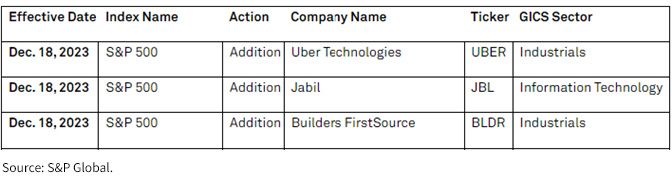
Looking at this rebalance date, we see that all three of the proposed additions outperformed the S&P 500 in the two weeks between the announcement date and the effective date. Uber outperformed by over 6%, Jabil by almost 12%, and Builders First Source by almost 18%.7
Figure 3: Performance of the S&P 500 Index Additions—the 2023 Rebalance Example
Expanding the Lens: A Five-Year Review
To get a better sense of this effect, we collected all the changes that occurred in the S&P 500 since 2019. This accounts for five years of constituent changes, specifically only looking at stocks that underwent changes where companies were chosen by the committee.
Figure 4: Looking at Historical S&P 500 Index Rebalances, Comparing Performance of Additions to Performance of Deletions Leading into and then After the Event
Adds: Specifically, stocks poised for inclusion in the S&P 500 tended to outshine the broader index by about 2.6% in the two-week run-up to their addition. However, once officially added, these stocks often fell short of the index and on average they underperformed by 4.7% over the next 12 months.
Drops: Conversely, companies on the verge of removal experienced an initial downturn, selling off before their actual exclusion. Yet, once removed, these stocks frequently started to recover, outpacing the index by nearly 5% on average in the following six months and by almost 16% over the next 12 months.
This pattern we see around the rebalance of indexes underscores how the explosion of passive investing and index changes can have long lasting impacts for adds/drops to the index.
We believe that investors and market strategists should consider these trends when navigating index rebalancing events, as they can have significant implications for investment strategies.
Stay tuned for a forthcoming in-depth research piece that will explore these index changes in greater detail, providing a more comprehensive understanding of their impact on the market and a deeper understanding of how this effect intertwines with popular value and low volatility narratives.
1 Source: “S&P Dow Jones Indices Annual Survey of Assets,” S&P Global, https://www.spglobal.com/spdji/en/documents/index-news-and-announcements/spdji-indexed-asset-survey-2022.pdf
2 Source: “SPIVA® U.S. Scorecard,” S&P Global, https://www.spglobal.com/spdji/en/documents/spiva/spiva-us-year-end-2023.pdf
3 Source: “S&P U.S. Indices Methodology,” S&P Global, https://www.spglobal.com/spdji/en/documents/methodologies/methodology-sp-us-indices.pdf
4 Source: “Tesla Set to Join S&P 500,” S&P Global, https://www.spglobal.com/spdji/en/documents/indexnews/announcements/20201116-1258362/1258362_tdec215addconsult.pdf
5 Source: Brian Scheid, “Apartment Investment & Management Dropped from S&P 500 to Make Way for Tesla,” S&P Global, https://www.spglobal.com/marketintelligence/en/news-insights/latest-news-headlines/apartment-investment-management-dropped-from-s-p-500-to-make-way-for-tesla-61715093
6 Source: “Uber Technologies, Jabil and Builders FirstSource Set to Join S&P 500; Others to Join S&P MidCap 400 and S&P SmallCap 600,” S&P Global, https://www.spglobal.com/spdji/en/documents/indexnews/announcements/20231201-1467851/1467851_dec2023shuf.pdf
7 Source: Jeremy Siegel with Jeremy Schwartz, research for Stocks for the Long Run, 6th ed., 2022. Past performance is not indicative of future results. Calculated from 12/1/23 to 12/15/23.
U.S. Quality Dividend Growth Fund


Global Chief Investment Officer
Jeremy Schwartz has served as our Global Chief Investment Officer since November 2021 and leads WisdomTree’s investment strategy team in the construction of WisdomTree’s equity Indexes, quantitative active strategies and multi-asset Model Portfolios. Jeremy joined WisdomTree in May 2005 as a Senior Analyst, adding Deputy Director of Research to his responsibilities in February 2007. He served as Director of Research from October 2008 to October 2018 and as Global Head of Research from November 2018 to November 2021. Before joining WisdomTree, he was a head research assistant for Professor Jeremy Siegel and, in 2022, became his co-author on the sixth edition of the book Stocks for the Long Run. Jeremy is also co-author of the Financial Analysts Journal paper “What Happened to the Original Stocks in the S&P 500?” He received his B.S. in economics from The Wharton School of the University of Pennsylvania and hosts the Wharton Business Radio program Behind the Markets on SiriusXM 132. Jeremy is a member of the CFA Society of Philadelphia.