

We Don’t Think Volatility Is an Effective Hedging Signal. Here’s Why.
Published March 3, 2016

Global Chief Investment Officer
In a recent blog post, we outlined why volatility is not among our preferred currency-hedging signals. To recap, by definition, volatility does not indicate a specific direction of a currency pair, and it would lead to opposite conclusions for U.S.-based investors compared to internationally based investors. But to expand on the analysis, consider the following: If there were a correlation between volatility and, say, U.S. dollar strength or weakness AND if an investor were willing to rely on this correlation persisting, then perhaps a more or less volatile environment could be taken to indicate the likeliness of U.S. dollar strength or weakness. However, although such correlations have been observed sporadically in the past, they have not proved persistent. The chart below shows the correlation between historic volatility (measured as the standard deviation of daily spot movements over a rolling 63-day window at successive month-ends) and the returns from being long U.S. dollar in a hedge against each of the euro, Japanese yen and pound sterling in the following month. Although there have been times when this correlation was positive at a statistically significant level, it has also been negative at times, and overall has proved highly sporadic and unstable over the full period shown. 36-Month Rolling Correlation: Currency Pair Spot Rate Volatility (63 days) vs 1m Passive Hedging Return (Long USD, 1m Lag)
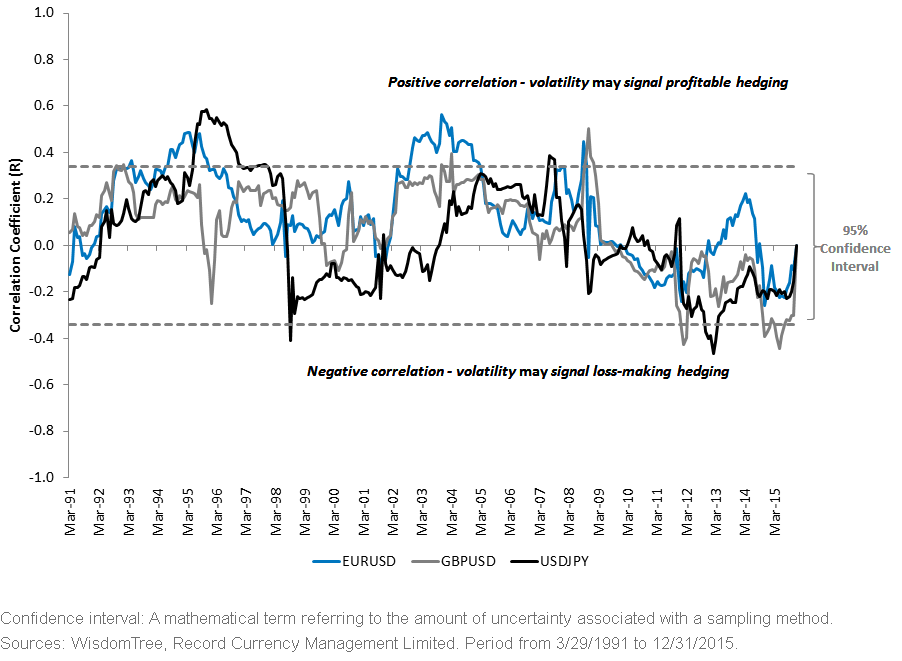
Using volatility as a currency-hedging signal could therefore be a classic case of relying on a sporadic correlation that has emerged from time to time and naively assuming that it will continue into the future. It is worth asking, though, why this correlation emerged. We attribute it to the “safe-haven” status that the U.S. dollar acquired at times during the financial crisis of 2008–2009 (indeed, it’s noteworthy that even in this period, returns from being long U.S. dollar frequently had the lowest correlation with volatility, and hence safe-haven status, when measured against the Japanese yen, itself a regional safe haven). Should we expect this status to persist? To some degree, U.S. Treasuries will always be seen as one of the world’s safest asset classes. However, if U.S. dollar interest rates continue to increase, it’s possible the dollar becomes more of an “investment” than a “funding” currency in certain currency strategies, in which case we would expect its risk sensitivity to increase and safe-haven status to diminish. Therefore, relying on the sporadic correlation seen in the past could be even more unreliable in a rising U.S. dollar rate environment. All of this reinforces why we favor three directional signals in applying our hedge ratios. Higher U.S. interest rates, the momentum of the U.S dollar or an undervalued dollar will all signal to U.S. investors to hedge their euro exposure, while also being a signal to euro-based investors not to hedge their U.S. dollars. These three signals are thus consistent by virtue of being directional. Volatility does not share this feature and relies on a weak link between the correlation of U.S. dollar volatility and the strength of the U.S. dollar. Given the multitude of factors at play impacting currency markets, relying on this correlation of volatility to stay positive for an extended period seems a bet we would not be willing to take.
Important Risks Related to this Article
Hedging can help returns when a foreign currency depreciates against the U.S. dollar, but it can hurt when the foreign currency appreciates against the U.S. dollar.
No WisdomTree Fund is sponsored, endorsed, sold or promoted by Record Currency Management (“Record”). Record has licensed certain rights to WisdomTree Investments, Inc., as the index provider to the applicable WisdomTree Funds, and Record is providing no investment advice to any WisdomTree Fund or its advisors. Record makes no representation or warranty, expressed or implied, to the owners of any WisdomTree Fund regarding any associated risks or the advisability of investing in any WisdomTree Fund.
Categories
About the contributor

Global Chief Investment Officer
Jeremy Schwartz has served as our Global Chief Investment Officer since November 2021 and leads WisdomTree’s investment strategy team in the construction of WisdomTree’s equity Indexes, quantitative active strategies and multi-asset Model Portfolios. Jeremy joined WisdomTree in May 2005 as a Senior Analyst, adding Deputy Director of Research to his responsibilities in February 2007. He served as Director of Research from October 2008 to October 2018 and as Global Head of Research from November 2018 to November 2021. Before joining WisdomTree, he was a head research assistant for Professor Jeremy Siegel and, in 2022, became his co-author on the sixth edition of the book Stocks for the Long Run. Jeremy is also co-author of the Financial Analysts Journal paper “What Happened to the Original Stocks in the S&P 500?” He received his B.S. in economics from The Wharton School of the University of Pennsylvania and hosts the Wharton Business Radio program Behind the Markets on SiriusXM 132. Jeremy is a member of the CFA Society of Philadelphia.