


The Power of Momentum: Enhancing Our High Yield Bond Strategy
Published December 12, 2024

Behnood Noei, CFA
Director, Fixed Income
Key Takeaways
- We recently enhanced our U.S. High Yield Corporate Bond Indexes by integrating equity momentum signals to complement its traditional fundamental analysis.
- Incorporating equity momentum helps anticipate turning points by offering a clearer view of market sentiment, enabling better-informed investment decisions during periods of market volatility.
- By focusing only on the top and bottom 10% of issuers based on equity momentum, the strategy balances predictive insights with disciplined turnover management, aiming to boost returns while controlling risks.
Listen to the blog post below:
We’ve recently made some improvements to our High Yield Corporate Bond strategies1, guided by extensive analysis and an understanding of current market dynamics. Let’s explore the changes we’ve made, why we’ve made them and how these improvements position us for future success.
Motivation Behind the Changes
Our High Yield Corporate approach has faced challenges in recent years, primarily due to the aftermath of COVID-19. Fiscal support during the pandemic helped prop up fundamentally weak companies such as cruise lines, while certain cash-rich sectors, such as Telecommunication Services, have experienced significant pressure.
As a result, we identified an opportunity to enhance our strategy to better align with evolving market conditions. By incorporating equity momentum, we introduced a tool that complements our fundamentally driven signals, adding a layer of flexibility to further optimize our risk/return profile.
The Role of Equity Momentum: A Key Enhancement
Momentum is a well-established concept in financial markets, specifically equity markets, that is often used to predict turning points. It is particularly useful in navigating periods of volatility and uncertainty. Our extensive testing has shown that incorporating equity momentum into our high yield strategy could help us respond more effectively to market shifts. Equity return momentum, which reflects recent performance trends, provides valuable insights that complement and enhance our traditional fundamental analysis.
Why focus on equity momentum specifically? Corporate debt momentum can often be noisy, as fluctuations in bond prices can reflect a range of factors beyond fundamental changes in the issuer's creditworthiness, such as duration and other issue-specific features. Equity momentum, on the other hand, tends to provide a clearer signal, offering a focused view of market sentiment toward the issuer. By analyzing the equity side, we can better gauge the broader market perspective, serving as a useful check on our fundamental analysis.
We decided to use equity momentum as a tool to anticipate turning points, but we needed a disciplined approach to avoid excessive turnover, which could reduce returns. Therefore, we concentrated only on the extremes—issuers with equity momentum scores in the top 10% or bottom 10% of the public universe. This targeted approach allows us to leverage momentum's predictive power while keeping turnover in check.
We conducted a comprehensive quantile analysis to assess the effectiveness of the equity momentum factor in systematically identifying high-performing bonds within the high yield universe. Bonds were categorized into five distinct quantiles, and extreme deciles (top and bottom 10%) based on the percentage rank of one-, three- and six-month equity returns of their parent companies among public issuers within the universe, evaluated on a semi-annual rebalancing schedule. As shown in figure 1 below, our analysis, covering the period from 2016 to 2024, demonstrated that the highest momentum quintile and the top 10% momentum score consistently achieved superior performance compared to the lowest quantile and the bottom 10%, underscoring the predictive value of equity momentum.
Figure 1: U.S. High Yield: Equity Momentum
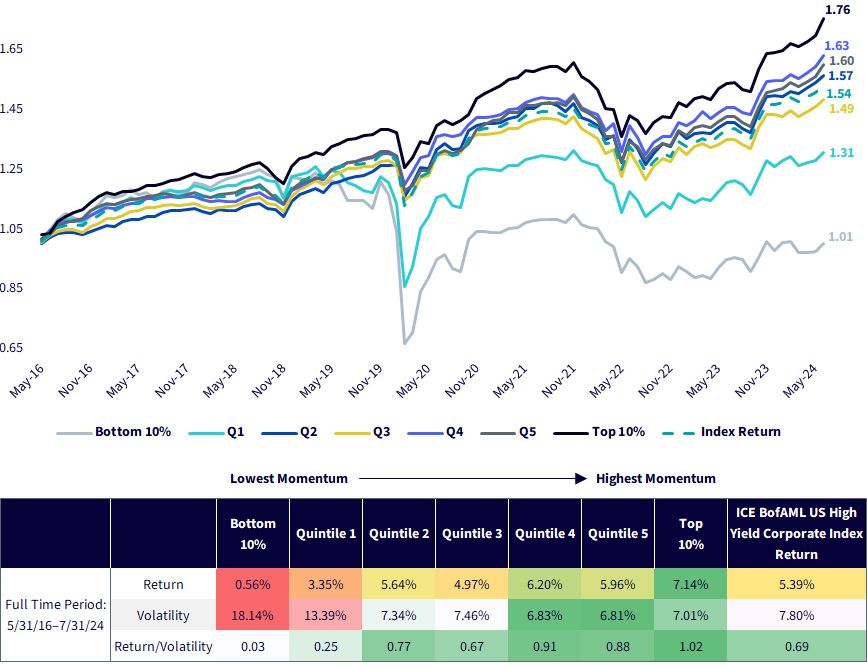
Sources: WisdomTree, FactSet, as of 7/31/24. For definitions of terms in the charts above, please visit the glossary.
How Momentum Works in Our Strategies
Our momentum implementation follows a carefully designed framework. We combined average signals over one-, three- and six-month periods to create a composite score. This composite helps smooth out short-term noise while still capturing significant trends. By focusing on the extremes, we’ve found a way to add value while minimizing the risk of over-trading.
Extreme momentum signals, whether in the top or bottom 10%, serve as a check on our fundamental signals. Here’s how:
- Negative cash flow but strong momentum: In some cases, a company may have negative long-term cash flow, yet its equity momentum is strong. This strong momentum can indicate that the market expects a turnaround before it’s reflected in cash flows, providing a reason to maintain the position rather than cutting it.
- Positive cash flow but weak momentum: Conversely, if a company has positive cash flow but very weak equity momentum, it could signal that market sentiment is deteriorating and that fundamentals may soon follow. In such cases, we exit our position as a precaution.
A key aspect of our new approach is determining when to "turn off" a momentum signal. Once a positive or negative momentum signal is activated, we use a longer-term momentum measure to decide when to revert. Specifically, we look at the 12-month momentum, and a signal is turned off only when it falls below the top 30% or rises above the bottom 30%. This method ensures that we are not overly reactive to short-term fluctuations and keeps our focus on longer-term trends.
Final Thoughts: A Balanced Approach
These recent changes represent a significant step forward for our High Yield Corporate Bond strategy. By maintaining a strong foundation in fundamental analysis while selectively incorporating momentum, we’ve added a layer of dynamism better suited to today’s market conditions. Importantly, this doesn’t mean we’ve abandoned our fundamental principles—rather, we’ve enhanced them with a data-driven overlay that allows us to act more nimbly when market conditions change.
The power of momentum lies in its ability to help us anticipate the change before the fundamentals catch up. By focusing on just the extremes, we’re able to capture its benefits without incurring the costs associated with increased turnover. This balanced approach is designed to improve returns, reduce risk and create a more resilient portfolio.
We believe these enhancements will position us more strongly for the future, and we’re excited to continue finding ways to add value to our investors’ portfolios in an ever-evolving world.
1 The WisdomTree U.S. High Yield Corporate Bond Index (WFCHY), the WisdomTree U.S. Short-term High Yield Corporate Bond Index (WFCHYS) and the WisdomTree U.S. High Yield Corporate Bond Zero Duration Index (I35476)
Categories
About the contributor

Behnood Noei, CFA
Director, Fixed Income
Behnood Noei serves as Director of Fixed Income at WisdomTree Asset Management, where he develops the firm’s suite of fixed income and currency exchange-traded funds and enhances existing investment processes. Behnood has 11 years investment experience in portfolio management and quantitative research. Prior to joining WisdomTree in 2022, Behnood was a portfolio manager and developer of some of the fixed income ETFs at J.P.Morgan Asset Management, where he was directly responsible for managing more than 7 Fixed Income ETFs and multiple SMAs with more than $13Billion in assets. He graduated from The Ohio State University with Master of Science degree in Finance and is a CFA charter holder.