

Rethinking How to Access Emerging Markets
Published March 18, 2026

Research Analyst
Key Takeaways
- Emerging markets have surged recently, returning 14.83% year-to-date and nearly 50% over the past year—far outpacing developed markets and strengthening the case for broad exposure through strategies like the WisdomTree Emerging Markets ex-State-Owned Enterprises Fund (XSOE).
- While emerging markets offer strong growth potential, state-owned enterprises can introduce governance and principal-agent risks, making rules-based strategies such as XSOE, which excludes companies with 20% or greater government ownership, an appealing way to focus on firms with clearer profit incentives.
- Investors seeking to capture the small-minus-big factor in emerging markets may complement core exposure like XSOE with the WisdomTree Emerging Markets SmallCap Dividend Fund (DGS). A balanced 70/30 core-and-tilt allocation aims to blend governance-aware exposure with small-cap return potential.
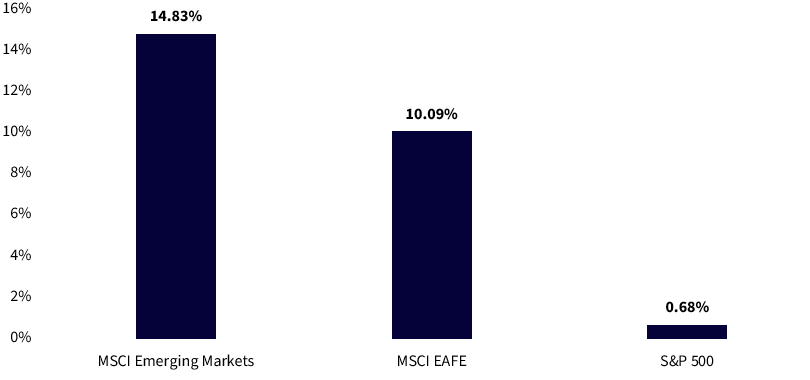
Emerging markets have been on a tear recently. The S&P 500 is roughly flat year-to-date, while the MSCI EAFE Index has returned 10.09%. The MSCI Emerging Markets Index has returned 14.83%, significantly outpacing its developed market counterparts.
Figure 1: Year-to-Date Performance
Source: WisdomTree, FactSet. Returns from 12/31/2025 to 2/27/2026. You cannot invest directly in an index. Past performance is not indicative of future results.
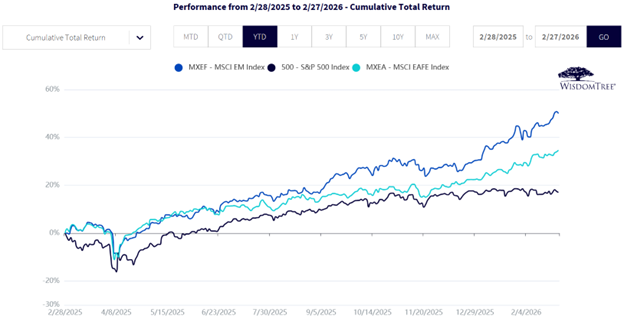
One-year returns show an even bigger disparity, with the MSCI Emerging Markets Index, the MSCI EAFE Index, and the S&P 500 returning 49.96%, 34.63%, and 16.99% respectively.
Figure 2: 1-Year Cumulative Performance
Source: WisdomTree, FactSet. Returns from 2/28/2025 to 2/27/2026. You cannot invest directly in an index. Past performance is not indicative of future results.
A smart way to access emerging markets is to have some exposure to the small-minus-big factor, which reflects the tendency of small companies to deliver outsized returns relative to larger companies over longer periods. This is especially true in the more volatile emerging markets.
Figure 3: Size Factor Returns
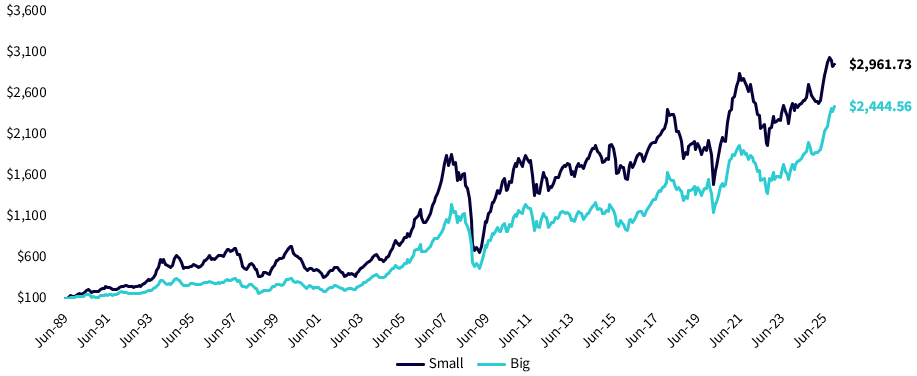
Source: WisdomTree, Kenneth R. French Data Library. "Big" stocks represent the top 90% of June market capitalization within each country, while "Small" stocks represent the bottom 10%. Returns shown are the average returns of the low, medium and high book-to-market portfolios within each size segment. Returns from 6/30/1989 to 12/31/2025. Past performance is not indicative of future results.
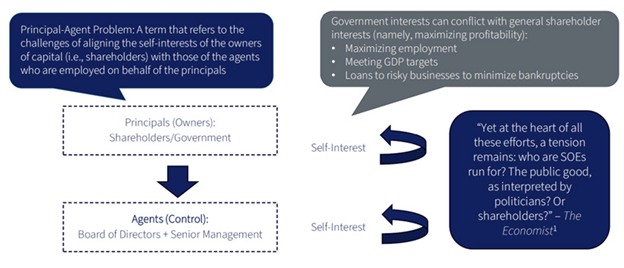
However with that opportunity can come unique governance risks, particularly principal-agent risk. The principal-agent problem occurs when the people running a company (management, the “agents”) have incentives that don’t perfectly align with the people providing the capital (shareholders, the “principals”). In emerging markets, this misalignment can be more pronounced in state-owned enterprises (SOEs), where management may be accountable not only to outside shareholders but also to government priorities. That can mean objectives like maintaining employment, supporting strategic industries, or meeting political goals may take precedence over profitability, capital discipline and returns for minority shareholders.
Figure 4: Principal–Agent Risks in State-Owned Enterprises
Source: "Government-Controlled Firms: State Capitalism in the Dock," The Economist, 11/20/14. SOE refers to state-owned enterprises.
Investors can seek to reduce this risk by limiting exposure to SOEs, where minority shareholders may have less influence and governance outcomes can be less predictable. The WisdomTree Emerging Markets ex-State-Owned Enterprises Index uses a rules-based methodology to exclude companies with 20% or higher government ownership, aiming to emphasize companies with clearer profit incentives and potentially stronger alignment with shareholders.
Figure 5: State-Owned vs. Non-State-Owned Enterprise Returns—MSCI Emerging Markets Index
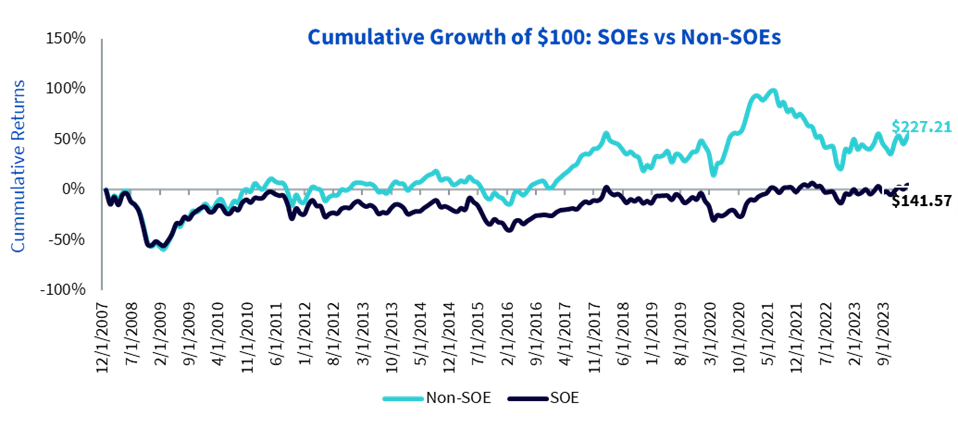
Source: WisdomTree, FactSet. Returns from 12/31/2007 to 12/31/2025. You cannot invest directly in an index. Past performance is not indicative of future results.
Recent strength in emerging markets also appears to be broad-based, not driven by a single country. Several markets—including Korea, Mexico, Taiwan and South Africa—have participated in the rally. That breadth can reinforce the case for maintaining diversified, all-cap exposure to the asset class, while using thoughtful tools to manage risks like governance and state ownership.
Figure 6: MSCI Emerging Markets Country Returns
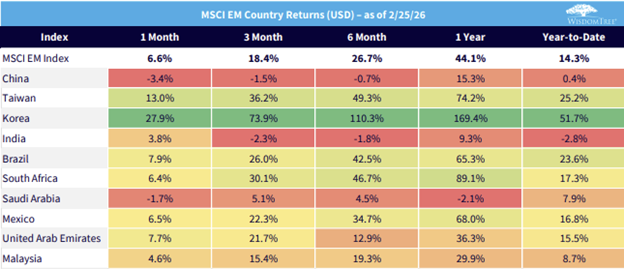
Source: WisdomTree, FactSet. Returns as of 2/25/2026. You cannot invest directly in an index. Past performance is not indicative of future results.
The WisdomTree Emerging Markets ex-State-Owned Enterprises Fund (XSOE) and the WisdomTree Emerging Markets SmallCap Dividend Fund (DGS) offer two complementary ways to access emerging markets equities. XSOE provides broad EM exposure while seeking to manage principal-agent risk by filtering out state-owned enterprises. DGS can complement a core emerging markets holding by emphasizing smaller, dividend-paying companies, an approach that may help investors tap into the small-minus-big (SMB) effect and the growth potential often associated with smaller firms in emerging markets.
Investors can also consider a simple core-and-tilt allocation, such as 70% XSOE and 30% DGS, that keeps the portfolio anchored in broad, governance-aware EM exposure while adding a measured small-cap dividend tilt. While a 50/50 split may look compelling in a historical backtest, many investors may find that level of small-cap concentration more aggressive than they prefer. By contrast, a 70/30 blend seeks to balance broad participation in emerging markets with some of the potential benefits of the size factor. The table below compares risk and return metrics for a 70/30 blend of XSOE and DGS versus IEMG, which tracks the broad MSCI Emerging Markets Index.
Figure 7: Blended Portfolio Risk and Return vs. IEMG
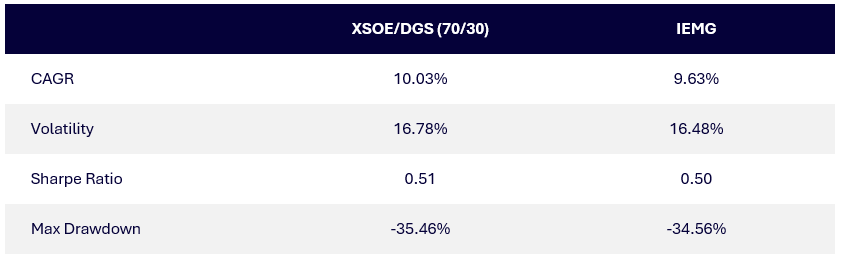
Source: WisdomTree, FactSet. Returns from 12/31/2016 to 2/27/2026. Past performance is not indicative of future results. Investment return and principal value of an investment will fluctuate so that an investor's shares, when redeemed, may be worth more or less than their original cost. Current performance may be lower or higher than the performance data quoted. For the most recent month-end and standardized performance, click the relevant ticker: XSOE, DGS, IEMG.
For definitions of terms in the table, please visit our glossary.
Conclusion
As emerging markets regain momentum, investors may want to be deliberate about how they take risk. Seeking potential upside from the size factor while remaining mindful of governance headwinds common in state-owned enterprises can be a smarter way to access the asset class. Emerging markets can be volatile, but we believe a thoughtful portfolio construction may help investors stay invested through the cycle
Figure 8: Additional Information
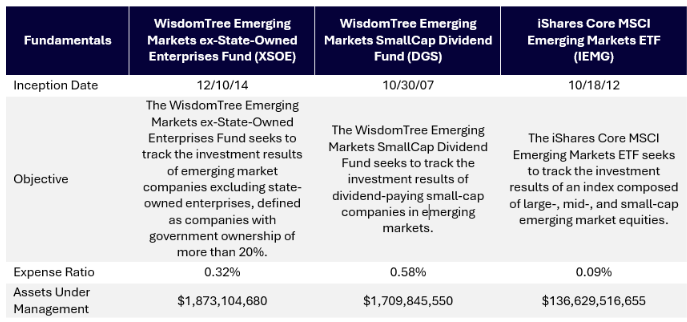
Source: WisdomTree, iShares, as of 3/12/26.
Important Risks Related to this Article
All funds are managed differently and do not react the same to economic or market events. The investment objectives, strategies, policies or restrictions of other funds may differ and more information can be found in their respective prospectuses. Therefore, we generally do not believe it is possible to make direct fund to fund comparisons in an effort to highlight the benefits of a fund versus another similarly managed fund.
XSOE: There are risks associated with investing, including possible loss of principal. Foreign investing involves special risks, such as risk of loss from currency fluctuation or political or economic uncertainty. Investments in emerging or offshore markets are generally less liquid and less efficient than investments in developed markets and are subject to additional risks, such as risks of adverse governmental regulation and intervention or political developments. Funds focusing their investments on certain sectors and/or regions increase their vulnerability to any single economic or regulatory development. This may result in greater share price volatility. The Fund invests in the securities included in, or representative of, its Index regardless of their investment merit and the Fund does not attempt to outperform its Index. Please read the Fund’s prospectus for specific details regarding the Fund’s risk profile.
DGS: There are risks associated with investing, including possible loss of principal. Foreign investing involves special risks, such as risk of loss from currency fluctuation or political or economic uncertainty. Funds focusing on a single sector and/or smaller companies generally experience greater price volatility. Investments in emerging, offshore or frontier markets are generally less liquid and less efficient than investments in developed markets and are subject to additional risks, such as risks of adverse governmental regulation, intervention and political developments. Due to the investment strategy of this Fund, it may make higher capital gain distributions than other ETFs. The securities of small-capitalization companies generally trade in lower volumes and are subject to greater and more unpredictable price changes than larger capitalization stocks or the stock market as a whole. Small-capitalization companies may be particularly sensitive to adverse economic developments as well as changes in interest rates, government regulation, borrowing costs and earnings. Dividends are not guaranteed, and a company currently paying dividends may cease paying dividends at any time. The Fund invests in the securities included in, or representative of, its Index regardless of investment merit, and the Fund does not attempt to outperform its Index. Please read the Fund’s prospectus for specific details regarding the Fund’s risk profile.
For IEMG’s risk disclosures, please click here.
Categories
About the contributor

Research Analyst
Hyun Kang joined WisdomTree in July 2022 as a Research Analyst. As a part of the Index team, he assists with the creation and maintenance of the firm’s indexes and supports the group’s research initiatives across various strategies. Hyun graduated from Carnegie Mellon University, with a B.S. in Business Administration and an additional major in Statistics and Machine Learning.