

Reconfiguring Core-Plus Fixed Income for the Trump Inflection
Published December 21, 2016

Chief Investment Officer, Fixed Income and Model Portfolios
The long-term ramifications of the Trump victory are yet to be understood. We hope that the business-positive aspects (tax cuts, regulatory rollback and easier repatriation) overwhelm the potential dark side of protectionism in supporting credit valuations (in other words, that Good Trump out-trumps Bad Trump). For income-oriented investors, complementing core fixed income with high-yield corporates has been commonly used to boost income potential. With rates likely to tick higher but credit remaining resilient, a possible variation on the core-plus idea could be to complement an all-weather portfolio with an interest rate-hedged high-yield strategy.
For much of this year, we have encouraged investors to look at their core fixed income exposures in a different light. Core bond strategies need not be driven by market capitalization or the discretion of an active portfolio manager. Disciplined, passively managed strategies can be constructed to enhance income potential while broadly maintaining the risk characteristics of the investment-grade universe. In addressing income scarcity in many core beta strategies, these core alternatives could provide a needed solution and flexible foundation for a fixed income portfolio. One such strategy is the Bloomberg Barclays U.S. Aggregate Enhanced Yield Index (Agg EY), which shifts weights toward higher-yielding securities within the broad investment-grade universe. This strategy picks up roughly 60 basis points (bps) above the yield of the Bloomberg Barclays U.S. Aggregate Index (Agg).1
We believe a variation on the “core-plus” strategy that combines enhanced core positions with zero duration high-yield strategies might best position investors for the coming months. The blend has the potential to increase yield while reducing duration. A portion of interest rate risk is exchanged for additional credit risk.
How does an interest rate-hedged strategy within the high-yield market work? An investor simply invests in a portfolio of high-yield bonds and then—using short positions in either Treasury bonds or futures—constructs offsetting rate exposures across the curve. So the net Treasury rate risk exposure is zero. High-yield bonds are predominantly driven by credit risk, but the value of this interest rate hedge extends more broadly to the overall portfolio.
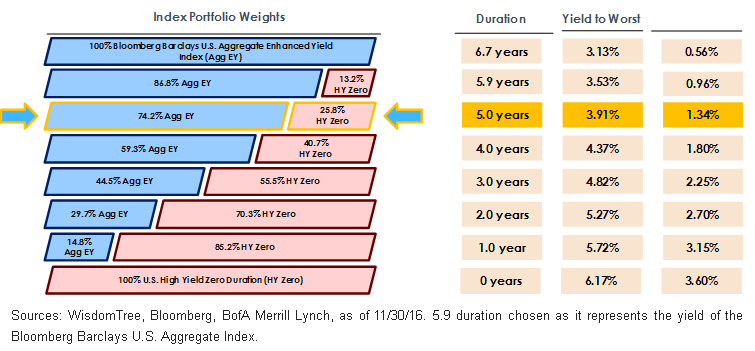
The table below illustrates how blends between enhanced core and high-yield zero (HY Zero) strategies can be combined to achieve various duration targets and the yield and spreads to core benchmark that result from such combinations. To target a duration of five years, you would need to allocate about 26% to HY Zero with about a 74% allocation to Agg EY. This resulting Agg EY and HY Zero portfolio mix has a yield to worst of 3.91%, which is 1.34% more than the Agg.2
Targeting Duration by Blending a High-Yield Zero Duration Strategy with an Enhanced Yield Core Portfolio
For definitions of indexes and terms in the chart, visit our glossary.
Over the last year-and-a-half, we have seen 10-Year Treasury yield rates do a round-trip (2.18% to 1.39% to 2.38%) and credit spreads rise and fall; a mixture of 80% enhanced core with 20% interest rate-hedged high yield has outperformed the Agg by 0.98%, albeit with higher volatility (3.7% against 3.2%). Credit remains fairly priced relative to still-low Treasury term premium and mortgage-backed spreads. With politics potentially more corporate friendly and durations still extended, an enhanced core-plus strategy that trims a little interest rate risk could serve investors well in the coming months, in our view.
1Source: Bloomberg, as of 11/30/16.
2Sources: WisdomTree, BofA Merrill Lynch, Bloomberg, as of 11/30/16.
Important Risks Related to this Article
Fixed income investments are subject to interest rate risk; their value will normally decline as interest rates rise. In addition, when interest rates fall, income may decline. Fixed income investments are also subject to credit risk, the risk that the issuer of a bond will fail to pay interest and principal in a timely manner or that negative perceptions of the issuer’s ability to make such payments will cause the price of that bond to decline.
About the contributor

Chief Investment Officer, Fixed Income and Model Portfolios
Rick Harper serves as the Chief Investment Officer, Fixed Income and Model Portfolios at WisdomTree Asset Management, where he oversees the firm’s suite of fixed income and currency exchange-traded funds. He is also a voting member of the WisdomTree Model Portfolio Investment Committee and takes a leading role in the management and oversight of the fixed income model allocations. He plays an active role in risk management and oversight within the firm.
Rick has over 29 years investment experience in strategy and portfolio management positions at prominent investment firms. Prior to joining WisdomTree in 2007, Rick held senior level strategist roles with RBC Dain Rauscher, Bank One Capital Markets, ETF Advisors, and Nuveen Investments. At ETF Advisors, he was the portfolio manager and developer of some of the first fixed income exchange-traded funds. His research has been featured in leading periodicals including the Journal of Portfolio Management and the Journal of Indexes. He graduated from Emory University and earned his MBA at Indiana University.