
IHDG
International Hedged Quality Dividend Growth Fund

Published October 27, 2025

Director, Research
International equities are finally attracting investors' attention. After a dominant 16-year stretch for U.S. stocks, many investors have overlooked meaningful exposure outside the U.S.
But with stretched U.S. valuations and concerns over an AI-driven bubble, interest abroad is being renewed. While international equities' outperformance this year is modest by historical standards, it marks a notable shift—led by traditional value sectors such as Telecoms, Utilities and Banks rather than the AI-related leadership driving U.S. markets.
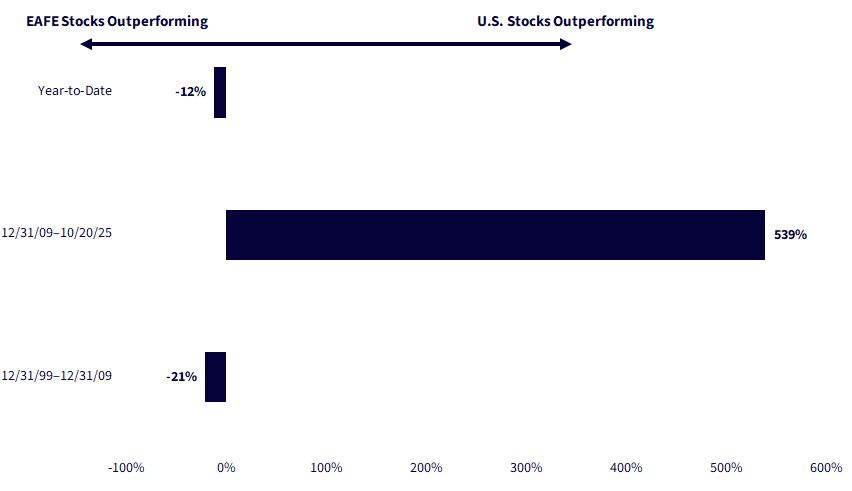
Sources: WisdomTree, MSCI, S&P, as of 10/20/25. You cannot invest directly in an index. Past performance is not indicative of future returns.
The WisdomTree International Quality Dividend Growth Fund (IQDG) and WisdomTree International Hedged Quality Dividend Growth Fund (IHDG) provide investors with exposure to developed-market dividend payers with high profitability and strong earnings growth expectations—a combination designed to support long-term dividend growth potential.
The WisdomTree International Quality Dividend Growth Index, which underlies both Funds, completed its annual rebalance effective October 23, 2025, incorporating methodology enhancements aimed at refining its role as a core international equity allocation.
IQDG and IHDG have long served as developed-market counterparts to the WisdomTree U.S. Quality Dividend Growth Fund (DGRW).
Historically, DGRW's dividend requirement pulled it slightly toward value, while the profitability and growth screens created a growth tilt in the international version.
To help balance the growth side of foreign markets with a more "core" international focus, the Index methodology was refined in two ways:
These changes ensure the Index captures broad developed-market exposure while maintaining the Index's quality and dividend growth orientation.
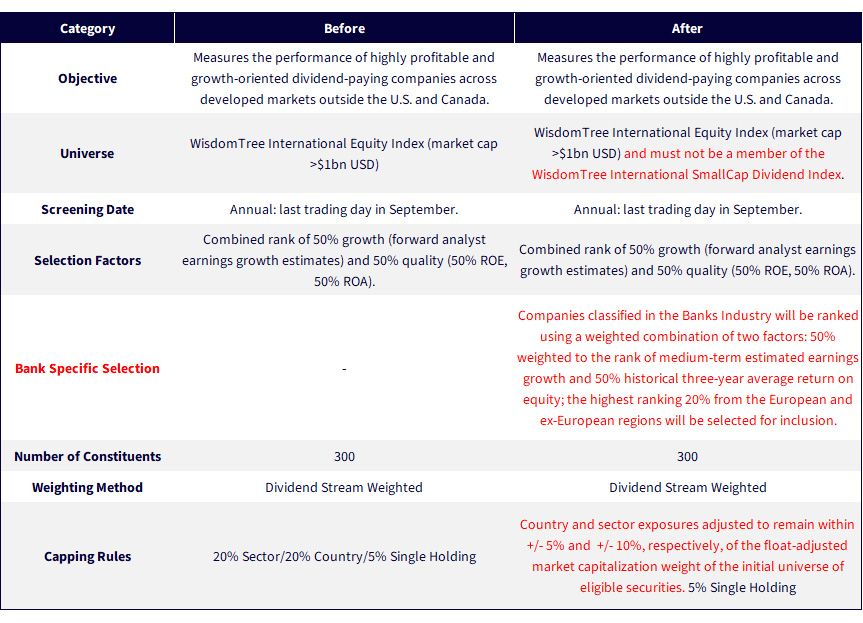
Source: WisdomTree
Both return on assets (ROA) and return on equity (ROE) are widely used measures of profitability. In the WisdomTree Quality Dividend Growth methodology, the two metrics are used together to capture complementary dimensions of company quality: ROE gauges how efficiently a company uses shareholders' equity to generate profits, while ROA helps penalize firms that rely heavily on leverage to drive those profits.
In other words, a company with high ROE but low ROA may be using excessive leverage to boost returns, something our process explicitly seeks to avoid.
Banks, however, operate with significant leverage as an inherent part of their business model, which makes cross-sector profitability comparisons less meaningful. Because bank assets are typically marked to market, ROA tends to understate profitability relative to other industries. In contrast, ROE provides a more relevant measure of bank performance, particularly when comparing profitability among financial-sector peers.
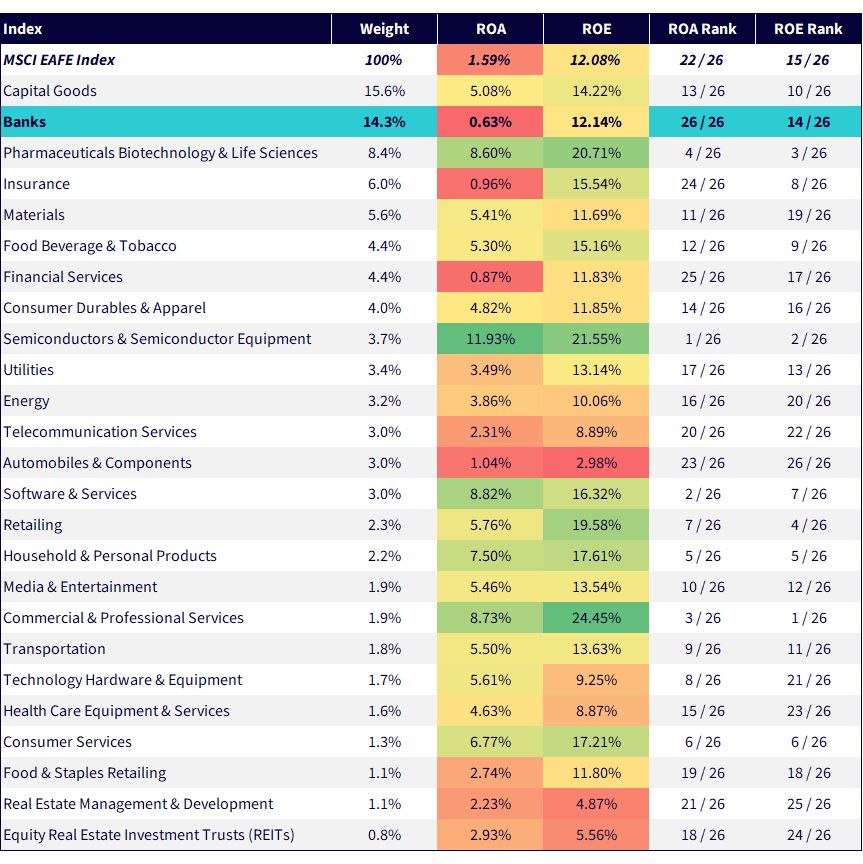
Sources: WisdomTree, MSCI, as of 9/30/25. You cannot invest directly in an index.
Given Banks' substantial presence in developed international markets (14% of MSCI EAFE), the Index adjustments allow for a more representative core exposure—increasing bank weight from 0.2% to 10.8% post-rebalance.
This adjustment improves alignment with the market benchmark while maintaining discipline around quality and risk management.
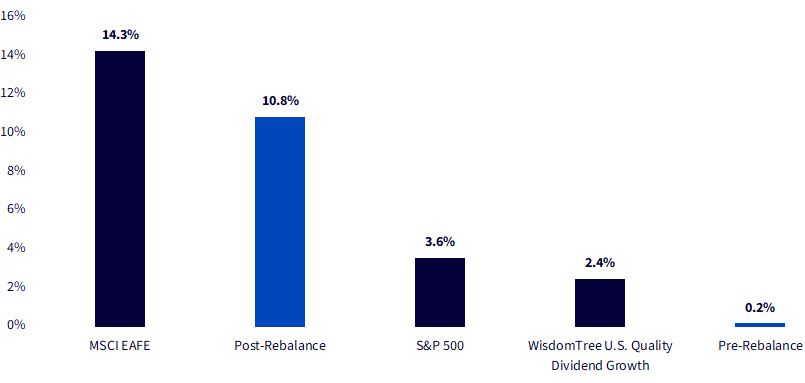
Sources: WisdomTree, MSCI, S&P. Pre-Rebalance is the WisdomTree International Quality Dividend Growth Index as of 9/30/25. Post-Rebalance is the WisdomTree International Quality Dividend Growth Index as of the 9/30/25 screening date. You cannot invest directly in an index.
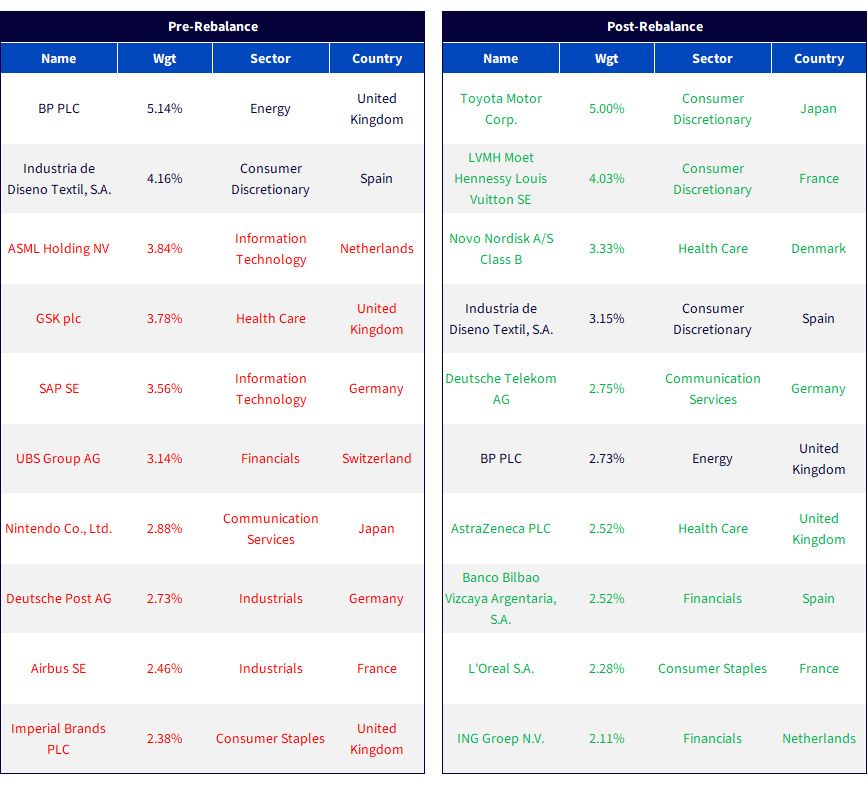
The rebalance refreshed nearly the entire top-10 holdings list.
New leaders include Toyota, LVMH and Novo Nordisk, with BBVA and ING Group joining as top-10 additions.
Source: WisdomTree. Pre-Rebalance is the WisdomTree International Quality Dividend Growth Index as of 9/30/25. Post-Rebalance is the WisdomTree International Quality Dividend Growth Index as of the 9/30/25 screening date. You cannot invest directly in an index.
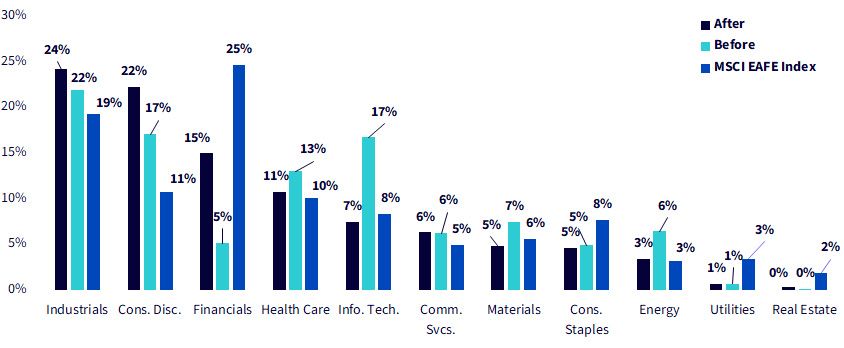
These shifts bring sector exposures closer to the MSCI EAFE benchmark while preserving meaningful over-weights in Consumer Discretionary (+11%) and Industrials (+5%), both consistent with WisdomTree's quality-growth tilt.
Sources: WisdomTree, MSCI, as of 9/30/25. Before is the WisdomTree International Quality Dividend Growth Index as of 9/30/25. After is the WisdomTree International Quality Dividend Growth Index as of the 9/30/25 screening date. You cannot invest directly in an index.
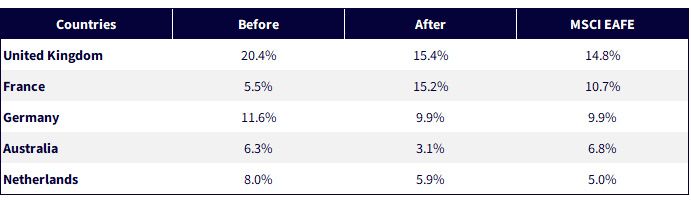
The largest changes occurred in France (+10%) and the United Kingdom (–5%), leaving country weights broadly consistent with MSCI EAFE.
Sources: WisdomTree, FactSet, MSCI, as of 9/30/25. Before is the WisdomTree International Quality Dividend Growth Index as of 9/30/25. After is the WisdomTree International Quality Dividend Growth Index as of the 9/30/25 screening date. You cannot invest directly in an index.
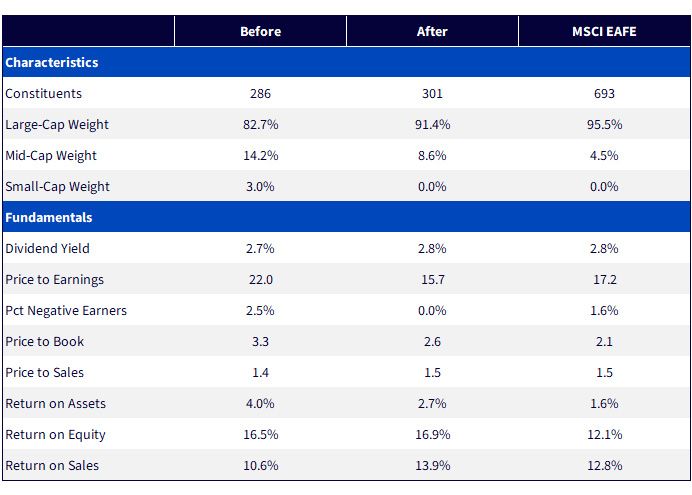
Post-rebalance, the Index exhibits:
These enhancements create a more attractively valued and higher-quality international equity basket, while maintaining strong income potential.
Sources: WisdomTree, FactSet. Before is the WisdomTree International Quality Dividend Growth Index as of 9/30/25. After is the WisdomTree International Quality Dividend Growth Index as of the 9/30/25 screening date. You cannot invest directly in an index.
Following the rebalance, the Index shows a 12% higher overlap with MSCI EAFE, resulting in a lower tracking error and more direct exposure for investors seeking a core international allocation.
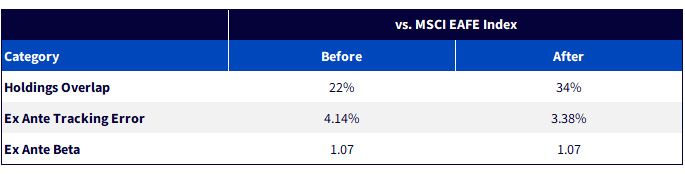
Sources: WisdomTree, MSCI, as of 9/30/25. Before is the WisdomTree International Quality Dividend Growth Index as of 9/30/25. After is the WisdomTree International Quality Dividend Growth Index as of the 9/30/25 screening date. You cannot invest directly in an index.
Turnover increased modestly to 57%, up from 48% in 2024, reflecting both the methodology refinements and the refreshed positioning.
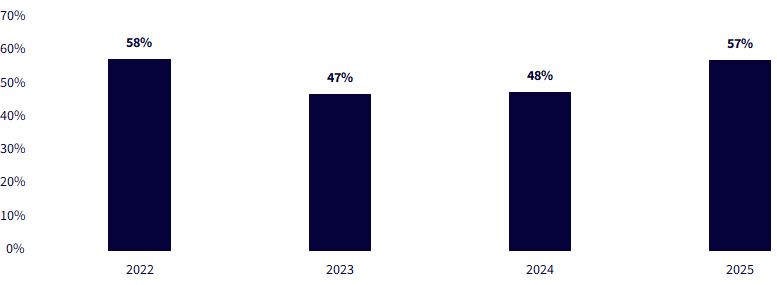
Source: WisdomTree. Rebalance turnover of the WisdomTree International Quality Dividend Growth Index
After years of U.S. dominance, investors are revisiting developed international equities. The WisdomTree International Quality Dividend Growth Index now offers a more balanced, core-aligned approach—capturing quality and dividend growth characteristics without an excessive growth or value bias.
The enhanced methodology, greater bank representation and improved valuation profile together position IQDG and IHDG for a potential leadership phase in international markets anchored in fundamentals.
IQDG: There are risks associated with investing, including the possible loss of principal. Foreign investing involves special risks, such as risk of loss from currency fluctuation or political or economic uncertainty. Heightened sector exposure increases the Fund’s vulnerability to any single economic, regulatory or other development impacting that sector. This may result in greater share price volatility. The Fund invests in the securities included in, or representative of, its Index regardless of their investment merit, and the Fund does not attempt to outperform its Index or take defensive positions in declining markets. Due to the investment strategy of this Fund, it may make higher capital gain distributions than other ETFs. Dividends are not guaranteed, and a company currently paying dividends may cease paying dividends at any time. Please read the Fund’s prospectus for specific details regarding the Fund’s risk profile.
IHDG: There are risks associated with investing, including the possible loss of principal. Foreign investing involves special risks, such as risk of loss from currency fluctuation or political or economic uncertainty. To the extent the Fund invests a significant portion of its assets in the securities of companies of a single country or region, it is likely to be impacted by the events or conditions affecting that country or region. Dividends are not guaranteed, and a company currently paying dividends may cease paying dividends at any time. Investments in currency involve additional special risks, such as credit risk and interest rate fluctuations. Derivative investments can be volatile, and these investments may be less liquid than other securities and more sensitive to the effects of varied economic conditions. As this Fund can have a high concentration in some issuers, the Fund can be adversely impacted by changes affecting those issuers. The Fund invests in the securities included in, or representative of, its Index regardless of their investment merit, and the Fund does not attempt to outperform its Index or take defensive positions in declining markets. Due to the investment strategy of this Fund, it may make higher capital gain distributions than other ETFs. Please read the Fund’s prospectus for specific details regarding the Fund’s risk profile.

Director, Research
Matt Wagner joined WisdomTree in May 2017 as an Analyst on the Research team. He currently serves as a Director, where he supports the creation, maintenance, and reconstitution of WisdomTree’s indexes and actively managed ETFs. Matt began his career at Morgan Stanley, working as an analyst in Treasury Capital Markets from 2015 to 2017, focusing on unsecured funding planning, execution, and risk management. He graduated magna cum laude from Boston College in 2015 with a B.A. in International Studies, concentrating in Economics. In 2020, he earned a Certificate in Advanced Valuation from NYU Stern. He is also a Chartered Financial Analyst (CFA) charterholder.