

How to Achieve the "Buffett Factor" in Index Construction
Published March 31, 2017

Global Head of Research
Within smart beta discussions today, factor exposures are a hot topic. Quality is one factor that has been popular, and it typically is defined as some combination of the following:
- Earnings growth, consistency or stability
- High return on equity (ROE), return on assets (ROA) or other measures of net income relative to a fundamental input (such as return on invested capital (ROIC))
- Low debt
Warren Buffett even wrote in one of his annual letters that, when thinking about acquisition criteria, quality would include “businesses earning good return on equity while employing little or no debt.”1
Diverse Approaches to Achieve This “Buffett Factor” in Index Construction
Two MSCI indexes that are focused on quality within U.S. equities are the MSCI USA Quality Index and the MSCI USA Sector Neutral Quality Index. While each index defines quality and selects securities from the MSCI USA Index based on the same criteria (return on equity, debt to equity and earnings variability), the MSCI USA Sector Neutral Quality Index then normalizes the weights of securities within each sector so that the total sector weights match those of the MSCI USA Index at the semiannual index rebalances.
The MSCI USA Quality Index has no such constraint placed upon its sector exposures.
WisdomTree Entered the Quality Fray in 2013
In April 2013, WisdomTree began live calculation of the WisdomTree U.S. Quality Dividend Growth Index. Critical differences from MSCI’s approach to stock selection and weighting include:
- All components pay regular cash dividends.
- A growth criterion, focused on the forward-looking growth estimates of operating earnings.
- Quality criteria, focused on three-year averages of return on equity and return on assets.
- Components are weighted by their respective Dividend Streams®.
Individual constituents are capped at 5% and sectors are capped at 20% at each annual rebalance,2 but there are no constraints relative to a parent Index or universe.
Which Index Offers the “Best” Exposure to Quality?
We pose this question here precisely because, although it always may be an initial thought, its true importance depends on framing. Does best mean strongest performance in the future? Unfortunately, that one is impossible to know with certainty. Does best mean a strong set of quality metrics? Does best mean a broad-based, diversified approach balanced with strong quality metrics?
With any factor and ultimately any smart beta index, it’s always important to take a step back and specify the characteristics that are most desirable as well as those that are open to compromise.
Sector Exposures: The Obvious Difference
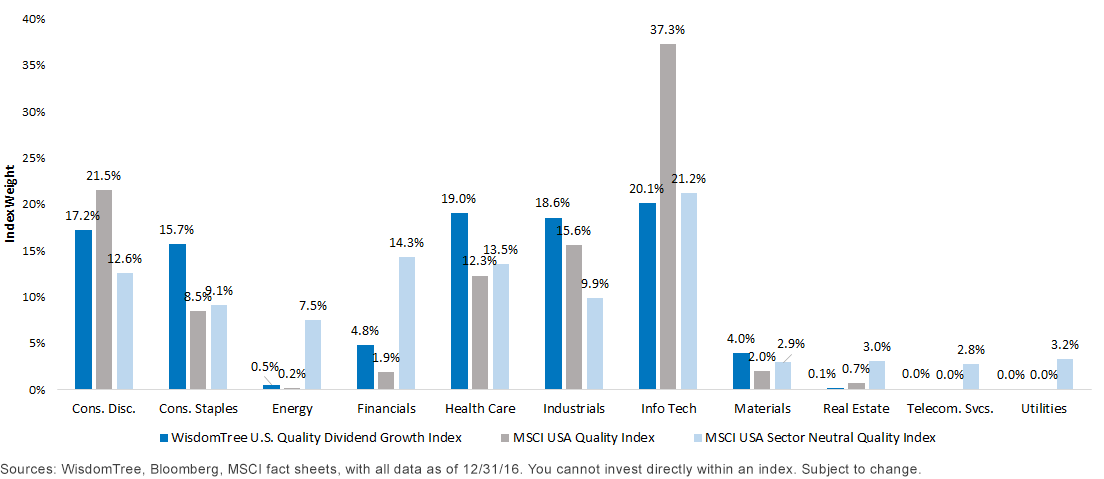
- MSCI USA Quality vs. MSCI USA Sector Neutral Quality Indexes: Given the nomenclature and difference in methodology that we’ve discussed, this is where the clear difference would be evident. The greater-than-37% weight to Information Technology of the MSCI USA Quality Index clearly stands out. On the opposite end of the spectrum, the extremely small exposures to Energy and Financials of the MSCI USA Quality Index also stand out.
- Quality Sectors: Given that the WisdomTree U.S. Quality Dividend Growth Index has a differentiated approach to quality, we believe that sectors where the WisdomTree Index and the MSCI USA Quality Index are over-weight in very high-quality sectors relative to the MSCI USA Sector Neutral Quality Index. This would be true of Consumer Discretionary and Industrials, as of December 31, 2016. Both indexes were under-weight in the notably lower-quality sectors of Energy, Financials, Real Estate, Telecommunication Services and Utilities.
Bottom Line: Investors have to determine how important sector neutrality to a market cap-weighted index benchmark truly is in determining their focus on quality (or any factor, for that matter). At WisdomTree, we clearly believe in sector diversification and broadness of exposure, but if a focus on quality is truly the goal, we ask:
Why dilute the focus on quality by requiring market capitalization weights to lower-quality sectors?
WisdomTree’s Approach: High Quality and Diversified Sector Exposures
Our prediction, based solely on index methodology, would be that the MSCI USA Quality Index would tend toward the highest measures of quality, as that is its sole focus.
Now, a greater-than-37% exposure to any single sector may not be feasible for all investors, creating a potential drawback.
Can the WisdomTree U.S. Quality Dividend Growth Index generate more favorable measures of quality relative to the MSCI USA Sector Neutral Quality Index approach?
Measuring Three Quality Indicators
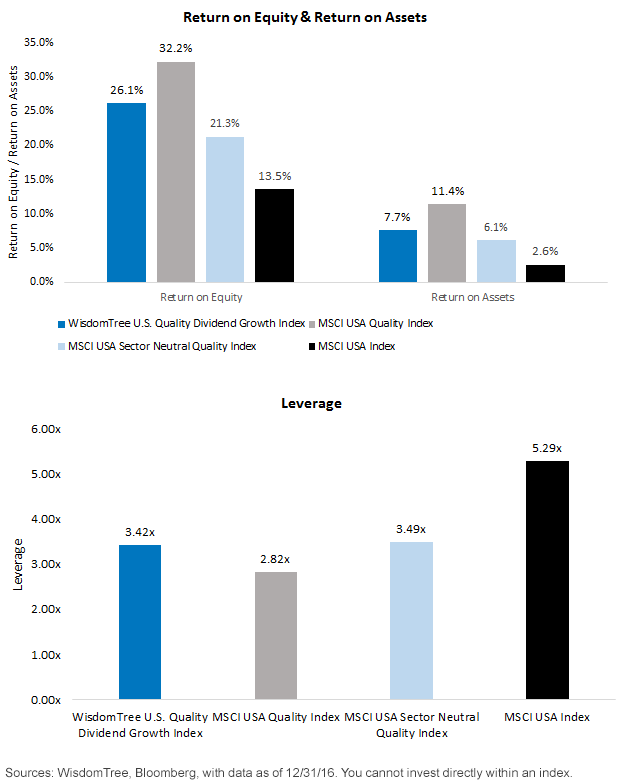
- Return on Equity: While the WisdomTree Index did not beat the MSCI USA Quality Index, it did exceed the MSCI USA Sector Neutral Quality Index.
- Return on Assets: The relative ordering of the indexes was the same on this measure as on return on equity.
- Leverage: Lower leverage tends to indicate higher quality. The WisdomTree and the MSCI USA Sector Neutral Quality Indexes were quite similar, with the WisdomTree slightly lower.
Conclusion
So far, we’ve seen one of the major exchange-traded fund (ETF) providers switch their ETF from the original MSCI USA Quality Index to the MSCI USA Sector Neutral Quality Index. As we discussed in this post, while the original MSCI USA Quality Index had major sector bets and concentration, the sector-neutral approach does result in downgrade of potential ROE and ROA improvements. WisdomTree’s Quality Dividend Growth methodology was designed to allow meaningful sector differentials and tilts versus the broader market, but we do so in constrained way—balancing what we believe is exposure to the quality factor while not concentrating too much in any one sector.
1Berkshire Hathaway Annual Shareholder Letter, 1/28/15.
2Between annual rebalances, individual companies may see their weights increase above 5% and sectors may see their weights increase above 20% due to market movement.
Important Risks Related to this Article
Dividends are not guaranteed, and a company currently paying dividends may cease paying dividends at any time.
About the contributor

Global Head of Research
Christopher Gannatti began at WisdomTree as a Research Analyst in December 2010, working directly with Jeremy Schwartz, CFA®, Director of Research. In January of 2014, he was promoted to Associate Director of Research where he was responsible to lead different groups of analysts and strategists within the broader Research team at WisdomTree. In February of 2018, Christopher was promoted to Head of Research, Europe, where he was based out of WisdomTree’s London office and was responsible for the full WisdomTree research effort within the European market, as well as supporting the UCITs platform globally. In November 2021, Christopher was promoted to Global Head of Research, now responsible for numerous communications on investment strategy globally, particularly in the thematic equity space. Christopher came to WisdomTree from Lord Abbett, where he worked for four and a half years as a Regional Consultant. He received his MBA in Quantitative Finance, Accounting, and Economics from NYU’s Stern School of Business in 2010, and he received his bachelor’s degree from Colgate University in Economics in 2006. Christopher is a holder of the Chartered Financial Analyst Designation.