

European Equities Heating Up: A Quality Growth Approach
Published June 21, 2017

Director, Research
Over the past eight years of the U.S. bull market in equities, it has not paid to diversify outside of the more richly valued U.S. markets. But recently, the international markets have been outperforming, and sentiment has been improving. The European economies are a number of years behind the U.S. in their economic recovery, and the markets have the potential to catch up with the U.S.
One-Two Punch: Valuation & Growth
As of May 25, from a valuation perspective, a forward price-to-earnings (P/E) ratio of 16 and a current dividend yield of 3.3% for the MSCI Europe Index start to support a compelling investment story when compared to the S&P 500 Index P/E at 19 and a yield of 2.0%. This valuation is further enhanced by looking at the relative opportunities compared to traditional fixed income instruments. In the U.S., the 10-Year Treasury yield of around 2.25% is now slightly ahead of the dividend yields of U.S. equities. In Europe, the average premium of equities over bonds is roughly twice as high as the U.S. equity premium. For example, Germany’s earnings yield (inverse of P/E ratio) is 5.1% while the 10-year bund yield is .36%, resulting in an equity premium of 4.7%. A similar story exists for France, with an equity premium of 4.3%. The U.S. has an equity premium of 2.4%, about 230 basis points (bps) below that of Germany and 190 bps below France. What this means is that equity investors in Europe are paid a relatively higher premium than equity investors in the U.S.1
While we are excited about the prospects for European equities, we must be cognizant that not all of Europe’s economic and political issues are behind us. One investment strategy that balances the valuation opportunity of Europe but screens for quality and growth characteristics may help increase the odds of successful outcomes.
The Quality Tilt: Under-weight Leverage
Much has been said about the remarkable recovery of the financial sector since the 2007–2008 financial crisis. The U.S. financial sector, that is. A recent special report in The Economist focused on the relative weakness of European banks and the challenges that continue to lay ahead for the industry, not least of which is the European Central Bank’s (ECB) easy money policies from which the rest of the European economy stands to benefit.2
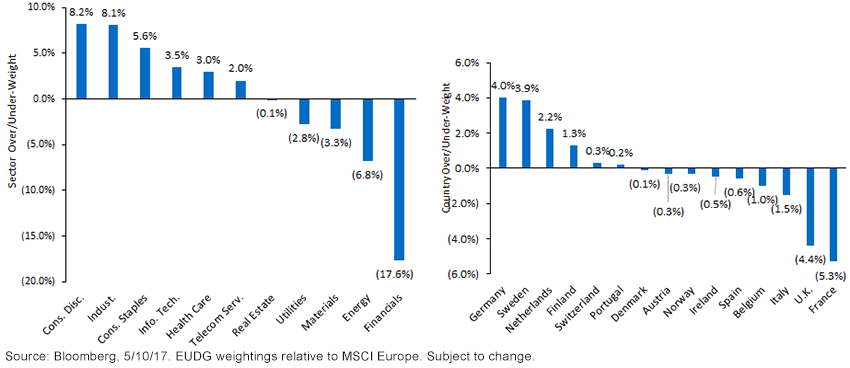
With that in mind, investors should consider that the MSCI Europe Index currently has a 21% weight to the Financials sector. Compare that to the WisdomTree Europe Quality Dividend Growth Fund (EUDG), which is under-weight in Financials by 17.6%.3 The Energy, Materials and Utilities sectors are also significant under-weights.
On the other hand, Consumer Discretionary, Industrials and Consumer Staples are the more significant over-weights.
Understanding EUDG’s Exposures relative to the MSCI Europe Index
Quality and Growth Screens
The index that EUDG tracks selects companies for inclusion based on a 50-50 split that weights quality, represented by return on equity (ROE) and return on assets (ROA), and growth, based on expected earnings growth forecasts. This quality factor was constructed to incorporate profitable companies, as measured by ROE, that are not overly levered as measured by ROA. Financial institutions have a high degree of leverage, and are therefore given a limited weighting in EUDG. The similarly levered Energy sector, another industry with a high degree of uncertainty due to the direction of crude oil prices, is under-weight 6.8%.
The top sectors in which EUDG is currently over-weight—Consumer Discretionary and Industrials—are more cyclical sectors that could benefit from improved European and global economic growth.
Avoiding the “Sick Man of Europe”
EUDG has benefited year-to-date from being under-weight in France, the United Kingdom and Italy, three countries that still have big question marks lingering over long-term economic growth prospects.
Europe has long been a market of haves and have-nots. Northern Europe versus Southern Europe. Continental Europe versus the U.K. Avoiding the losers of the European economic recovery may be just as important as picking the winners.
But What about Growth?
Investors comparing the U.S. bull market to the current European experience may be thinking, “What has performed better than growth?” This is an important consideration, one that EUDG addresses with its tilt toward the growth factor bundled within a quality tilt. Rather than investing in growth stocks that are not tilted toward some measure of value, such as consistent dividend payments, EUDG tilts toward companies with high earnings growth forecasts, with expectations of also returning the highest dividend growth.
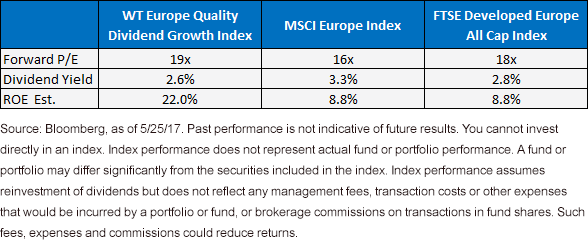
When we look at the valuations underlying EUDG’s index, we see P/E ratios that sell at a small premium —approximately 1 to 3 P/E multiple points higher compared to the MSCI Europe Index or the FTSE Developed Europe All Cap Index, and the dividend yields tend to be about 20 to 70 bps lower. But the key differentiator is quality characteristics. Bloomberg ROE estimates show 22.0% for the WisdomTree Europe Quality Dividend Growth Index versus 8.8% for both the MSCI and FTSE European indexes. ROE is a key variable that leads to better investment returns over long periods of time, and it’s a variable Warren Buffett often describes as one of his main focal points for acquiring companies. With ROE advantages likely occurring in the quality dividend growth index, and with P/E multiples being very similar, we’d say quality offers an attractive relative opportunity set over the longer-run.
1Source: Bloomberg, 5/25/17.
2Source: “American Banks Have Recovered Well; Many European Ones Much Less So,” The Economist, 5/6/17.
3Source: Bloomberg, 5/10/17.
Important Risks Related to this Article
There are risks associated with investing, including possible loss of principal. Foreign investing involves special risks, such as risk of loss from currency fluctuation or political or economic uncertainty. This Fund focuses its investments in Europe, thereby increasing the impact of events and developments associated with the region which can adversely affect performance. Dividends are not guaranteed and a company currently paying dividends may cease paying dividends at any time. Investments in currency involve additional special risks, such as credit risk and interest rate fluctuations. As this Fund can have a high concentration in some issuers, the Fund can be adversely impacted by changes affecting those issuers. The Fund invests in the securities included in, or representative of, its Index regardless of their investment merit and the Fund does not attempt to outperform its Index or take defensive positions in declining markets. Please read the Fund’s prospectus for specific details regarding the Fund’s risk profile.
Investments focusing on certain sectors and/or smaller companies increase their vulnerability to any single economic or regulatory development. This may result in greater share price volatility.
Categories
About the contributor

Director, Research
Matt Wagner joined WisdomTree in May 2017 as an Analyst on the Research team. He currently serves as a Director, where he supports the creation, maintenance, and reconstitution of WisdomTree’s indexes and actively managed ETFs. Matt began his career at Morgan Stanley, working as an analyst in Treasury Capital Markets from 2015 to 2017, focusing on unsecured funding planning, execution, and risk management. He graduated magna cum laude from Boston College in 2015 with a B.A. in International Studies, concentrating in Economics. In 2020, he earned a Certificate in Advanced Valuation from NYU Stern. He is also a Chartered Financial Analyst (CFA) charterholder.