

A Surprising Quality Discount in the U.S.
Published September 15, 2016

Global Chief Investment Officer
Looking around the globe today, with interest rates in Europe and Japan at depressed, even negative yields, global investors are searching near and far to achieve positive cash flows from their assets. This global hunt for yield has implications across a variety of asset classes, creating a surprising valuation discrepancy in the U.S. dividend-focused market. The surprise is that quality stocks in the U.S. are trading at a discount valuation multiple compared to high-dividend stocks, while in the international markets—both developed and emerging markets—they are trading at a more significant premium valuation multiple that is warranted. To set up this analysis, we’ll discuss WisdomTree’s two distinct dividend strategies that are focused on opposite sides of the dividend market in every region: “High Dividend”: In the spirit of the name, WisdomTree high-dividend Indexes sort their respective universes by the dividend yield and select the top 30% of dividend payers by their current dividend yield. The goal for these Indexes is to create more dividend-oriented cash flow today.1 “Quality Dividend Growth”: With a forward-looking set of stock selection factors, these Indexes try to identify companies that can grow dividends in the future. These Indexes use a combination of "quality" screens—historical three-year return on equity (ROE) and return on assets (ROA) combined with the expected earnings growth over the longer term. While still weighting indexes by their cash dividends, these Indexes seek growth of dividends instead of current yield.2 When one screens for quality and growth factors, our expectation is that one should pay a higher price-to-earnings (P/E) multiple for these stocks. Businessman and investor Charlie Munger3 has a great explanation for why companies with higher returns on capital (i.e., our quality Indexes’ ROE screen) should justify a higher valuation:
Over the long term, it’s hard for a stock to earn a much better return than the business which underlies it earns. If the business earns 6% on capital over 40 years and you hold it for that 40 years, you’re not going to make much different than a 6% return—even if you originally buy it at a huge discount. Conversely, if a business earns 18% on capital over 20 or 30 years, even if you pay an expensive looking price, you’ll end up with a fine result.4—Charlie Munger What is interesting across the global markets, you find that quality dividend indexes in emerging markets or the developed world, there is a significant quality premium over the high-dividend segments in the market currently. The quality premium Price to Earnings (P/E) multiple in the developed world is 31%, and the premium P/E multiple in the emerging markets is 39%.5 Given the high returns on capital these quality companies are generating, one might be able to justify even further valuation premiums. But still there is a premium, and that is natural. In the U.S., however, quality stocks are actually trading at a 13% discount compared to U.S. high-dividend stocks. To me, this represents one of most interesting valuation opportunities in the global markets today. The WisdomTree U.S. Quality Dividend Growth Index might be among the most undervalued segments of the U.S. market compared to other opportunities, in my view.
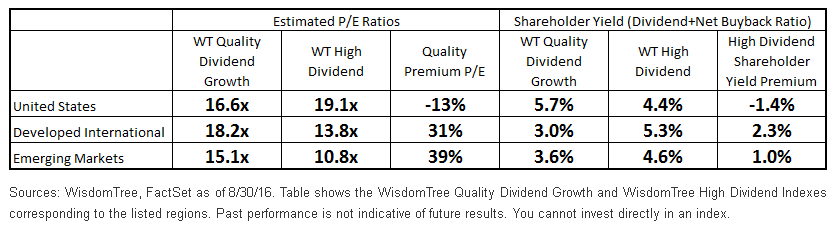
Looking Beyond P/E Ratios for Valuation Levels: Dividend + Net Buybacks If one combines the dividend and net buybacks, this is a measure of total shareholder distributions that can also be used to evaluate the various markets. Given the higher growth profiles of the quality Indexes, one should expect high- dividend stocks to have a higher total shareholder yield. • In the developed international markets, the high dividend shareholder yield premium is currently over 2 percentage points ahead of the quality dividends, and in the emerging markets, this premium is 1 percentage point. • But in the U.S., the quality dividend growth index actually had a 1.4% total shareholder distribution advantage over the high-dividend strategy. • This advantage for quality stocks was primarily driven by the higher buyback ratio of this index Index (with net buybacks over 3% and dividend yield over 2%), compared to the 3.8% dividend and 0.5% buyback ratio of the high-dividend stocks. To summarize: the global search for yield has flooded the U.S. markets with investors seeking the potential safety of high-dividend stocks. While these stocks may continue to perform well if we have a further declining interest rate environment or we experience more market volatility—say from the U.S. presidential election results—I’d say that from a pure valuation perspective, I would prefer U.S. quality stocks as the most undervalued segment of the U.S. markets today. 1References the following Indexes: the WisdomTree High Dividend Index, the WisdomTree International High Dividend Index and the WisdomTree Emerging Markets High Dividend Index. 2References the following Indexes: the WisdomTree U.S. Quality Dividend Growth Index, the WisdomTree International Quality Dividend Growth Index and the WisdomTree Emerging Markets Quality Dividend Growth Index. 3Charlie Munger is best known for his position as the vice chairman of Berkshire Hathaway. 4From a speech Munger gave in 1995, available here. 5 Source: WisdomTree, FactSet as of 8/30/16.
Important Risks Related to this Article
Dividends are not guaranteed, and a company currently paying dividends may cease paying dividends at any time.
Categories
About the contributor

Global Chief Investment Officer
Jeremy Schwartz has served as our Global Chief Investment Officer since November 2021 and leads WisdomTree’s investment strategy team in the construction of WisdomTree’s equity Indexes, quantitative active strategies and multi-asset Model Portfolios. Jeremy joined WisdomTree in May 2005 as a Senior Analyst, adding Deputy Director of Research to his responsibilities in February 2007. He served as Director of Research from October 2008 to October 2018 and as Global Head of Research from November 2018 to November 2021. Before joining WisdomTree, he was a head research assistant for Professor Jeremy Siegel and, in 2022, became his co-author on the sixth edition of the book Stocks for the Long Run. Jeremy is also co-author of the Financial Analysts Journal paper “What Happened to the Original Stocks in the S&P 500?” He received his B.S. in economics from The Wharton School of the University of Pennsylvania and hosts the Wharton Business Radio program Behind the Markets on SiriusXM 132. Jeremy is a member of the CFA Society of Philadelphia.