

What’s hot: Which party will industrial metals attend?
Published 15 July 2022

While the Federal Reserve, European Central Bank and other developed world central banks are removing the punch bowl from the party, the People’s Bank of China (PBOC) is serving the Baijiu . Industrial metal prices could lift as they move to the afterparty.
Developed world central banks removing the punchbowl
Increasing fears of an economic recession are weighing on commodity prices as many developed nations’ central banks rev up their fight against inflation. As hawkish central bank headlines dominate the press, commodity prices are increasingly ignoring the underlying tightness in supply of many commodities. The US June 2022 Consumer Price Index inflation print from last week, which surprised once again to the upside, has increased the market’s conviction that the US Federal Reserve will raise Fed fund rates by anywhere between 75 and 100 basis points when the Federal Open Market Committee convenes on July 27th. The European Central Bank is likely to exit negative interest rates by September and commence its first increase in the Refi rate since 2011.
PBOC serving the Baiju
But while many investor’s eyes are focused on these developed market central banks, the People’s Bank of China has been loosening its monetary policy setting for several months. China has been grappling with slower economic growth for most of this year due to the country’s zero COVID policy. Q2 2022 grew only by 0.4% y-o-y, missing the 1.2% expectations and 4.8% from the prior quarter. Hence the central bank has been easing policy for some time. That effort is starting to show in aggregate financing to the real economy (Figure 1) . Not only was the reading higher in June 2022 than the average since 2017, but it is also close to the reading from March 2020 when extraordinary efforts were made to help avert the Chinese economy falling off a cliff when COVID-19 became a global pandemic.
Source: WisdomTree, Bloomberg, January 2017 – June 2022 Historical performance is not an indication of future performance and any investments may go down in value
Metal demand to rise
Historically, a boost in aggregate financing to the real economy in China has been accompanied by a boost in demand for metals. Figure 2 illustrates the case for China’s copper demand. Given that China accounts for more than 50% of demand for copper, nickel, zinc and aluminium , this is meaningful for the supply-demand balance of all metals used in infrastructure.
Source: WisdomTree, Bloomberg, Aggregate financing to real economy: January 2017 – June 2022, China refined copper demand: January 2017 – March 2022 Historical performance is not an indication of future performance and any investments may go down in value
China’s government encouraging more infrastructure spending
In addition to central bank policy loosening, the government has been also providing stimulus. In April 2022, President Xi called for an “all-out” effort to construct infrastructure. Proposed projects ranged from waterways and railways to facilities for cloud computing. Back in April however, words felt cheap. Today, we are seeing evidence of government financing support. In July 2022 media reports claimed China’s Ministry of Finance is considering allowing local governments to sell 1.5 trillion yuan ($220 billion) of special bonds in the second half of this year. These special bonds are traditionally used to raise money for infrastructure spending. In aggregate, according to Bloomberg calculations, China is making 7.2 trillion yuan (US$1.1 trillion) available for infrastructure spending. That represents a decisive move away from the focus on debt control from last year.
China government support for infrastructure spending
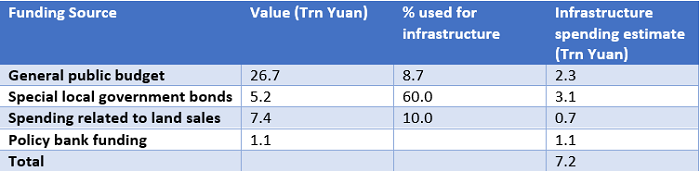
Source: Bloomberg calculations based on official statements and reporting. Refer to government backed funds only Historical performance is not an indication of future performance and any investments may go down in value
Conclusion
While China faces several challenges ranging from falling property sales to private market reluctance to invest in infrastructure during uncertain times, we believe the strong lift in aggregate financing to the real economy and government support for financing infrastructure bode well for an infrastructure rebound. Along with that will be a boost for metal demand. China’s outsized presence in metal demand will be felt in prices once the initial shock of developed market central bank hawkishness abates.
1 Baijiu, a traditional alcoholic drink from China is the most-consumed distilled spirit in the world (Source: https://londonspiritscompetition.com/en/blog/insights-1/baijiu-the-most-commonly-consumed-spirit-in-the-world-198.htm#:~:text=Research%20shows%20that%20when%20put,highest%20volume%20spirit%20consumed%20globally.)
2 Total social financing (TSF) refers to the aggregate volume of funds provided by China’s domestic financial system to the private sector of the real economy within a given timeframe. It includes financing from the following 10 sources: RMB loans; Foreign currency loans; Entrusted loans; Trust loans; Undiscounted bank bills of acceptance; Corporate bonds; Non-financial corporate domestic equity financing; Insurance company repayments; Investment property; Financing via other financial instruments.
3 Source: IMF Special Focus Report 2018: Changing of the Guard - Shifts in Industrial Commodity Demand
Categories
About the contributor

Head of Commodities and Macroeconomic Research, WisdomTree Europe
@NiteshShahWTNitesh Shah is a seasoned financial professional with over 24 years of experience in research and investment strategy. As Head of Commodities & Macroeconomic Research at WisdomTree Europe, he leads market analysis and insights across asset classes, with a focus on commodities and exchange-traded products. Previously, he held roles at Moody’s, HSBC Investment Bank, The Pension Protection Fund, and Decision Economics, building expertise in market analysis and strategy. Nitesh earned a master’s degree in International Economics and Finance from Brandeis University and a bachelor's in Economics from the London School of Economics. His insights are frequently featured in financial media, and he is a sought-after speaker at industry events. He also hosts the ‘Commodity Exchange’ podcast, where he discusses trends shaping global markets. Passionate about guiding investors, Nitesh provides actionable insights to help them navigate complex financial landscapes.