
WDEF LN
WisdomTree Europe Defence UCITS ETF - EUR Acc

Published 4 April 2025

For decades, the United States has enjoyed a status of economic exceptionalism, attracting a disproportionate share of global capital relative to the size of its economy. For instance, the U.S. accounts for approximately 72.92% of the MSCI World Index and 66.41% of the MSCI ACWI Index—both market-cap-weighted—despite contributing only 26.3% to global GDP.
U.S. exceptionalism refers to the belief that the United States possesses unique economic strengths that make it a standout—or even superior—environment for innovation, growth, and long-term investment compared to other nations. This idea has historically served both as an investment narrative and as a reflection of real structural advantages within the U.S. economy.
Key Drivers of This Perception:
Historic Implications of
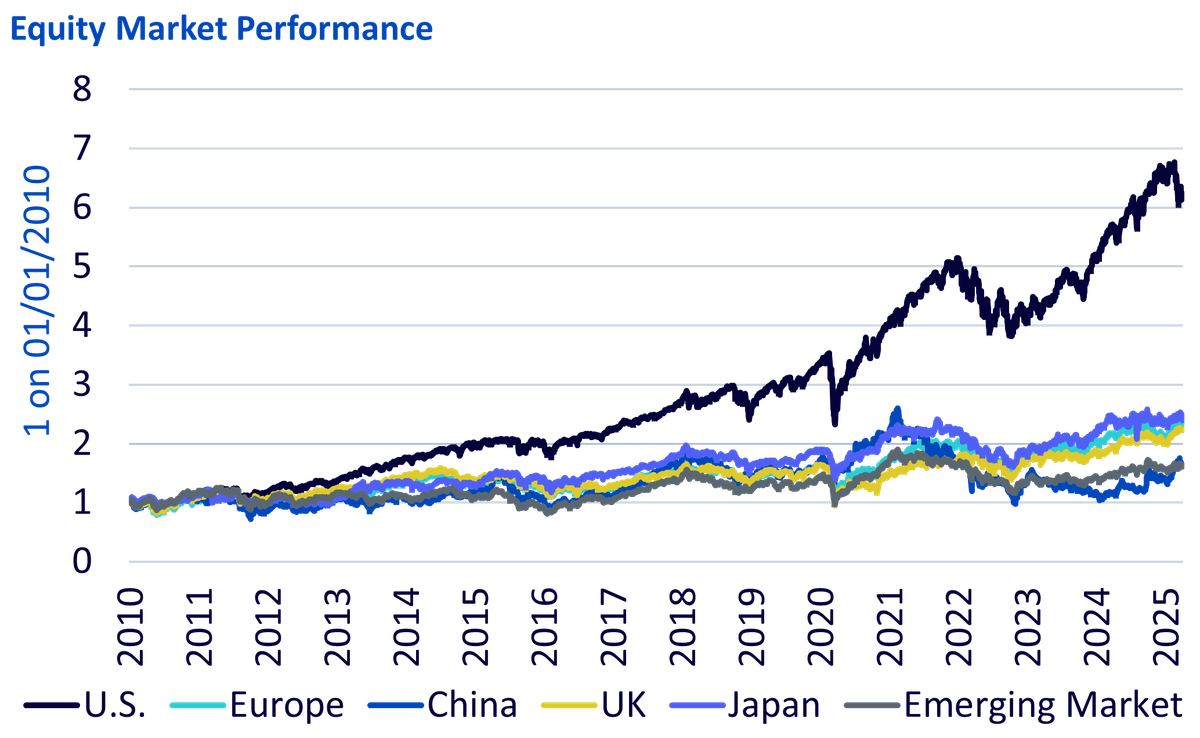
Source: Bloomberg, WisdomTree. 01/01/2010 to 03/04/2025. Based on MSCI Net Total Return USD Indices. Historical performance is not an indication of future performance and any investments may go down in value.
Lately, international investors are beginning to challenge this long-held belief. These doubts have been compounded by erratic policy moves from the current U.S. administration. The reduction of U.S. security commitments globally and a pivot toward protectionist or mercantilist trade policies have unsettled traditional allies and investors alike.
In particular, the U.S. drawdown of international security support has led many European nations to abandon prior budgetary constraints and accelerate defence spending in pursuit of military rearmament.
European governments are not making short-term, reactionary purchases—they are redesigning their defence strategies for the long term. Germany’s €100 billion special fund is set to be fully allocated by 2027, and France, Poland, and the UK have committed to record military budgets. Europe has historically relied on U.S. defence contractors for high-end military technology, but policy changes are prioritizing domestic suppliers. Reflecting investor confidence in this strategic shift, the WisdomTree Europe Defence UCITS ETF has garnered US$817mn in inflows in the first 16 trading days since its launch on 11 March 2025.
Meanwhile, U.S. tech dominance is also under scrutiny. The emergence of China’s DeepSeek—a more cost-efficient AI model—has sparked fresh scepticism over the valuations of high-flying U.S. chipmakers like Nvidia. These valuations have been predicated on the belief that U.S. firms would maintain pricing power for longer than may now seem realistic.
Additionally, the U.S. dollar is losing some of its traditional “flight to safety” appeal. Following the announcement of new tariffs on April 2, 2025, which heightened fears of a slowdown in global growth, the U.S. Dollar Index (DXY) fell 2.5% within just 18 hours.
U.S. equity benchmarks have significantly underperformed their international counterparts year-to-date. As of the latest data, U.S. indices have lagged Europe by 13.6% and China by 19.3%.
While part of this divergence could be attributed to cyclical factors, there is growing concern among investors about a structural shift—one that may signal a closing of the performance gap between the U.S. and the rest of the world.
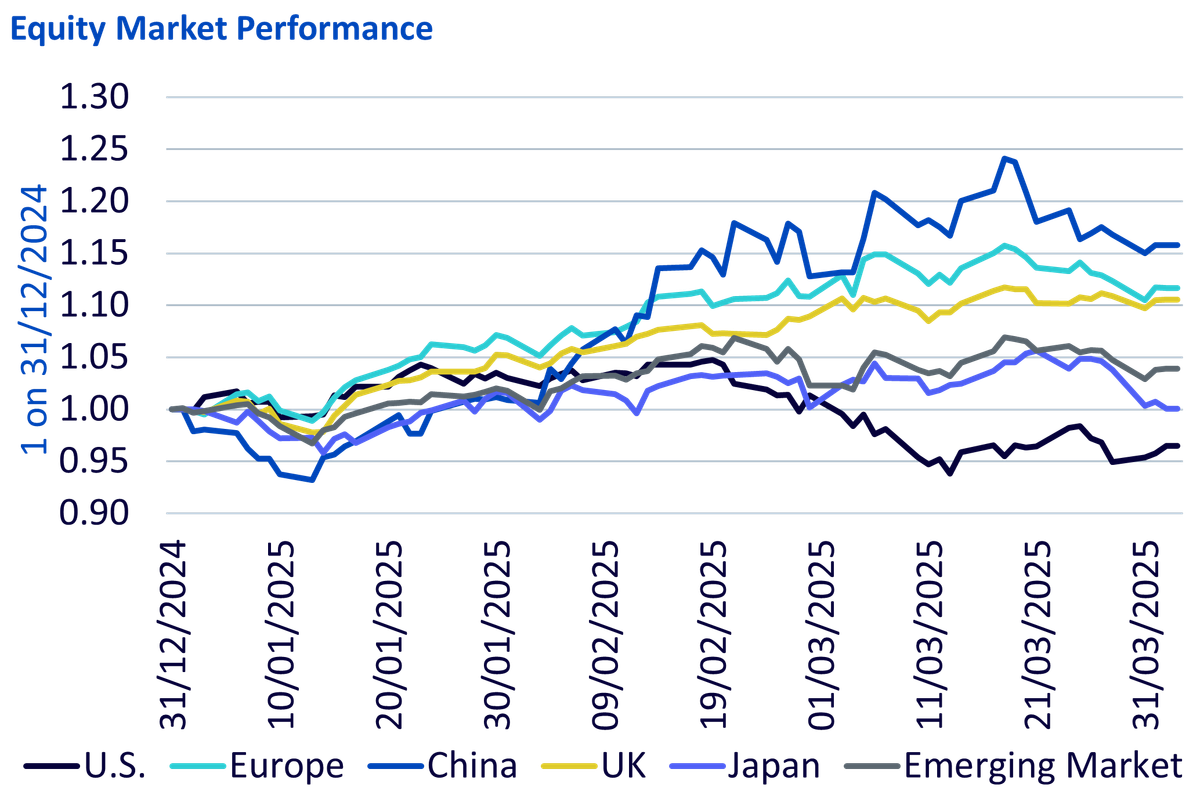
Source: Bloomberg, WisdomTree. 31/12/2024 to 03/04/2025. Based on MSCI Net Total Return USD Indices. Historical performance is not an indication of future performance and any investments may go down in value.
Investor behaviour reflects these changing dynamics. European ETF investors, in particular, have been reallocating capital from U.S. to European funds, as shown in the table below:
Asset Class | 1 week flow | 1 month flow | 3 months flow | 1 year flow |
|---|---|---|---|---|
US equities | 0.140bn | (1.6bn) | 8.3bn | 102.7bn |
European equities | 2.1bn | 15.5bn | 29.3bn | 38.1bn |
Source: Bloomberg, as of 03 April 2025, flows in USD. Flows are shown for all ETFs listed in Europe. Figure shown in brackets is negative.
The decades-long narrative of U.S. economic exceptionalism is increasingly being questioned. A combination of policy unpredictability, weakening global alliances, and growing competition—especially in key sectors like technology—has eroded some of the confidence that underpinned U.S. dominance.
As non-U.S. equity markets outperform and global investment flows rebalance, European ETFs are beginning to see renewed attention. The shift may signal not just a short-term rotation, but a broader reassessment of global investment priorities.

Head of Commodities and Macroeconomic Research, WisdomTree Europe
@NiteshShahWTNitesh Shah is a seasoned financial professional with over 24 years of experience in research and investment strategy. As Head of Commodities & Macroeconomic Research at WisdomTree Europe, he leads market analysis and insights across asset classes, with a focus on commodities and exchange-traded products. Previously, he held roles at Moody’s, HSBC Investment Bank, The Pension Protection Fund, and Decision Economics, building expertise in market analysis and strategy. Nitesh earned a master’s degree in International Economics and Finance from Brandeis University and a bachelor's in Economics from the London School of Economics. His insights are frequently featured in financial media, and he is a sought-after speaker at industry events. He also hosts the ‘Commodity Exchange’ podcast, where he discusses trends shaping global markets. Passionate about guiding investors, Nitesh provides actionable insights to help them navigate complex financial landscapes.

