
BTCW LN
WisdomTree Physical Bitcoin

Published 9 June 2026

Director, Digital Assets Research
In nature, the most prosperous islands are not the isolated ones.
They are the islands bursting with plant life, birds, insects, trade routes, migration paths, and fertile connections to the mainland. They attract new species, sustain complex ecosystems, and continuously adapt to changing conditions. The island becomes valuable not because it exists, but because life chooses to build there.
Successful blockchains operate in much the same way. The crypto industry often talks about blockchain technology as if technical specifications alone determine success. Faster throughput. Lower fees. Better consensus mechanisms. However, history shows that infrastructure by itself is rarely enough.
A blockchain succeeds when it becomes an ecosystem.
Many blockchains today resemble remote islands with pristine beaches but no inhabitants. Technically impressive, but quiet and empty.
Developers do not build there. Users do not stay there. Capital does not circulate there. Applications launch, but economic activity fails to compound. The ecosystem lacks biodiversity.
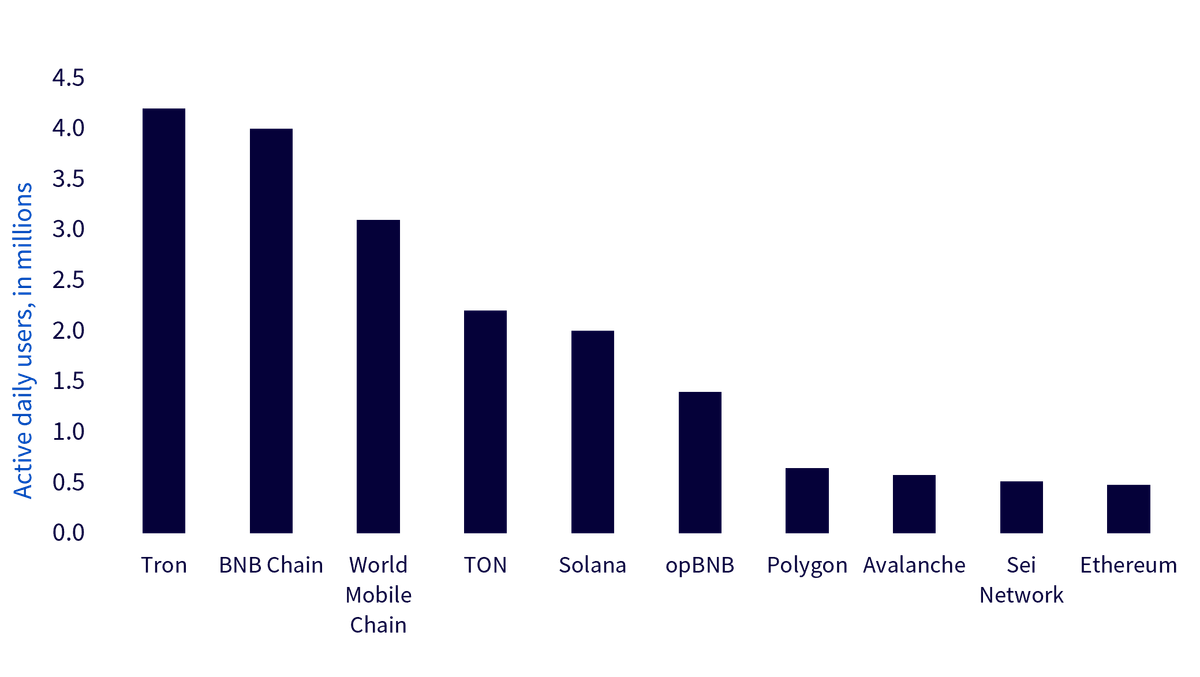
Source: Token Terminal. As at 29 May 2026. Historical performance is not an indication of future performance, and any investment may go down in value.
In blockchain terms, biodiversity means:
Without these layers of activity, a blockchain risks becoming economically sterile.
A thriving island contains interconnected systems. Birds spread seeds. Plants sustain insects. Insects feed larger animals. Nutrients circulate through the environment. Diversity creates resilience.
The same dynamic exists within blockchain ecosystems. Ethereum’s success, for example, was not solely driven by its smart contract capability. Its strength emerged from the interaction between developers, decentralised finance, institutional infrastructure, exchanges, custodians, and liquidity providers.
Each participant reinforced the network:
This is network compounding.
Importantly, ecosystems with greater diversity tend to survive shocks more effectively. When one application fails, others continue operating. When one narrative weakens, another emerges. The blockchain becomes less fragile.
The healthiest islands are rarely the most isolated. They trade with the mainland, exchange resources and attract visitors and migration flows. Connectivity enables survival.
This principle is becoming increasingly important in crypto. Early blockchain communities often pursued a vision of self-sufficiency; the idea that a single chain could dominate and operate largely in isolation. But the industry is evolving towards interoperability, recognising that connectivity creates stronger and more resilient networks.
Today, successful blockchains increasingly behave like economic hubs connected through bridges, messaging protocols and shared liquidity layers. A blockchain disconnected from the broader ecosystem risks becoming economically stranded.
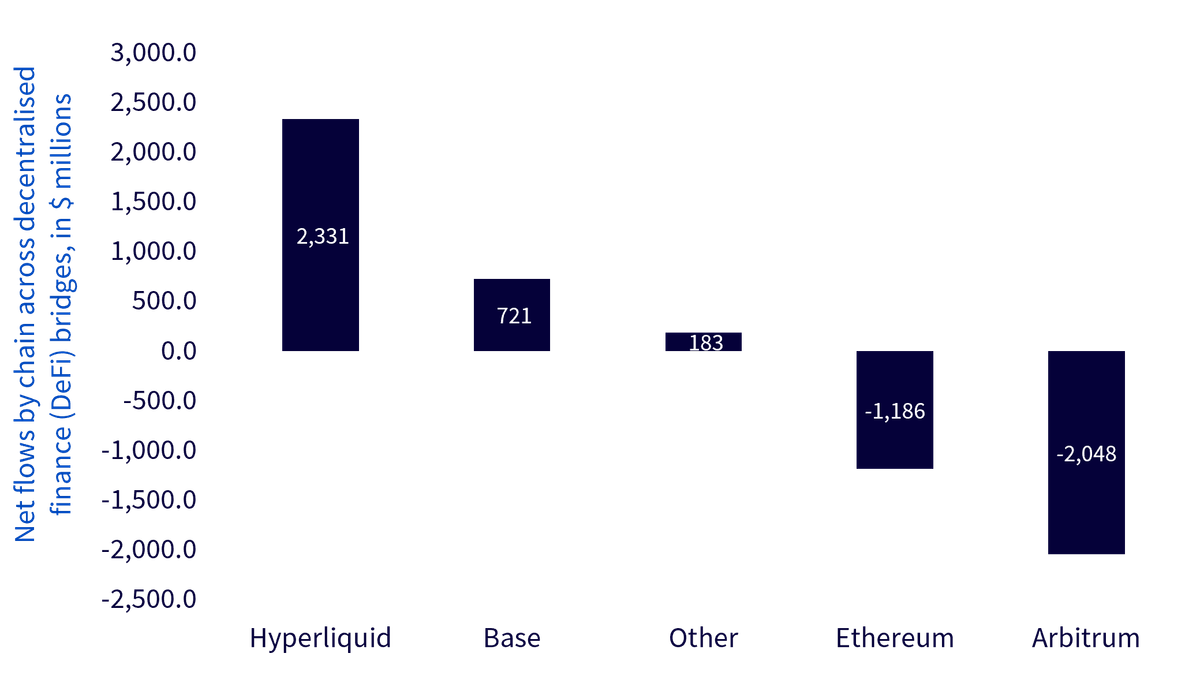
Source: Artemis Terminal. As at 29 May 2026. Historical performance is not an indication of future performance, and any investment may go down in value.
This is why interoperability infrastructure has become strategically important. Cross-chain bridges, token standards and interoperability protocols are not peripheral innovations; they are trade routes.
Capital wants mobility. Users want flexibility. Developers want access to the largest possible audience. The chains that facilitate these flows may be better positioned to attract sustained activity.
An empty airport is still empty infrastructure. The same is true for blockchains.
Low transaction fees and high throughput can improve the user experience, but they do not guarantee adoption. Economic gravity emerges when networks create opportunities for participants to coordinate, transact and build wealth together.
This distinction explains why some chains experience explosive early growth but struggle to retain activity over time.
Temporary incentives can attract tourists. Only strong ecosystems create permanent residents.
The blockchain industry is now entering a more mature phase where investors are increasingly evaluating the quality of on-chain economics rather than simply headline transaction metrics. They ask:
The answers to these questions illustrate ecological health.
The next phase of blockchain development may not produce a single dominant island. Instead, crypto increasingly resembles an archipelago: multiple specialised ecosystems connected through shared infrastructure.
Bitcoin may function as a monetary bedrock. Ethereum may continue operating as the largest financial settlement layer. Other chains may specialise in gaming, payments, tokenisation, or high-frequency applications.
The networks that ultimately succeed may not necessarily be the most isolated chains. They are more likely to be the networks that combine:
In nature, thriving islands do not survive because they wall themselves off from the world. They survive because life flows through them. The same may ultimately prove true for blockchains.
While ecosystem growth and network effects can support blockchain adoption, there is no guarantee that current leaders will maintain their positions. Blockchain networks face risks including technological change, cybersecurity incidents, regulatory developments, competition from alternative protocols, and shifts in user and developer activity. Digital asset markets can be highly volatile, and changes in network participation or liquidity may affect the long-term viability of individual blockchain ecosystems.

Director, Digital Assets Research
Dovile Silenskyte is a director of digital assets research at WisdomTree. Before joining WisdomTree in May 2024, Dovile worked as an index equity product strategist at BlackRock. Currently, she is responsible for conducting analyses for in-house digital assets publications and assisting the sales team with client queries about products and markets. Dovile holds an MSc in Finance from Texas A&M University – Commerce, and she is also a chartered financial analyst (CFA).
