

Robots are already amongst us
Published 10 November 2022

Global Head of Research
Elon Musk has continued to make headlines throughout 2022. As the CEO of Tesla and SpaceX, and the individual with the world’s highest net worth (at time of writing), it is hard to ignore his impact. Though news about Twitter has swamped the latest coverage, we were paying particular attention to Tesla’s ‘AI Day’.
A humanoid robot for under $20,0001
Tesla introduced Optimus to kick off the 2022 event. Importantly, even if a lot of progress has been made when measured on a year-on-year basis, this robot is not yet capable of acting anything like a regular person or performing job functions in full. Within robotics, the things that humans find easiest—walking, balancing, picking up simple objects—is precisely the stuff that robots find the hardest. Having perfect recall of all the world’s information, or processing power to do nearly any reasonable calculation, is much more easily within the robotic wheelhouse and, similarly, much harder for the human.
As is the case with many Tesla products, it will be important to continue to monitor the exponential progress that these technologies can take. We might think that robots like this could potentially lift heavy things, work in dangerous parts of factories or perform other higher risk functions, but technological history has many examples of new use cases emerging once something is deployed at scale. Optimus and other similar products may lead in directions we haven’t yet imagined.
2021 sees robotic installations hitting record highs
The International Federation of Robotics has an extensive array of information available for anyone seeking to learn more about different trends in the field of robotics. In Figure 1, we can see2:
- 2021 saw 31% year-on-year growth in installations of industrial robots across the globe.
- 2021 was the first year where the annual installations of industrial robots surpassed 500,000 units.
- If one looks instead at the trend of growth for the period from 2016 to 2021, there was a clear trend of 11% annualised growth. This was by no means a straight line—after 2018’s figure of 423,000 installations, 2019 and 2020 both dropped back below 400,000. In a sense, it appears that the 2021 figure of 517,000 re-establishes the trend of growth.
Figure 1: Industrial robot installations have expanded significantly from 2011 to 2021
Source: “Welcome to the Presentation of World Robotics 2022.” International Federation of Robotics. 2022. (accessed via: https://ifr.org/downloads/press2018/2022_WR_extended_version.pdf)
China has a huge robotic workforce
China is at the forefront of many geopolitical discussions as we write these words. The 2022 Party Conference on its own is an historic event, and we are also dealing with the ramping up of semiconductor export restrictions from the US, the continuation of ‘zero-Covid’ lockdowns and even speculations about what might or might not be in store for the ‘Taiwan Question’.
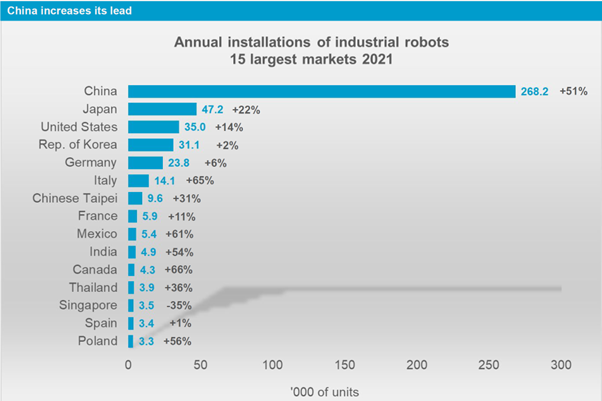
Still, Figure 2’s image comes across as rather stark. Prior to consulting the data, most people probably wouldn’t expect that China has the most industrial robotic installations—Japan or South Korea tend to be cited more often. Yet3:
- China had 268,200 industrial robotic installations in 2021—more than half of the total number of global installations at 517,000 cited from Figure 1.
- Japan is certainly a major market and was in the number 2 ranked position—but the drop from 268,200 to 47,200 is significant.
- China had 97,000 installations in 2016, whereas the rest of the world had 207,000. 2021 marked the shift where China had more installations than the rest of the world, after significant growth over the past five years.
- One of the more exciting growth industries was Automotive, where in 2020 China had 31,000 installations and 2021 had 62,000 installations. We know that electric vehicles and smart cities are a major focus in China, and it’s clear that this can be part of that investment effort.
Figure 2: China is a market leader in industrial robotic
Source: “Welcome to the Presentation of World Robotics 2022.” International Federation of Robotics. 2022. (accessed via: https://ifr.org/downloads/press2018/2022_WR_extended_version.pdf)
Service robots could be the bigger market
Industrial robots are certainly important and should continue to grow, but there is a broad range of possibilities for ‘service robots’. One can think of service robots as any robot that is not bolted to a factory floor4. In 2022, when it is difficult to fill certain types of jobs, service robots could be the ones that are more useful in this context.
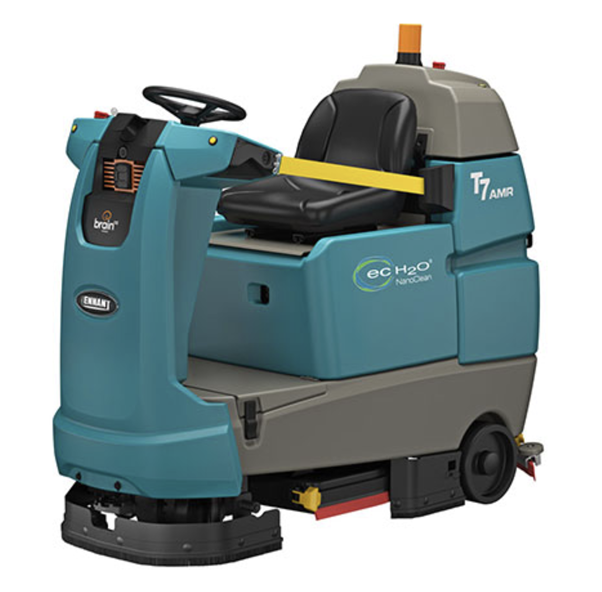
Figure 3 shows one concrete example of a robot that is being deployed presently to help in cleaning floors. In a tight labour market, companies may find it difficult to hire for these jobs but it’s still important that this cleaning is executed. The Tennant Co. T7AMR Robotic Floor Scrubber is sold with a specific eye toward appealing to an array of current concerns. The sales website indicates helping to address:
- Labour Challenges—we know it is difficult to hire for these types of workers in the fourth quarter of 2022.
- Safety—it is noted that the machine can be deployed safely in an environment alongside people.
- Environment—it is noted that the machine can use less detergent and less water, possibly appealing to the more environmentally conscious.
You might see this machine (or something similar) the next time you visit a local supermarket.
Figure 3: Tennant Co. T7AMR Robotic Floor Scrubber
Source: https://www.tennantco.com/en_us/1/machines/scrubbers/product.t7amr.robotic-floor-scrubber.M-T7AMR.html
Conclusion: robots represent opportunities for artificial intelligence and machine learning
We write frequently about artificial intelligence (AI) and machine learning, and we are always trying to present these as tools that provide real, tangible solutions rather than abstract algorithms. The floor scrubbing robot above is one such example, and it is noted that it is powered by BrainOS, an artificial intelligence software platform that powers the world’s largest fleet of autonomous mobile robots5. While cleaning the floor might seem like a straightforward task, we have to remember that the robot is also navigating, avoiding obstacles, adapting to changing environments (think—people moving around it), and more.
Even in a difficult economic environment and one that has seen challenging equity performance, we believe it is an interesting time to be thinking about these megatrends and companies like BrainOS seeking to deploy these technologies at scale.
1 Morris, James. “Tesla AI Day 2022: Musk Demonstrates Optimus Humanoid Robot for Under $20,000.” Forbes. 1 October 2022.
2 Source: “Welcome to the Presentation of World Robotics 2022.” International Federation of Robotics. 2022.
3 Source: “Welcome to the Presentation of World Robotics 2022.” International Federation of Robotics. 2022.
4 Source: Mims, Christopher. “Meet the Army of Robots Coming to Fill In for Scarce Workers.” Wall Street Journal. 15 October 2022.
5 Source: https://braincorp.com/uk/brainos/
Related blogs
+ Can AI replace people? The truck-driving case study
Related products
+ WisdomTree Artificial Intelligence UCITS ETF – USD Acc (WTAI/INTL)
Categories
About the contributor

Global Head of Research
Christopher Gannatti began at WisdomTree as a Research Analyst in December 2010, working directly with Jeremy Schwartz, CFA®, Director of Research. In January of 2014, he was promoted to Associate Director of Research where he was responsible to lead different groups of analysts and strategists within the broader Research team at WisdomTree. In February of 2018, Christopher was promoted to Head of Research, Europe, where he was based out of WisdomTree’s London office and was responsible for the full WisdomTree research effort within the European market, as well as supporting the UCITs platform globally. In November 2021, Christopher was promoted to Global Head of Research, now responsible for numerous communications on investment strategy globally, particularly in the thematic equity space. Christopher came to WisdomTree from Lord Abbett, where he worked for four and a half years as a Regional Consultant. He received his MBA in Quantitative Finance, Accounting, and Economics from NYU’s Stern School of Business in 2010, and he received his bachelor’s degree from Colgate University in Economics in 2006. Christopher is a holder of the Chartered Financial Analyst Designation.