

Rates going up…maybe not so fast
Published 10 December 2018

Head of Investment and Fixed Income Strategy
When examining the fixed income market outlook within the Euro zone, inevitably the discussion turns to Italy, and what the potential ramifications of this ongoing budget saga will be. Of course, the direction of European Central Bank policy (ECB) is closely linked here, but if we were to turn our attention to the broader economic outlook, how would that discussion pivot? Based upon recent data, it appears as if the widely held view that interest rates are poised to move higher may have to be revisited.
That being said, it is not as if we don’t think that Euro zone rates will, at some point, move higher, but the timing and magnitude of any potential increase could ultimately impact investment decisions. As we saw in the US, the ‘runway’ for an elevated rate setting can be much longer than expected, and traditional factors such as growth, inflation and central bank policy, do not always move in tandem.
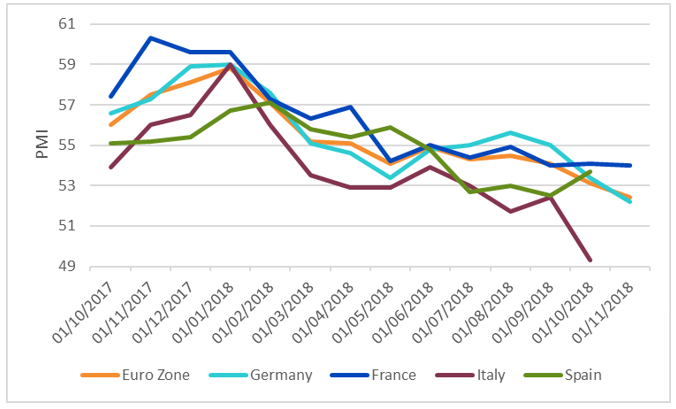
Figure 1: Euro zone Purchasing Managers Indices (PMI)
Historical performance is not an indication of future performance and any investments may go down in value.
With respect to Euro zone economic numbers, one could be easily forgiven for concluding that, perhaps, the peak in activity occurred last year. It’s not as if we are expecting a recession, but based upon recent data, a steady slowing in growth appears to be a potentially likely scenario. To provide some perspective, Euro zone real GDP rose up to +2.4% in 2017, but current consensus forecasts are looking for a reduced pace of +2.0% for this year and +1.7% for 2019.
The latest growth readings within the Euro zone certainly stood out, and not necessarily for positive reasons. German GDP came in at -0.2% in Q3 2018. This was weaker than expected and followed on the heels of a +0.5% gain in Q2 2018. In addition, it represented the first decline since 2015, and while it did reflect some temporary factors such as reduced auto production due to emissions testing, according to the statistics office, it was also the result of a drop in both exports and consumption. While the car production aspect could be reversed in upcoming data, the trade and consumption components certainly bear watching. For the Euro zone as a whole, growth also slowed to +0.2%, or half the pace of the prior period, and the lowest reading in four years.
Another important economic indicator to keep your eye on are the PMI reports. For the Euro zone and countries such as Germany, France, Italy and Spain individually, the readings seemed to have hit their peaks in late 2017/early 2018 and have been on a steady descent ever since (see figure 1). For the entire Euro zone, the latest figure fell to its lowest level in almost four years, highlighting the potential for further economic slowing.
Conclusion
Needless to say, this scenario has raised the debate regarding potential ECB action. While these numbers will more than likely not prevent the beginning of balance sheet normalization (expected to be announced at the 13 December 2018 policy meeting), it could push the ECB into a ‘later rather than sooner’ timetable for the first rate hike. For the record, the implied probability for this first rate hike has now been pushed out past October 2019, as of this writing.
Source of data unless stated otherwise: Bloomberg, 14 November 2018.
Related blogs
+ Will Eurozone bonds go ‘back to the future’?
+ Seeking to boost the yield on your Eurozone core fixed income exposure?
Related products
+ WisdomTree AT1 CoCo Bond UCITS ETF - USD Acc
+ WisdomTree EUR Aggregate Bond Enhanced Yield UCITS ETF - EUR
+ WisdomTree EUR Government Bond Enhanced Yield UCITS ETF - EUR
About the contributor

Head of Investment and Fixed Income Strategy
Kevin serves as the Head of Investment and Fixed Income Strategy. In this role, he writes macro and fixed income-related content and works closely with the sales, research and marketing teams. In addition, Kevin conducts client-facing webinars and meetings, providing expertise on WisdomTree’s existing and future bond ETFs. Prior to joining WisdomTree, Kevin spent 30 years at Morgan Stanley, where he was Managing Director and Chief Fixed Income Strategist for Wealth Management. He was responsible for tactical and strategic recommendations and created asset allocation models for fixed income securities. He was a contributor to the Morgan Stanley Wealth Management Global Investment Committee, primary author of Morgan Stanley Wealth Management’s monthly and weekly fixed income publications, and collaborated with the firm’s Research and Consulting Group Divisions to build ETF and fund manager asset allocation models. Kevin has an MBA from Pace University’s Lubin Graduate School of Business, and a B.S. in Finance from Fairfield University.