
WSDG LN
WisdomTree Global Sustainable Equity UCITS ETF - USD Acc

Published 19 June 2024

The drive towards sustainability is set to define a transformative era of economic growth, reshaping the investment landscape. This era of sustainability has ushered in a new business paradigm where profits and responsible practices go hand in hand. Sustainability is not just a passing trend but a fundamental necessity for businesses in the modern world.
Undoubtedly, the COVID-19 pandemic accelerated this trend as companies were awakened to the importance of sustainability in ensuring resilience and long-term success. Global supply chains today remain vulnerable to natural disasters and civil conflict. Supply chain shocks are known to account for around one-third of the strains in global production networks1. Embedded sustainability efforts result in a positive impact on business performance, encouraging companies to place sustainability at the core of their business strategy. Adopting sustainable practices yields a range of benefits, including cost reduction via responsible resource management, increased revenue, attracting and retaining talent, resilience, and brand loyalty. A study by Accenture showed that companies that invest in sustainable technologies can generate significant cost savings, such as a 12% reduction in energy costs and a 10% reduction in water costs2.
Back in 2015, world leaders came together and made a historic promise to secure the rights and well-being of everyone on a healthy, thriving planet when they adopted the 2030 Agenda for Sustainable Development and its 17 Sustainable Development Goals (SDGs) discussed here. The 17 SDGs, the cornerstone of the agenda, offer a roadmap towards a more sustainable economy and society by 2030. More than halfway to the SDG deadline, the United Nations (UN) report suggests that progress has been made since 2015, yet the world is not on track to achieve many SDGs by 2030. The political declaration of the 2023 SDGs summit showed a strong sense of policy continuity in still seeking to meet the SDGs within the 2030 timeline3. Looking ahead, prioritising SDGs will be a strategic necessity. A targeted and consolidated approach across government policies, corporate action, and investor decision-making should put the world back on track to achieve its SDG goals.
For investors seeking to align their investments with companies that prioritise sustainability, ethical practices, and transparent governance, WisdomTree presents its first sustainable core equity solution and SFDR Article 9 classified fund in collaboration with Irish Life Investment Managers (ILIM). The WisdomTree Global Sustainable Equity UCITS ETF (WSDG) seeks to provide access to companies from developed markets that positively contribute to social and environmental objectives. The strategy prioritises 11 of the 17 UN SDGs and uses a pillar-based approach to convert the 11 SDGs into four investable pillars.

Source: Irish Life Investment Managers, WisdomTree as of 31 May 2024
By integrating UN SDGs, investors align themselves with priorities that are supported by governments, international organisations, and civil society. In addition, the ETF also excludes companies based on environmental, social and governance (ESG) criteria. Therefore, the ETF allows investors to gain exposure to a global portfolio of developed market equities that holistically integrates the consideration of negative externalities and positive impacts.
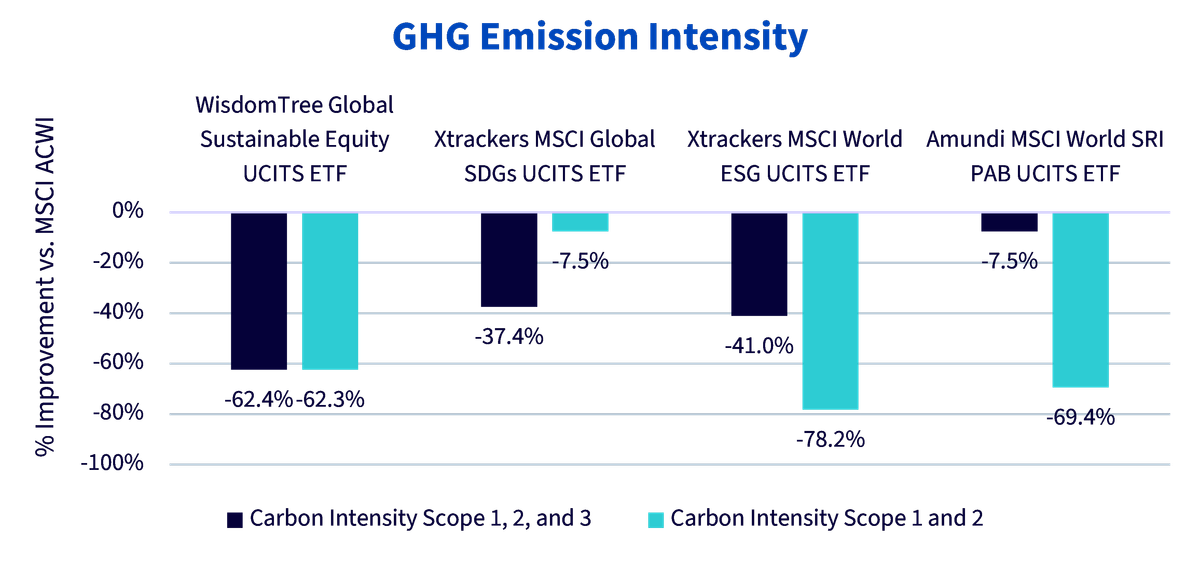
Take, for example, Greenhouse Gas (GHG) emissions, which are among some of the adverse indicators that we aim to reduce. We measure emissions across ‘scopes’. Scopes 1 and 2 measure operational carbon emissions, e.g., from heating or producing electricity. Scope 3 measures the ‘downstream’ emissions, i.e., those that originate from the usage of the final product.
As illustrated in the figure below, scope 1&2 carbon intensity (per revenue) is significantly lower in the MSCI World ESG UCITS ETF and emission-focused MSCI World SRI PAB UCITS ETF, which is expected as that is the key objective of such funds. The Scope 3 carbon intensity is lowest in WisdomTree Global Sustainable Equity UCITS ETF (WSDG), which indicates that the companies from WisdomTree Global Sustainable Equity UCITS ETF (WSDG) produce products whose use creates less carbon emissions per revenue.
Source: Solactive, Amundi, Xtrackers as of 30 April 2024. Historical performance is not an indication of future performance and any investments may go down in value.
The top three sector allocations in the WisdomTree Global Sustainable Equity UCITS ETF are (as illustrated below):
GICS Industry Group Breakdown | Weight |
|---|---|
Capital Goods | 20.7% |
Pharmaceuticals, Biotechnology and Life Sciences | 17.8% |
Semiconductors and Semiconductor Equipment | 15.3% |
Software and Services | 9.5% |
Technology Hardware and Equipment | 8.2% |
Materials | 6.0% |
Automobiles and Components | 5.8% |
Utilities | 3.7% |
Health Care Equipment and Services | 3.6% |
Food, Beverage and Tobacco | 2.1% |
Other | 7.2% |
Source: WisdomTree, Solactive, FactSet, Bloomberg. You cannot invest directly in an index. Historical performance is not an indication of future performance and any investments may go down in value.
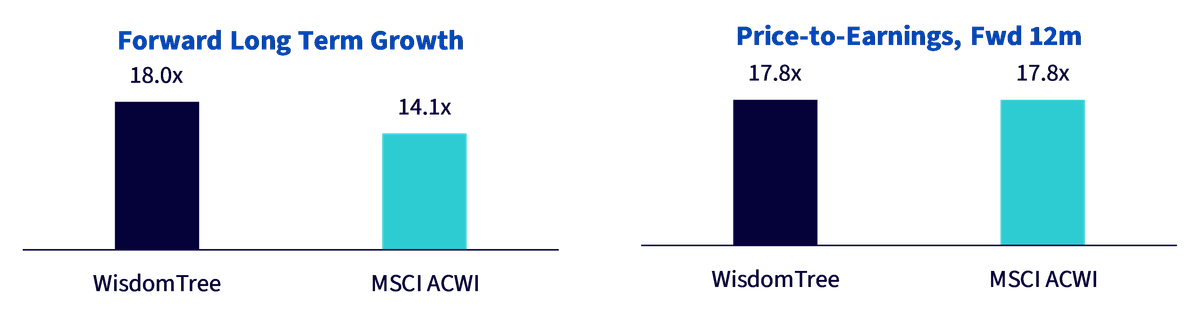
Owing to the high tilt to growth-oriented sectors in the WisdomTree Global Sustainable Equity UCITS ETF, the forward long-term growth estimate is higher at 18x versus the benchmark MSCI All Country World Index at 14.1x. While the valuation (price-to-earnings ratio) is at par with the benchmark at 17.8x.
Source: WisdomTree, Nasdaq, MSCI, FactSet, Bloomberg. Multiples as of 31 May 2024. Historical performance is not an indication of future performance.
1 European Central Bank Economic Bulletin Issue 8/2021
2 Accenture 2021 – High Tech Sustainability Strategies
3 UN General Assembly 18 September 2023
WisdomTree Global Sustainable Equity UCITS ETF - USD Acc

Director, Macroeconomic Research, WisdomTree Europe
@AneekaGuptaWTAneeka Gupta is Director of Research at WisdomTree. Prior to the acquisition of ETF Securities in April 2018, Aneeka worked as an Equity & Commodities Strategist at the company. Aneeka has 17 years of experience working as a Research Analyst across a wide range of asset classes. In her current role she is responsible for conducting analysis for all in-house equity, commodity and macro publications and assisting the sales team with client queries around products and markets. Prior to WisdomTree, Aneeka began her career as an equity analyst at Bear Stearns International Ltd in London. She also worked as an Equity Sales Trader at Sunrise Brokers across US and Pan European Exchanges. Before that she worked as an Equity Derivatives Sales Manager at Mashreq Bank in Dubai. Aneeka holds a Masters in Mathematics from Oxford University and a BSc in Mathematics from the University of Delhi, India. She is also a CFA Charterholder.
