

Markets embrace the Higher-for-Longer theme
Published 25 September 2023

It has been a big week of central bank policy announcements. While central banks in the US, UK, Switzerland, and Japan left key policy rates unchanged, the trajectory ahead remains vastly different. These central bank announcements were accompanied by a significant upward breakout in bond yields. Interestingly most of the increase in yields has been driven by higher real yields rather than breakeven inflation signifying a tightening of conditions. The bond markets appear to be acknowledging that until recession hits, yields are likely to keep rising.
Connecting the dots
The current stance of monetary policy continues to remain restrictive. The Fed’s dot plot, which the US central bank uses to signal its outlook for the path of interest rates, shows the median year-end projection for the federal funds rate at 5.6%. The dot plot of rate projections shows policymakers (12 of the 19 policymakers) still foresee one more rate hike this year. Furthermore, the 2024 and 2025 rate projections notched up by 50Bps, a signal the Fed expects rates to stay higher for longer.
The key surprise was the upgrade in growth and unemployment projections beyond 2023, suggesting a more optimistic outlook on the economy. The Fed’s caution is justified amidst the prevailing headwinds – higher oil prices, the resumption of student loan payments, the United Auto Workers strike, and a potential government shutdown.
Quantitative tightening continues on autopilot, with the Fed continuing to shrink its balance sheet by $95 billion per month. Risk assets such as equities, credit struggled this week as US yields continued to grind higher. The correction in risk assets remains supportive for the US dollar.
Figure 1: Fed’s Dot Plot – Summary of Economic Projections
Source: The Federal Reserve, WisdomTree as of 21 September 2023. Forecasts are not an indicator of future performance and any investments are subject to risks and uncertainties.
A hawkish pause by the Bank of England
In sharp contrast to the US, economic data has weakened across the board in the UK, with the exception of wage growth. The weakness in labour markets is likely to feed through into lower wages as discussed here. After 14 straights rate hikes, the weaker economic backdrop in the UK coupled with falling inflation influenced the Bank of England’s (BOE) decision to keep rates on hold at 5.25%. The Monetary Policy Committee (MPC) was keen to stress that interest rates are likely to stay at current levels for an extended period and only if there was evidence of persistent inflation pressures would further tightening in policy be required.
By the next meeting in November, we expect economic conditions to move in the MPC’s favour and wage growth to have eased materially. As inflation declines, the rise in real interest rates is likely to drag the economy lower without the MPC having to raise interest rates further. That said, the MPC is unlikely to start cutting rates until this time next year and even then, we only expect to see a gradual decline in rates.
Bank of Japan maintains a dovish stance
Having just tweaked Yield Curve Control (YCC) at its prior Monetary Policy Meeting (MPM) on 28 July, the Bank of Japan decided to keep its ultra easy monetary settings unchanged. The BOJ expects inflation to decelerate and said core inflation has been around 3% owing to pass-through price increases. Governor Ueda confirmed that only if inflation accompanied by the wages goal was in sight would the BOJ consider an end to YCC and a rate shift.
With its loose monetary policy, the BOJ has been an outlier among major central banks like the Fed, ECB and BOE which have all been hiking interest rates. That policy divergence has been a key driver of the yen’s weakness. While headline inflation in Japan has been declining, core inflation has remained persistently higher. The BOJ meeting confirmed that there is still some time before the BOJ exits from negative interest rate policy which is likely to keep the Yen under pressure. The developments in US Monetary Policy feeding into a stronger US dollar are also likely to exert further downside pressure on the Yen.
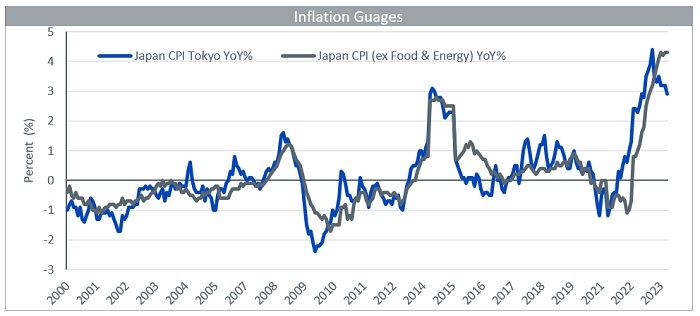
This year global investors have taken note that Japanese stocks are benefitting from the weaker Yen, relatively cheaper valuations and a long-waited return of inflation. Japanese companies are also becoming more receptive to corporate reform and shareholder engagement.
Adopting a hedged Japanese exposure
Taking a hedged exposure to dividend paying Japanese equities would be a prudent approach amidst the weaker yen. This goes to a point we often make - currency changes do not need to impact your foreign return, and you can target that local market return by hedging your currency risk. A hedged Japanese dividend paying equity exposure could enable an investor to hedge their exposure to the Yen.
Related blogs:
+ What's Hot: Higher for Longer
+ What's Hot: Bank of Japan sitting on the fence on easy policy exit
About the contributor

Director, Macroeconomic Research, WisdomTree Europe
@AneekaGuptaWTAneeka Gupta is Director of Research at WisdomTree. Prior to the acquisition of ETF Securities in April 2018, Aneeka worked as an Equity & Commodities Strategist at the company. Aneeka has 17 years of experience working as a Research Analyst across a wide range of asset classes. In her current role she is responsible for conducting analysis for all in-house equity, commodity and macro publications and assisting the sales team with client queries around products and markets. Prior to WisdomTree, Aneeka began her career as an equity analyst at Bear Stearns International Ltd in London. She also worked as an Equity Sales Trader at Sunrise Brokers across US and Pan European Exchanges. Before that she worked as an Equity Derivatives Sales Manager at Mashreq Bank in Dubai. Aneeka holds a Masters in Mathematics from Oxford University and a BSc in Mathematics from the University of Delhi, India. She is also a CFA Charterholder.