
GGRA LN
WisdomTree Global Quality Dividend Growth UCITS ETF - USD Acc

Published 24 April 2024

Head of Research, WisdomTree Europe.
2024 started on a strong note, with global equity markets gaining 8.9%1. The initial focus was on Artificial Intelligence, its growth potential and its impact on corporate profitability. However, with better-than-expected economic data being published in the US, Europe and China, market confidence grew, leading to a regional broadening of the bull market. Europe closed 7.6%1 up, which is quite close to the 10.3%1 of the US. The only weakness remains in Asia, leading to emerging markets returning only 2.4%1.
This instalment of the WisdomTree quarterly equity factor review aims to shed some light on how equity factors behaved during this first quarter and how this may have impacted investors’ portfolios.
In Q1, the MSCI World (+8.9%) and the MSCI USA (+10.3%) continued to perform very strongly. The impact of the AI megatrends continued to be felt, with Nvidia gaining 82.5% during the quarter, for example, but the big news was on the economic front. The economy in the US remained very robust, leading to the postponement of rate cuts to later in the year. Economic data out of Europe and China, while not amazing, was better than expected, leading to good performance in those markets as well.
Overall, this led to some broadening of the market's breadth. Only four out of the Magnificent Seven beat the S&P 500 this quarter, for example, with only Nvidia and Meta posting significant outperformance. The impact on factors was also clear, with a difficult quarter when many factors underperformed, as well as some rotation.
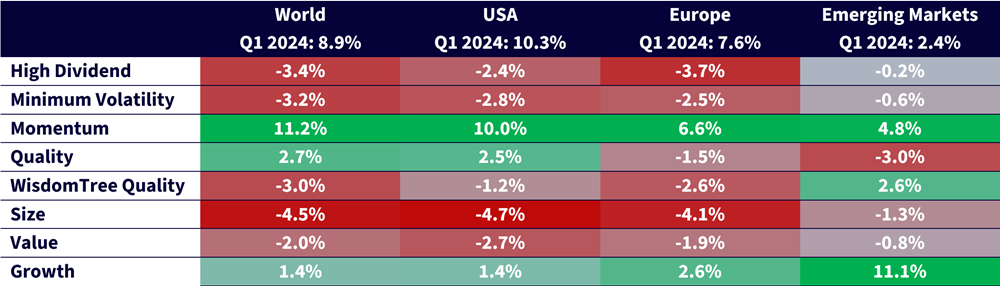
Source: WisdomTree, Bloomberg. 31 December 2023 to 31 March 2024. Calculated in US Dollars for all regions except Europe, where calculations are in EUR. Historical performance is not an indication of future performance and any investments may go down in Value.
In Q1, US equities returned their second consecutive double-digit return. While this may seem like nothing in the context of the last 18-month rally it is, in fact, quite rare. This is only the 19th time since 1927 that this happened (i.e. 5% of the time). Interestingly enough, the performance in the following six months has been positive 16 times out of 18, and the performance in the following 12 months has been positive 15 times out of 18.
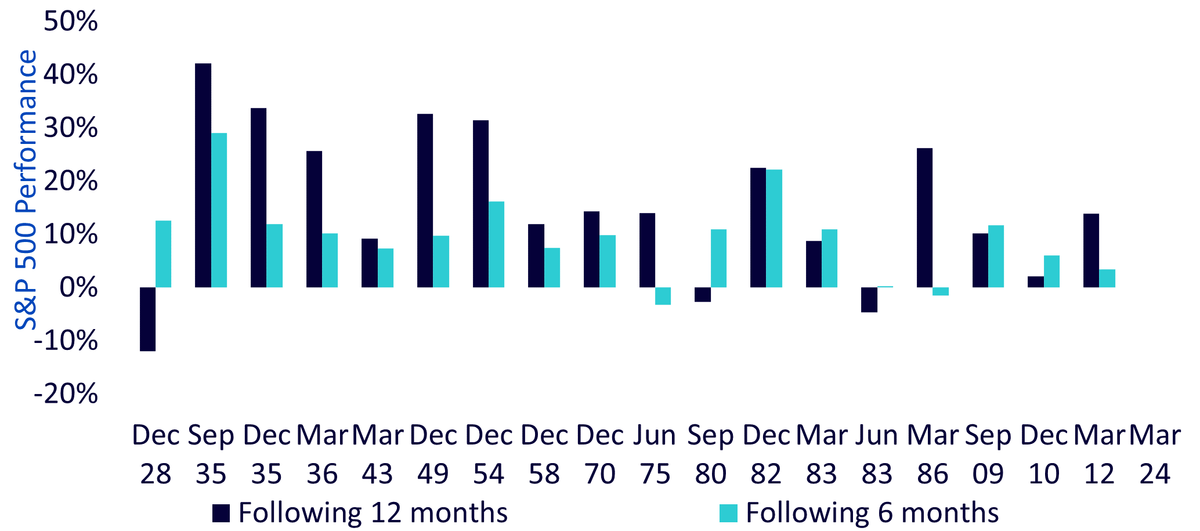
Source: WisdomTree, Bloomberg. 30 December 1927 to 31 March 2024. Calculated in US Dollars. Historical performance is not an indication of future performance and any investments may go down in Value.
Investors have focused on the market's narrowness since early 2023 and the emergence of the “Magnificent Seven” narrative. As discussed earlier, Q1 showed a divergence in the performance of those seven mega caps, with Tesla and Apple showing some weaknesses. To assess the evolution of the market's breadth this quarter, in Figure 3, we look at the Advance Decline Line for the S&P 500.
The Advance/Decline Line is a cumulative indicator. It is calculated by adding the difference between the number of advancing and declining stocks on a daily basis. So, the indicator goes up if more stocks advance rather than decline. It helps investors assess how wide the market is. In a rising market, if the indicator is going up, it means that the market is wide and that a majority of stocks are going up with the market. If the indicator is down, though, it indicates that only a minority of stocks are driving the market up, and that indicates narrowness and a potential weakness of the rally.
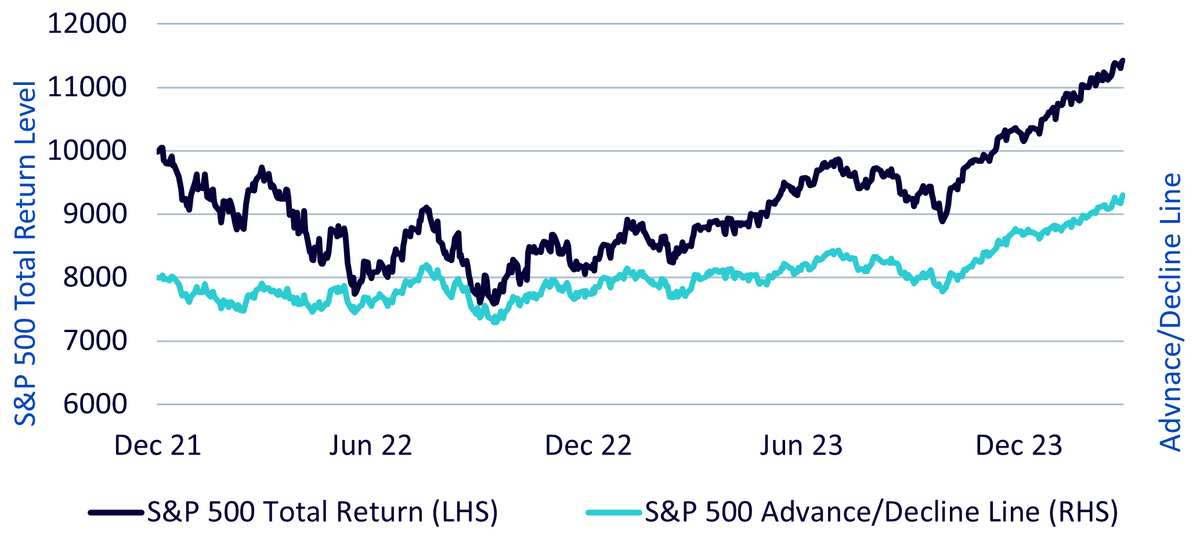
Source: WisdomTree, Bloomberg. 31 December 2021 to 31 March 2024. Calculated in US Dollars. Historical performance is not an indication of future performance and any investments may go down in Value.
Figure 3 clearly shows that market breadth has been improving since late 2023 and that the current bull market is now quite well supported.
In Q1 2024, developed markets became mostly more expensive. However, Small Caps and Growth Stocks became cheaper. The drivers for those moves varied, though. Small Caps’ valuations declined due to negative performance, while growth stocks' valuations declined due to increasing earnings.
Valuations in the US declined mostly except in Value and High Dividend. On the contrary, in Europe, valuations increased almost across the board.
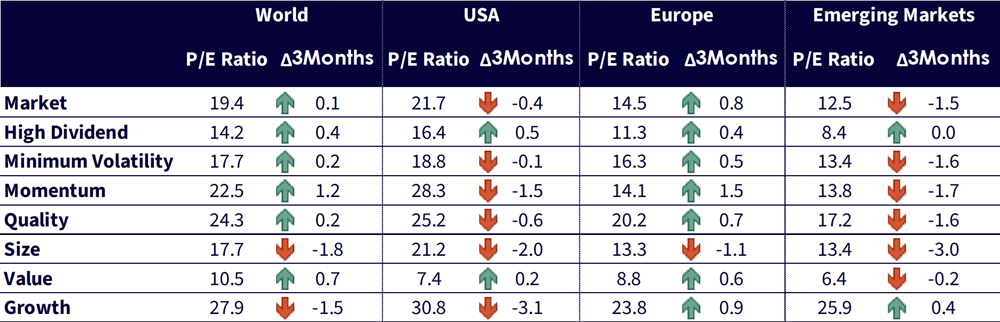
Source: WisdomTree, Bloomberg. As of 31 March 2024. Historical performance is not an indication of future performance and any investments may go down in Value.
Economies have been showing great robustness, and while “higher for longer” will continue a bit longer than expected, rate cuts are coming. These easier monetary conditions, combined with improving economies and broadening markets, should continue to provide a tailwind to equity markets. However, with valuations at relatively high levels and the upcoming US presidential election, risks remain ever-present. A balanced approach to equity investment that combines upside participation and downside protection could remain a safe choice for investors.
Sources
1 Source: WisdomTree, Bloomberg. 31 December 2023 to 31 March 2024. Historical performance is not an indication of future performance and any investments may go down in Value.

Head of Research, WisdomTree Europe.
Pierre Debru leads WisdomTree’s European research team and plays a pivotal role in the strategic direction of our European research efforts. His key areas of expertise extend across equity factors and quantitative strategies, portfolio construction and model portfolios, and thematic and crypto investments. Before joining the company in 2019, Pierre worked in Investment Research for DWS and the Xtrackers range for over five years. During this period, he focused on smart beta investments, model portfolio construction and thought leadership. Pierre has over 20 years of experience in investments and structured asset management. He graduated from Ecole Central Paris and obtained a Master of Science in Mathematics applied to Finance.


