
WTAI LN
WisdomTree Artificial Intelligence UCITS ETF - USD Acc

Published 29 January 2025

Head of Research, WisdomTree Europe.

Associate Director, Quantitative Research
Over the weekend, DeepSeek, a Chinese artificial intelligence (AI) lab, made headlines by unveiling large language models (LLMs) that rival those of OpenAI and Meta, but at a fraction of the training cost. This breakthrough has sent shockwaves through the AI World, leading to a significant decline in the Nasdaq index. DeepSeek's advancements challenge existing assumptions about the AI industry, reshaping both the competitive and investment landscapes.
This development serves as a wake-up call for AI and thematic investors alike. Regardless of their size, companies leading in a particular theme can be challenged over time. In thematic investing, disruption isn't the exception—it's the rule.
DeepSeek's milestone involves developing AI models comparable to leading U.S. counterparts but at substantially lower costs. Their R1 model was trained using 2,048 GPUs over 57 days, consuming 2.78 million GPU hours on Nvidia H800 chips—a modest figure for a 671-billion-parameter model, costing approximately $5 million in hardware1. In contrast, an earlier Open AI model like GPT-4, released in March 2023, required about 25,000 NVIDIA A100 GPUs over 90 to 100 days, costing around $63 million2.
The market responded swiftly to DeepSeek's advancements. Nvidia, a dominant player in AI hardware, experienced a notable stock decline, reflecting investor concerns about potential shifts in AI infrastructure demand. Prior to this development, it was believed that AI-driven gains were primarily captured by companies with substantial tech investments and high-end chip producers. DeepSeek's breakthrough suggests that:
From an investment standpoint, strategies that prematurely concentrated investments in Nvidia and hyperscalers may find that dominating the first half does not always imply winning the game.
Thematic investments seek to capitalize on the exceptional growth driven by structural changes in the world. Given that equity markets are often governed by the “winner takes it all” spirit, only a handful of companies typically capture the majority of these gains.
The primary objective for thematic investors should be to identify and invest early in these stocks. However, it's tempting to heavily invest in early leaders, assuming their continued dominance. This overconfidence is a common pitfall in thematic investing. Premature conclusions about market winners can lead to missed opportunities and heightened vulnerability to disruptions.
In the early days of the internet, companies like Yahoo, AltaVista, and Netscape seemed to have insurmountable leads. However, investors who bet solely on these firms were ultimately disappointed as they were challenged and overtaken by competitors such as Amazon, Google, and Microsoft. This underscores the importance of not drawing premature conclusions about market leaders.
The key to success in thematic investing lies in a balanced approach that combines conviction, expertise, and humility. This means constructing a portfolio that includes both the most promising current leaders and potential disruptors, whether they are newcomers or old foes adapting to new trends.
At WisdomTree, we have developed a unique Thematic Investment Philosophy anchored around four key pillars to address these challenges:
1. Expertise: Our investment process leverages domain expertise, often through partnerships with external specialists, to identify companies that offer focused exposure to a theme and stand to benefit most from its evolution.
2. Purity of Exposure: We concentrate on pure-play companies within a theme's ecosystem, reducing exposure to companies that only marginally engage with the theme.
3. Differentiation: Our portfolios are constructed to add distinct exposure, minimizing overlap with traditional equity benchmarks and offering distinct geographical or sectorial insights.
4. Transparency, Investability & Discipline: We build scalable and liquid portfolios with a transparent investment process, allowing investors to monitor and manage their investments effectively. This approach combines our expert partners' proprietary knowledge with disciplined index rules to avoid the pitfalls of "hype investing." The rigidity of the index rules ensures that the portfolio remains focused on the theme and that the manager does not end up investing in the fads of the moment.
By adhering to these principles, we create diversified portfolios that invest across the full breadth of the thematic opportunity, from established leaders to emerging disruptors. This approach allows our thematic strategies to benefit from the growth of current leaders while remaining resilient to potential disruptions.
The weighting methodology is also crucial. For themes early in the adoption curve, an equal-weighted approach acknowledges that no leaders have yet emerged. As themes mature, a modified market cap weighting—where weights depend on company size and relevance to the theme—ensures that early leaders receive significant weightings while accommodating potential disruptors. Only themes late in the adoption curve benefit from a market cap-weighted approach, as leaders are firmly established, and disruption is less likely.
Recognizing the vast potential of the AI megatrend, we've developed a strategy that aims to enable investors to capitalize on the success of the most relevant and impactful companies in the AI ecosystem; the early leaders and the potential disruptors. Our approach involves selecting high-conviction opportunities within three categories—enablers, engagers, and enhancers—reflecting their roles in the AI value chain. This framework captures the diverse opportunities in AI, offering refined exposure to the theme, while smart weighting emphasizes companies most influential in AI innovations within their respective groups and not just the biggest ones.
Consequently, the strategy provides a balanced exposure to semiconductor and software companies driving the AI theme, along with select firms leading AI solutions in their market segments. For instance, following DeepSeek's release, the strategy's semiconductor exposure led to losses, however, holdings in companies benefiting from lower inference costs helped offset some of those losses.
Diversification across themes is also a key tool to build resilient thematic portfolios that are less sensitive to disruptions. However, we wouldn’t do justice to the complexity of navigating such an exposure successfully, if we didn’t mention the time and extensive expertise required for tracking the developments across a vast array of themes – a resource not every investor has at their disposal.
After years of thematic research, WisdomTree has consolidated these efforts in a multi-theme strategies built around 3 layers of added value: Theme selection, Tactical capital allocation and expert-driven stock selection. This approach invests across a range of high-conviction themes to maximize diversification and spread the risk across the portfolio. The strategy leverages momentum-based tactical signals to capitalize on short-term strengths within specific themes.
On Monday 27th January, the strategy demonstrated pockets of resilience in its tech allocation stemming from exposures to cloud computing and cyber security that could benefit from lower AI computational expenses.
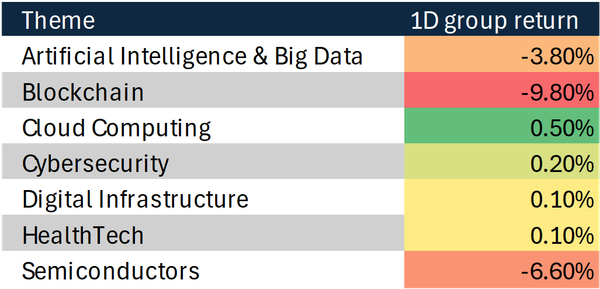
Source: WisdomTree, FactSet. As of 27th January 2025. You cannot invest directly in an index. Historical performance is not an indication of future results, and any investments may go down in value.
DeepSeek's recent advancements serve as a reminder of the dynamism inherent in thematic investing and the importance of a disciplined, diversified approach. By building portfolios that can both benefit from and remain resilient to disruption, investors can aim to better navigate the uncertainties of evolving markets and look to capitalize on emerging opportunities.
In thematic investing, as in sports, the game is far from over at halftime. Maintaining vigilance and avoiding overconfidence by keeping a diversified portfolio that accommodates early leaders, rising challengers, and potential disruptors will help ensure that investors are well-prepared for whatever the second half may bring.
1 https://www.unite.ai/how-deepseek-cracked-the-cost-barrier-with-5-6m/?utm_source=chatgpt.com
2 https://plainswipe.com/gpt-4-details-leaked/index.html

Head of Research, WisdomTree Europe.
Pierre Debru leads WisdomTree’s European research team and plays a pivotal role in the strategic direction of our European research efforts. His key areas of expertise extend across equity factors and quantitative strategies, portfolio construction and model portfolios, and thematic and crypto investments. Before joining the company in 2019, Pierre worked in Investment Research for DWS and the Xtrackers range for over five years. During this period, he focused on smart beta investments, model portfolio construction and thought leadership. Pierre has over 20 years of experience in investments and structured asset management. He graduated from Ecole Central Paris and obtained a Master of Science in Mathematics applied to Finance.

Associate Director, Quantitative Research
Elvira has been a member of the WisdomTree Research team since September 2018. With over nine years of experience in the ETF and asset management industry and an academic background in quantitative finance, Elvira combines technical expertise with thematic strategy insights to contribute to thought leadership research and the development of new innovative strategies at WisdomTree. As a lead specialist in thematic strategies, she supports the periodic review and rebalancing of thematic portfolios, delivers quantitative insights, bespoke analysis for clients, strategic thought pieces as well as commentary on market trends and thematic strategies. She also develops comprehensive product collateral designed to support client needs.


