

Five reasons why you might use an enhanced commodity strategy
Published 6 September 2017
Broad commodity strategies offer investors a way to diversify their investment portfolio and potentially reduce overall volatility. However, owning commodities can be challenging as there are significant costs related to rolling futures. This is why investors may wish to focus on enhanced strategies that seek to minimise these costs.
WisdomTree’s Enhanced Commodity UCITS ETF (ticker: WCOA) combines S&P’s dynamic rolling methodology with Bloomberg Commodity (BCOM) constituents and starting weights which offers a unique, low-volatility tool to access commodities. But investors may be wondering: what is dynamic rolling, how does it work, and why is it a potentially superior approach to accessing commodities?
This blog explores five key features of our Enhanced Commodity strategy and how it might add value to investor portfolios:
1) How dynamic rolling can minimise roll cost in contango
S&P’s dynamic roll methodology is key to managing the roll yield component of futures returns. It involves positioning further along the futures curve in contango markets for 18 out of 22 commodities (Gold, silver, soybean meal and soybean oil are not optimised due to lack of convexity/concavity in respective futures curves), specifically on sections of the curve where roll costs can be minimised. Contrasting this are front-month rolling strategies like BCOM, which often allocate where roll costs are highest and results in significant drag on returns over time. Figure 1 highlights this and the importance of roll costs, not price, on historic commodity returns. By mitigating roll costs, dynamic roll strategies captured annual outperformance of 3% to 8.5% against front-month strategies over the past three years, five years and since 2001. Against a backdrop of persistent oversupply concerns between shale and OPEC, contango in crude is unlikely to change, hence dynamic roll strategies are the ideal way to allocate into commodities.
Figure 1: Minimising rolling costs improves performance
Annualised return decomposition compared between dynamic and standard rolling broad commodity strategies
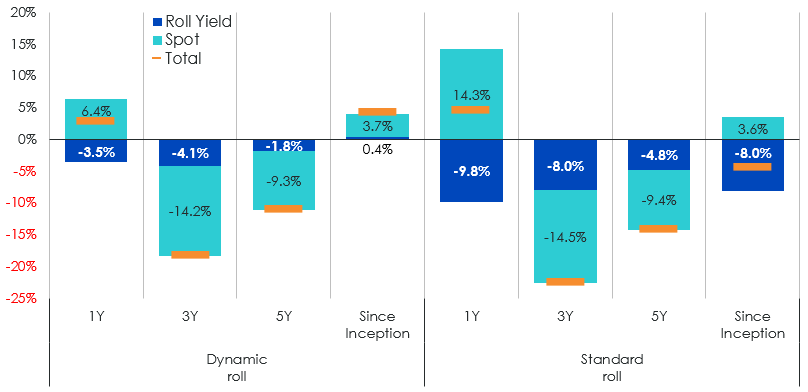
Source: WisdomTree, Bloomberg. Data from 31/05/01 to 31/07/17. Past performance is not indicative of future returns. Dynamic strategy represented by S&P GSCI Dynamic Roll ER Index. Standard strategy strategy represented by S&P GSCI ER Index.
2) How dynamic rolling can maximise roll return in backwardation
When commodity futures are in backwardation, WisdomTree’s Enhanced Commodity UCITS ETF dynamic contract selection shifts towards the cheapest section of the respective futures curves. This ensures that the maximum positive roll yield is captured as per front-month strategies. For commodities constantly exhibiting seasonal backwardation like natural gas and agriculture, dynamic rolling can capture a predictable source of alpha.
3)How dynamic rolling offers lower volatility, compared to broad equity baskets and gold
Aside from managing roll yield, dynamic rolling also plays a crucial role in dampening volatility. This stems from front-month strategies being more closely related to volatile spot price movements than longer-dated futures contracts. Consider Figure 2, for example, which contrasts the annualised volatility of WTI futures across different tenors. At 36%, the volatility of front-month WTI futures is equivalent to a one-in-five probability of making or losing at least 6% on a weekly basis. A 2Y WTI futures contract (current contract held by WisdomTree’s Enhanced Commodity UCITS ETF), by comparison, has markedly lower volatility of 21%.
Given the dynamic roll’s tendency to allocate into far-out futures in contango markets, overall sensitivity to spot prices is suppressed. This underpins WisdomTree’s Enhanced Commodity UCITS ETF lower volatility profile (14.2%) against BCOM (16.7%) and other asset classes including diversified equities (17.2% for MSCI ACWI) and gold (17.7%). From an asset allocation perspective, WisdomTree’s Enhanced Commodity UCITS ETF allocations may potentially reduce overall portfolio volatility.
Figure 2: Lower portfolio volatility with enhanced commodities
Annualised volatility profile of different asset classes and WTI Crude Oil Futures
Source: WisdomTree, Bloomberg. Data from 05/01/01 to 31/07/17.
Past performance is not indicative of future returns. Annualised volatility based on weekly returns.
4) BCOM starting weights and constituents offer a balanced approach to commodities investing
5) WisdomTree’s Enhanced Commodity UCITS ETF offers compelling absolute and risk-adjusted returns against peers
WisdomTree’s Enhanced Commodity strategy (tracking Optimised Roll Commodity Index) outperformed broad commodity peers across multiple time horizons since inception, in both absolute and risk-adjusted terms. The combination of volatility-suppressing futures positioning, balanced commodity weight allocations and alpha-generating roll make WCOA a better portfolio diversifier and commodities access tool than competing broad commodity strategies.
How can you invest?
The table below outlines the different share classes available for investors:
Fund name | Code | ISIN | Listing Currency | Share Class Currency | TER |
|---|---|---|---|---|---|
WisdomTree Enhanced Commodity UCITS ETF – USD Acc | WCOA | IE00BYMLZY74 | USD | USD | 0.35% |
WisdomTree Enhanced Commodity UCITS ETF – USD | WCOG | IE00BZ1GHD37 | USD | USD | 0.35% |
Listing Currency
Share Class Currency
WisdomTree Enhanced Commodity UCITS ETF – USD Acc
IE00BYMLZY74
WisdomTree Enhanced Commodity UCITS ETF – USD
IE00BZ1GHD37
Investors sharing this sentiment may consider the following UCITS ETFs:
You might also be interested in reading…