
COPA LN
WisdomTree Copper

Published 4 March 2024

The HMS Beagle, the naval vessel used by Charles Darwin for his voyages around the world, was built in 1825 with copper skins below the water line. The purpose of this copper sheathing was to protect the hull of the ship from biofouling, i.e., the attachment of unwanted organisms that can slow the vessel down and affect its longevity. Today, boats and ships often use copper-based paints to provide the same function.
Humans have been familiar with the qualities and diverse applications of copper for over 10,000 years. Around 4000 BC to 3500 BC, the science of metallurgy emerged in Egypt when copper was heated, moulded into shapes and alloyed to create bronze – giving rise to the Bronze Age1.
Today, copper is often referred to as the bellwether for the global economy, with its demand signalling how well the economy is doing. However, it is its strong electrical conductivity, energy efficiency, and its ability to be moulded into shapes and drawn into wires that have made copper a core energy transition commodity.
In this blog, we discuss copper’s role in the energy transition and key considerations related to its demand and supply.
Being an enabler of electrification, copper is at the heart of the energy transition. According to our energy transition industry expert partners Wood Mackenzie, copper’s annual demand is expected to rise from around 28 million tonnes in 2020 to over 68 million tonnes2 by 2050 – driven almost entirely by emerging sources of demand like electric vehicles, charging infrastructure, renewable energy, and energy storage systems.
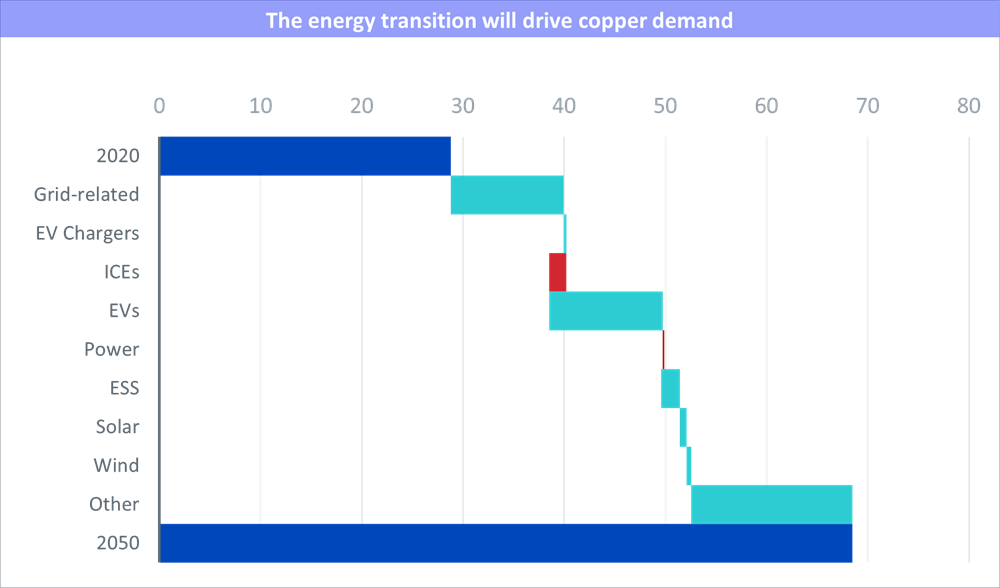
Source: Wood Mackenzie, 2023. Forecasts aligned to 1.5-degree scenario. Data presented in Millions of Tonnes. Negative growth in red. Forecasts are not an indicator of future performance and any investments are subject to risks and uncertainties.
At the United Nations Climate Change Conference (COP28), world leaders have pledged to triple global renewable energy capacity by 2030. This audacious goal is only achievable through greater quantities of key raw materials like copper. But the production of copper through new mines takes time. According to S&P Global’s 2023 report, that studied 34 copper mining projects, going from discovery to production took an average of 16 years. At WisdomTree, we believe the push for green technologies will create a surge in copper demand which will push prices higher and thereby incentivise more investment in primary (mining) and secondary (recycling) supply. But supply could be playing catch-up with demand in the coming years. This is where the opportunity lies for investors.
Today, copper and copper alloy products are used across a wide range of industries. Data from the US Geological Survey about copper’s domestic use illustrates this (see figure below):
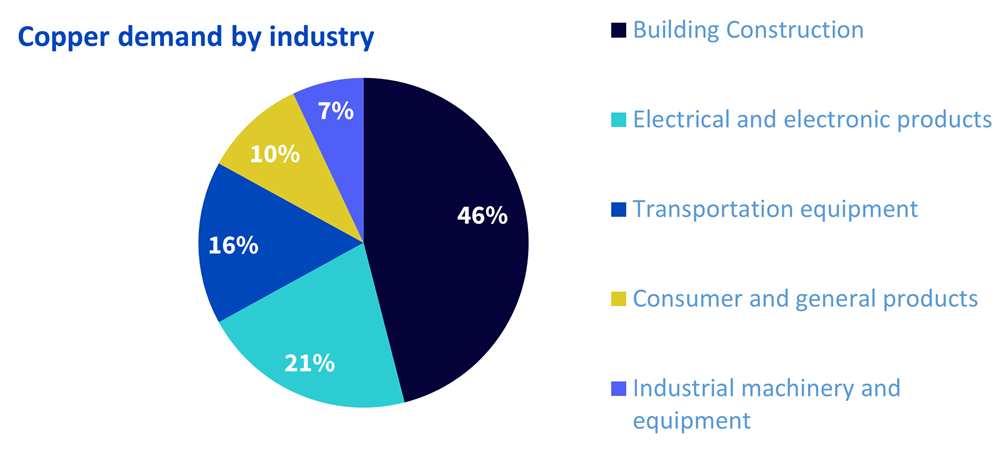
Source: US Geological Survey Mineral Commodity Summaries, 2023. Data shows domestic use for the US.
In terms of countries, China is by far the biggest consumer of copper with an estimated consumption of 6.75 million metric tons in 2023. The United States ranks at number two with an estimated 2023 consumption of 3.8 million metric tons – out of a total global consumption of around 28 million metric tons3.
Because of China’s dominance as the biggest source of demand, manufacturing activity in the country is often used as a heuristic to gauge the cyclical prospects of copper. Moreover, given copper is deeply embedded across multiple industrial applications, it is seen as a cyclical asset with its fate tied to the ebb and flow of the economy. We believe the new structural source of demand growth from the energy transition is currently underappreciated by markets, which presents investors with an opportunity to view copper as a potential thematic investment.
In 2023, weak sentiment towards China’s economic growth was a drag on copper prices. But China is transitioning from using copper just for its traditional purposes like consumer electronics and construction to buying large quantities of the metal for electrifying its energy system. China is leading the world in its deployment of renewable energy, battery storage, electric vehicles, and charging infrastructure.
Chile and Peru are the biggest suppliers of copper worldwide. Chile’s share of global supply stands at around 27% while Peru’s share is around 11%4. The Democratic Republic of Congo, China, and the United States are other key copper producers.
Five out of the 10 biggest copper mines are in either Chile or Peru. The largest mine in the world is the Escondida Mine in Antofagasta, Chile, which produced an estimated 1.06 million tonnes of copper in 20225. The mine is expected to operate until 2078.
This expected life of mines underscores another key point about copper supply. Copper is available in abundance in the earth’s crust. Global copper reserves – deposits that have been discovered, evaluated, and assessed to be profitable, currently stand at around 870 million metric tons. Copper resources – discovered deposits that are potentially profitable and undiscovered deposits based on preliminary geological surveys – currently stand at around 5,000 million metric tons6. However, in the decade after the global financial crisis, mining investment for commodities needed in the energy transition largely trended downwards7. We believe a tailwind behind commodities from the energy transition will incentivise more investment across the value chain of metals like copper.
Copper’s current supply concentration creates a risk to copper output. In recent years, miners in Chile and Peru have faced resistance from the masses for further expansion in mining activity, due to environmental concerns creating political pressure on the governments. With demands to produce more on the rise from the energy transition, if the countries move to tighten approval processes for expansion in mining activity, supply deficits in copper could widen despite the abundant availability of the metal in the earth. This issue can be exacerbated by declining ore grades (the quality of raw material extracted from the earth that is processed and purified), a constant challenge faced by miners that requires more investment to overcome.
Copper can be recycled repeatedly without losing its physical properties. Currently around a third of total copper supply comes from recycled metal8.
The silver lining for copper, to reduce its dependence on primary supply from mining, is recycling. Copper’s recyclability makes a compelling case for scaling up the recycling industry. More recycled metal will foster sustainable growth in copper supply and reduce the world’s dependence on new mining.
Thus, overall, copper is looking to redefine itself from being a cyclical commodity to one that has a structural tailwind from the energy transition behind it. We believe demand growth is expected to outpace supply growth in the years to come creating an opportunity for investors to consider copper, among other similar industrial metals, a thematic investment opportunity.
At WisdomTree, we offer a range of solutions for investors interested in copper. WisdomTree Copper (COPA) gives investors exposure to the metal through commodity futures. WisdomTree also offers a range of commodity futures baskets that feature copper. Notably, WisdomTree Energy Transition Metals and WisdomTree Battery Metals have been developed in partnership with industry experts Wood Mackenzie to identify the most important commodities in the energy transition and battery themes, respectively, and weigh them in appropriately.
1 Copper.org, 2024.
2 Some sources of data refer to tonnes and others refer to metric tons. Both are used interchangeably in industry and refer to 1000kg of mass.
3 Statista, January 2024.
4 Statista, March 2023 based on production numbers from 2021.
5 Mining-technology.com
6 Copper Alliance, 2024.
7 FD Intelligence, 2023.
8 Copper Alliance, 2024.

Director, Research
@MobeenTahirWTMobeen is a member of WisdomTree’s research team where he focuses on a wide range of asset classes to offer strategic and tactical insights to our clients on global markets and investment products. Before joining WisdomTree in December 2018, Mobeen worked at Willis Towers Watson as an investment consultant advising institutional clients as well as their in-house fund business on asset allocation and portfolio construction with his research focus being equity and multi-asset smart beta. Mobeen has a BSc (Hons) in Accounting and Financial Management from Loughborough University and an MSc in Accounting and Finance from the London School of Economics and Political Science. He is also a CFA Charterholder.
