
WBLK LN
WisdomTree Blockchain UCITS ETF - USD Acc

Published 18 July 2024

Senior Associate, Quantitative Research
As we approach the midpoint of 2024, approximately 89 days have passed since the pivotal bitcoin halving event in April1. While bitcoin flirted with all-time highs earlier in the year, surpassing $73,0002, it has yet to breach this threshold. Historically, any significant price change following halving events has not always been immediate; two of the last three halvings saw delayed price increases. This pattern underscores the importance of patience for investors awaiting the ‘halving trade’ to play out. To keep things in context, bitcoin closed just under $64,000 on 20 April (halving date), not too far from the current price of $63,000 as of the time of writing.
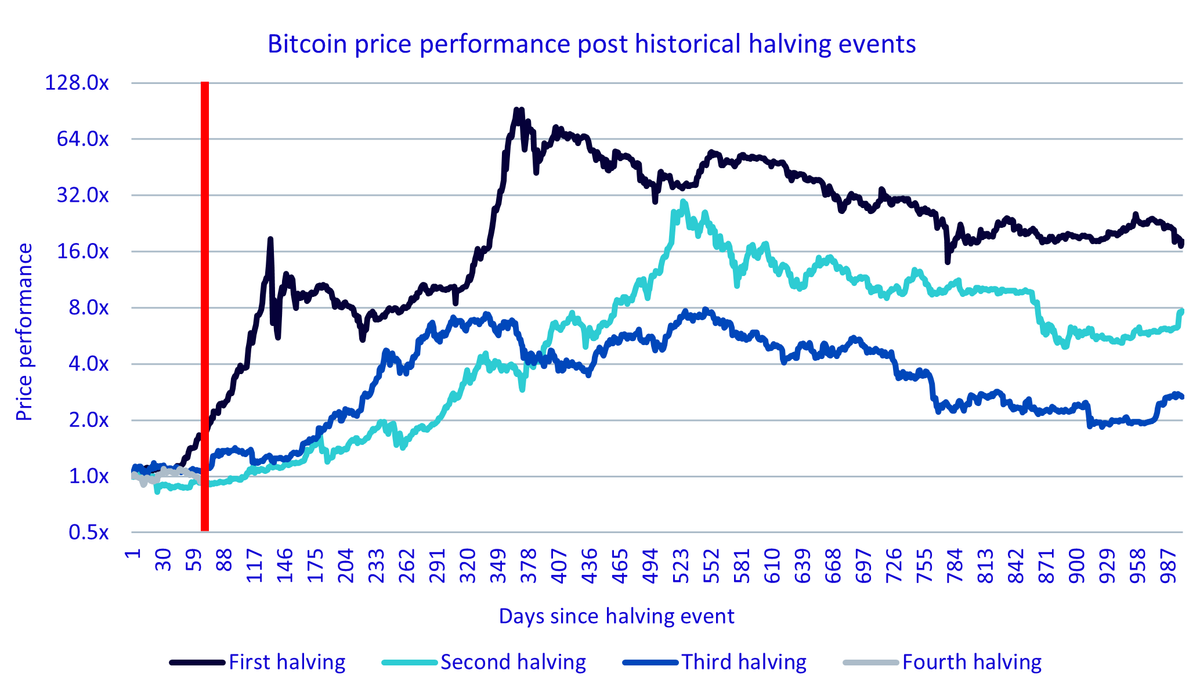
Source: Glassnode, WisdomTree as of 2 July 2024 . Rebased to 1 in from halving date. The vertical red bar indicates where we are as of June 30, 2024. Historical performance is not an indication of future performance and any investment may go down in value.
The recent halving has had a profound impact on bitcoin's supply dynamics:
Bitcoin continues to offer a distinctive approach to monetary policy:
The halving has significantly affected the bitcoin mining landscape:
While major bitcoin price impacts have yet to materialise, the halving has meaningfully affected miners. May's bitcoin production decreased compared to April due to reduced rewards following the halving.
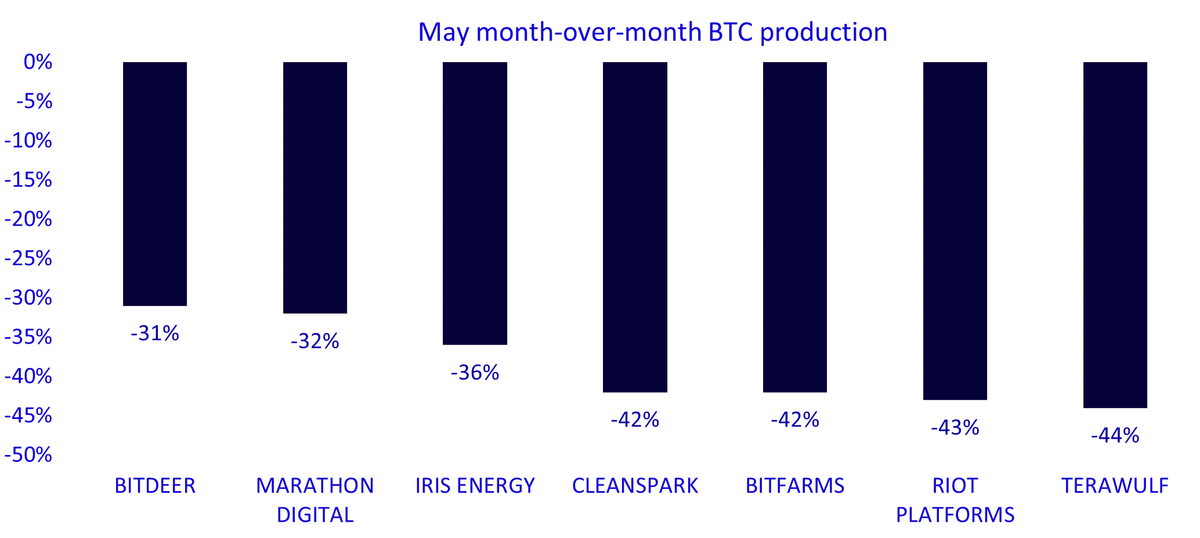
Source: WisdomTree, Blockworks, https://blockworks.co/news/who-mined-most-btc-since-bitcoin-halving. Historical performance is not an indication of future performance and any investment may go down in value.
This shift has catalysed several industry trends alluded to in the bullets above:
There is a notable divergence in performance within the mining space. Well-capitalised and efficient firms are better positioned to thrive in an increasingly competitive ecosystem. Those that have been nimble and quick to adjust to the changing market dynamics have so far outperformed their peers.
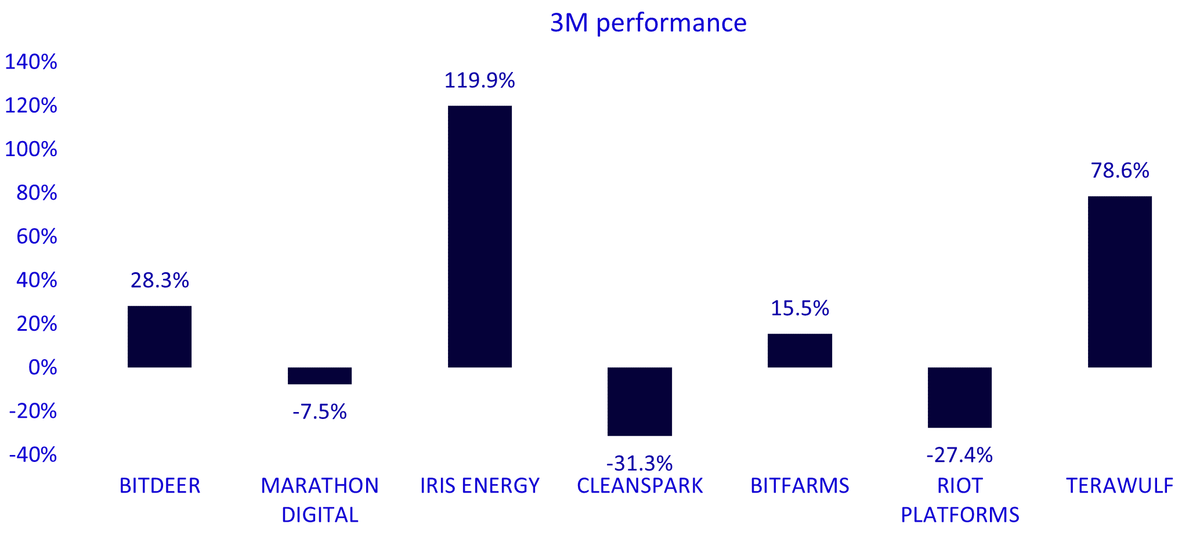
Source: Bloomberg as of 26 June 2024. Historical performance is not an indication of future performance and any investment may go down in value.
As we navigate the post-halving landscape, it's crucial for investors to maintain a long-term perspective. Historical patterns suggest that any significant price change may not be immediate but tends to evolve over several months following the halving event. Bitcoin's deflationary nature and transparent monetary policy make it a compelling long-term store of value, with each halving event presenting an opportunistic entry point into the asset class due to the supply constraints it introduces, which has historically led to upward pricing pressure.
As a result of this event, the bitcoin mining industry is adapting, with efficient and innovative firms poised for growth ahead, amidst increased pressure from reduced bitcoin block rewards. While patience is required in the short term, the long-term prospects for bitcoin and the mining sector remain promising. Investors should stay informed, consider opportunities within the space, and recognise this is a trend that will play out over the back half of 2024.
1 The halving took place on 20 April 2024.
2 Source: Coinmarketcap. Bitcoin daily close price reached an all time high of $73,079 on 14 March 2024.
3 https://fortune.com/crypto/2024/04/24/bitcoin-wallets-waking-up-lost-coins-satoshi/
4 https://www.bloomberg.com/news/articles/2024-05-28/riot-platforms-pursues-takeover-of-rival-bitcoin-miner-bitfarms
5 A measure of computational power that is being used to mine and process transactions on a Proof-of-Work blockchain, such as Bitcoin
6 https://investors.terawulf.com/news-events/press-releases/detail/79/terawulf-announces-may-2024-production-and-operations-update
7 https://www.afr.com/technology/how-this-aussie-bitcoin-miner-is-cashing-in-on-the-nvidia-ai-boom-20240616-p5jm6w
WisdomTree Blockchain UCITS ETF - USD Acc

Senior Associate, Quantitative Research
Blake Heimann joined WisdomTree in 2020 and, in his current role as Senior Associate, supports the creation, maintenance, and reconstitution of our indices. Blake began his career in finance in 2017 as an Analyst at TD Ameritrade, and later a Quantitative Analyst with focuses on research and development of machine learning applications in finance. Blake has bachelor’s degrees in Mathematics and Economics from Iowa State University, as well as his Masters in Computer Science at Georgia Tech, with a specialization in Machine Learning. He is currently pursuing a Masters in Finance from the London School of Economics.
