

A red sky at night, an agricultural investor’s delight?
Published 24 February 2021

The world is not short of weather-related proverbs. Whether they have a scientific basis or not is less well understood. But meteorologists agree we are currently in La Niña climate pattern. This climate phenomenon does have a scientific basis. Agricultural commodity prices are highly influenced by the weather. Unfortunately, the weather is one of the hardest things to predict. But sometimes persistent weather patterns like the La Niña emerge. They offer us an opportunity to say which way crop yields are biased and which way prices are likely to head.
What is the La Niña phenomenon?
The La Niña climate pattern is naturally occurring phenomenon that occurs due to fluctuating ocean temperatures in the central and eastern equatorial Pacific which change trade wind patterns and thus affects global weather. The current La Niña started in August to September 2020 and meteorologists expect it to last until March 2021 with a 95% probability1. La Niñas are the cold phase of the El Niño Southern Oscillation, where ocean temperatures in the region of the equatorial Pacific fall by more than 0.5°C from normal. But this doesn’t mean that world temperatures are also cooler everywhere. Indeed, a La Niña can make some places cooler and wetter than normal and other places drier and warmer than normal. The key thing is that these climate patterns change the weather from what is normally expected. This has implications for commodities that are climate dependent like agricultural commodities.
La Niña climate impacts
The typical change in weather over winter months are summarised in the graphic below. You can see that even within a single country like the US, the direction of change in weather isn’t the same in all parts. While the Northwest of the US is likely to be cooler than normal, the South is likely to be warmer and drier than normal.
Source: National Oceanic and Atmospheric Administration (Climate.gov)
La Niña crop impacts
Studies have demonstrated that La Niña has an impact and crop yields including wheat, soybean and corn2. Typically, regions where wheat, soybean and corn crop yields decline (such as North, Central and South America) outweigh the regions where La Niña boosts yields (like West Africa). However, we should note that the La Niña impact on crops tends to be less pronounced than El Niño crop impacts.
We should also note that each La Niña episode will be somewhat different from the past. At any point in time, there are many weather patterns that compete with each other and therefore it is hard to isolate the effects of one particular weather pattern.
La Niña price impacts
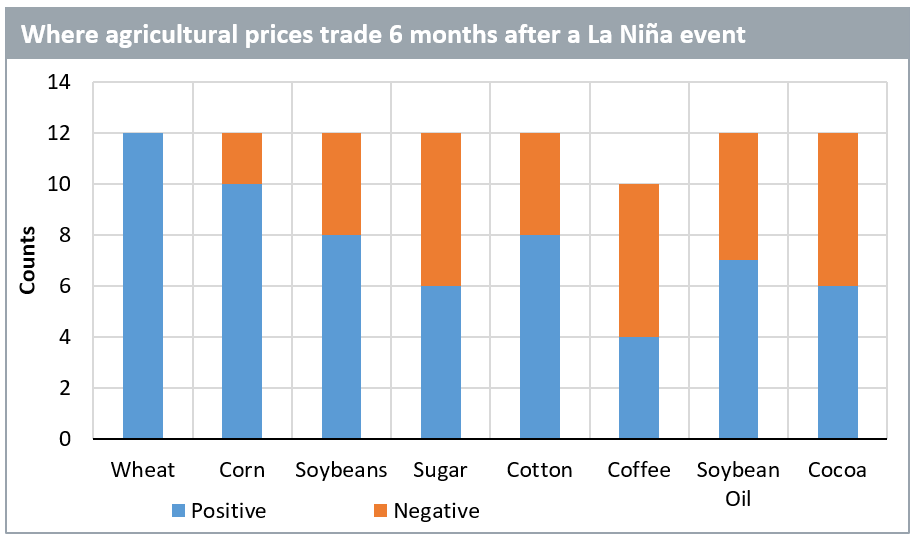
We have analysed prices of agricultural commodities in the past 12 episodes of La Niña’s that we have seen since 1950. In all 12 cases, wheat prices traded higher six months after the La Niña event started. In 10 out of the 12 episodes corn traded higher. In eight out of the 12 episodes, soybean and cotton traded higher six months after the event started. For most other the commodities the results were somewhat mixed.
Are we seeing typical La Niña weather right now?
In normal years, a La Niña would reduce global temperatures on average. However, in 2020 (when the current La Niña started) global temperatures were 0.5°C higher temperatures than in 2010 (the next warmest La Niña year). This may affect the amplitude of the weather event. Average temperatures in the North of US were warmer than average in January 2021 (source: NOAA), but cold spells are likely to drive the temperatures lower than average according to NOAA’s forecasts. Some of the dryness in Brazil and Argentina is attributed to La Niña conditions3.
Conclusions
As we approach the final months of La Niña we are seeing weather conditions in line with this climate phenomenon. Historically these events have been price positive for wheat, corn, soybean, cotton.
2 For example, see Impacts of El Niño Southern Oscillation on the global yields of major crops, by Toshichika Iizumi, Jing-Jia Luo, Andrew J. Challinor, Gen Sakurai, Masayuki Yokozawa, Hirofumi Sakuma, Molly E. Brown & Toshio Yamagata, May 2014.
Related blogs
+ USDA WASDE Preview More supply tightening expected
+ Wheat and corn continue a bullish run
Related products
+ WisdomTree Corn 2x Daily Leveraged
Categories
About the contributor

Head of Commodities and Macroeconomic Research, WisdomTree Europe
@NiteshShahWTNitesh Shah is a seasoned financial professional with over 24 years of experience in research and investment strategy. As Head of Commodities & Macroeconomic Research at WisdomTree Europe, he leads market analysis and insights across asset classes, with a focus on commodities and exchange-traded products. Previously, he held roles at Moody’s, HSBC Investment Bank, The Pension Protection Fund, and Decision Economics, building expertise in market analysis and strategy. Nitesh earned a master’s degree in International Economics and Finance from Brandeis University and a bachelor's in Economics from the London School of Economics. His insights are frequently featured in financial media, and he is a sought-after speaker at industry events. He also hosts the ‘Commodity Exchange’ podcast, where he discusses trends shaping global markets. Passionate about guiding investors, Nitesh provides actionable insights to help them navigate complex financial landscapes.