


Where might investors find the next Nvidia?
Published 29 April 2024

Key Takeaways
- Nvidia is providing the engine for artificial intelligence (AI) justifying the hype around the company.
- The AI value chain is diverse and pure-play AI companies can belong to a range of different sectors.
- Investing across the AI value chain gives investors exposure to many companies that could achieve similar success.
On 18 March 2024, Nvidia unveiled its new Blackwell platform. According to the company, its new GB200 Grace Blackwell Superchip provides an up to 30x performance increase compared to the same number of NVIDIA H100 Tensor Core GPUs1 and reduces cost and energy consumption by up to 25x. This will enable breakthroughs in data processing, engineering simulation, electronic design automation, computer-aided drug design, and quantum computing.
This is an exciting list of use cases and a significant step up in terms of performance compared to the company’s next best chip which is already the best by far on the market.
Investors naturally anguish over whether Nvidia’s share price rally can be sustained and if its 1.6 trillion-dollar gain in market capitalisation in the last twelve months is justified2. Ask a hundred analysts and you might get a full spectrum of responses. But if you ask whether Nvidia is innovating, selling real products that appeal to customers, and staying ahead of its competition, the answer is a resounding yes.
Still, investing in a single stock comes with a risk profile that might not work for everyone. Investors who are sold on the artificial intelligence megatrend are now wondering where they might be able to find the next Nvidia-like success story. In this blog, we outline how a pure exposure to the AI value chain gives investors the best chance of doing so.
The AI value chain
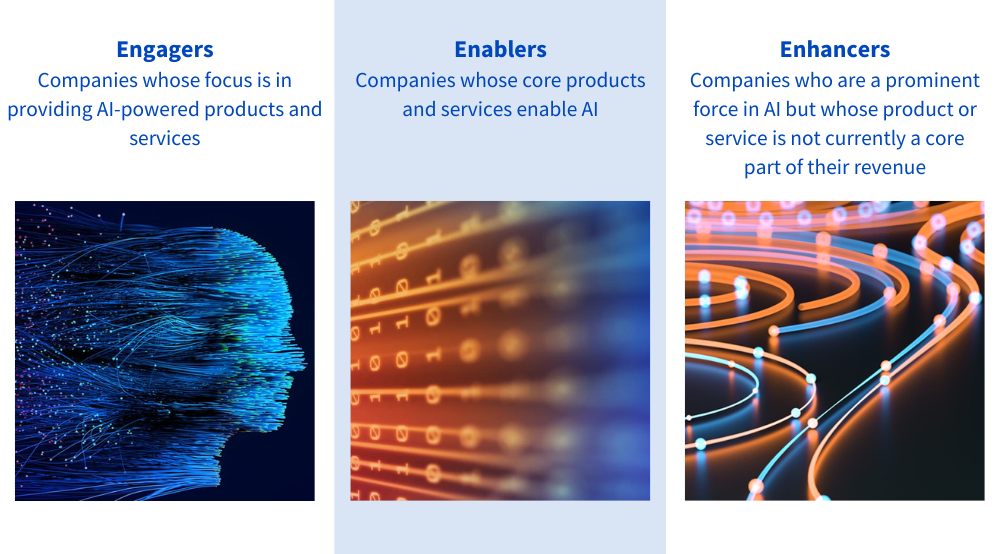
Source: WisdomTree, Consumer Technology Association, 2024.
Engagers
Engagers focus on providing AI-powered products and services. Engagers can come from any industry. The common thread that connects them is their use of AI as part of their core business. At WisdomTree, we believe that in an AI investment strategy, engagers warrant the highest weight.
Illumina is an example of an engager in the biotechnology industry. In June 2023, Illumina announced PrimateAI-3D, an AI algorithm that predicts with unprecedented accuracy disease-causing genetic mutations. According to the company, each person carries millions of genetic variants that underlie individual differences in health and disease risk, but most of those variants are presently of unknown function. AI can help highlight disease-causing mutations facilitating the development of personalised medicine, rather than generalised medicine. This is going to herald an exciting new era in biotechnology3.
AI tools are enabling cyber criminals to launch more sophisticated attacks than ever before. Cybersecurity companies are, therefore, also making a concerted effort to embed AI within their solutions. SentinelOne, a prominent cybersecurity company, has recently announced Purple AI, a security framework that is designed to detect earlier, respond faster, and stay ahead of attacks. The software, which is now in beta, will empower security analysts to conduct better investigations and secure their organisations with the assistance of a generative AI tool that can perform complex functions but communicate in simple language4.
ServiceNow is another engager which provides software to facilitate smarter, faster, and better ways to work. Its generative AI-powered Now Assist solution can help summarise text, provide customer support, create content and write code. It is a perfect example of how AI will help streamline tasks, improve efficiency, and allow office-based humans to do more value-added tasks.
Enablers
Enablers typically form the foundation of AI adoption. Semiconductors are an ideal example. Semiconductor chips, also known as integrated circuits, are the backbone of modern electronics, comprising tiny electronic components etched onto a silicon wafer. These chips are pivotal for AI, especially generative AI, due to their capability to handle massive amounts of data and execute complex computations rapidly. In generative AI applications, semiconductor chips power neural network architectures, enabling tasks such as image generation, natural language processing, and music composition. Their high processing speed and energy efficiency make them indispensable for advancing the capabilities of AI systems. At WisdomTree, we believe that in an AI investment strategy, enablers warrant the second highest weight, closely behind engagers.
Naturally, Nvidia features in this category. But despite Nvidia’s name becoming practically synonymous with semiconductors in recent times, it is not alone in this space. Taiwan Semiconductor Manufacturing Company (TSMC) is a dedicated foundry business, which means that it manufactures semiconductor products as a service. Nvidia is one of its clients making TSMC indispensable in Nvidia’s supply chain.
Qualcomm is another notable AI enabler. Its products facilitate the adoption of AI across many industries including automotive, mobile, consumer electronics and networking. In the automotive industry, for example, its Snapdragon product is helping create an AI-powered connected car that can deliver a personalised experience for its passengers, be connected to cloud services, and help cars become automated.
Enhancers
Enhancers are companies that are a prominent force in AI, but their AI-powered products or services are not most of their overall revenue. At WisdomTree, we believe that given their relevance in the value chain, an AI investment strategy should allocate a small weight to enhancers as well.
Tesla is an example of an enhancer. Tesla is an automotive and clean energy company, but its autonomous driving software is miles ahead of its competitors. Even though regulation varies around the world in terms of what level of autonomous driving might be permitted, Tesla cars have the capability to collect data and learn from real world driving scenarios even when autonomous driving is not actively engaged. This means that as and when more regions around the world become amenable to greater levels of autonomous driving, Tesla’s cars will be frontrunners on account of their head start in collecting data and learning from it.
Other household tech companies like Microsoft also belong among enhancers. Microsoft’s traditional software solutions like Windows and Office are not AI-based, but the company is swiftly embedding AI in its solutions. For example, Microsoft Copilot is a large language model designed to be a chatbot companion to allow users to better utilise Microsoft software. Moreover, the company’s ownership of ChatGPT developer OpenAI also gives it a leadership role in the AI ecosystem.
Enhancers can, therefore, potentially become engagers if AI becomes a core part of their business. Until then, a small weight allows the investment strategy to recognise their importance in the space, but ensure differentiation versus major market indices.
Conclusion
The next Nvidia could come from anywhere across the AI value chain. The examples mentioned in this blog merely illustrate how varied the value chain can be. Diversification across the value chain can help investors build an exposure poised to benefit from the future growth of businesses in this space as companies are classified and weighted based on their AI characteristics and credentials rather than market capitalisation. This also helps mitigate the risk of overconcentration in any single stock as companies go through hype cycles.
Sources
1 Graphics processing unit.
2 Source: WisdomTree, Bloomberg, as of April 2024.
3 Illumina.com, June 2023. https://www.illumina.com/company/news-center/press-releases/press-release-details.html?newsid=b067ea3b-be0e-4318-a910-6bd659e0d232
4 Sentinelone.com, April 2024. https://www.sentinelone.com/platform/purple/
Related articles

About the contributor

Mobeen Tahir
Director, Research
@MobeenTahirWTMobeen is a member of WisdomTree’s research team where he focuses on a wide range of asset classes to offer strategic and tactical insights to our clients on global markets and investment products. Before joining WisdomTree in December 2018, Mobeen worked at Willis Towers Watson as an investment consultant advising institutional clients as well as their in-house fund business on asset allocation and portfolio construction with his research focus being equity and multi-asset smart beta. Mobeen has a BSc (Hons) in Accounting and Financial Management from Loughborough University and an MSc in Accounting and Finance from the London School of Economics and Political Science. He is also a CFA Charterholder.