
NCLR LN
WisdomTree Uranium and Nuclear Energy UCITS ETF - USD Acc

Published 11 September 2025

In 20211, according to the World Economic Forum’s Global Risks Report, the world’s top risks were dominated by global challenges like climate change, the global pandemic, and biodiversity loss. In 20252, the focus has shifted to more immediate dangers like armed conflict, misinformation, and economic confrontation. Clearly, the risks most concerning people today reflect a more fragmented world.
For investors, fragmentation creates risks but also new areas of opportunity. This blog summarises the key messages from WisdomTree’s Thematic Outlook outlining five growth opportunities.
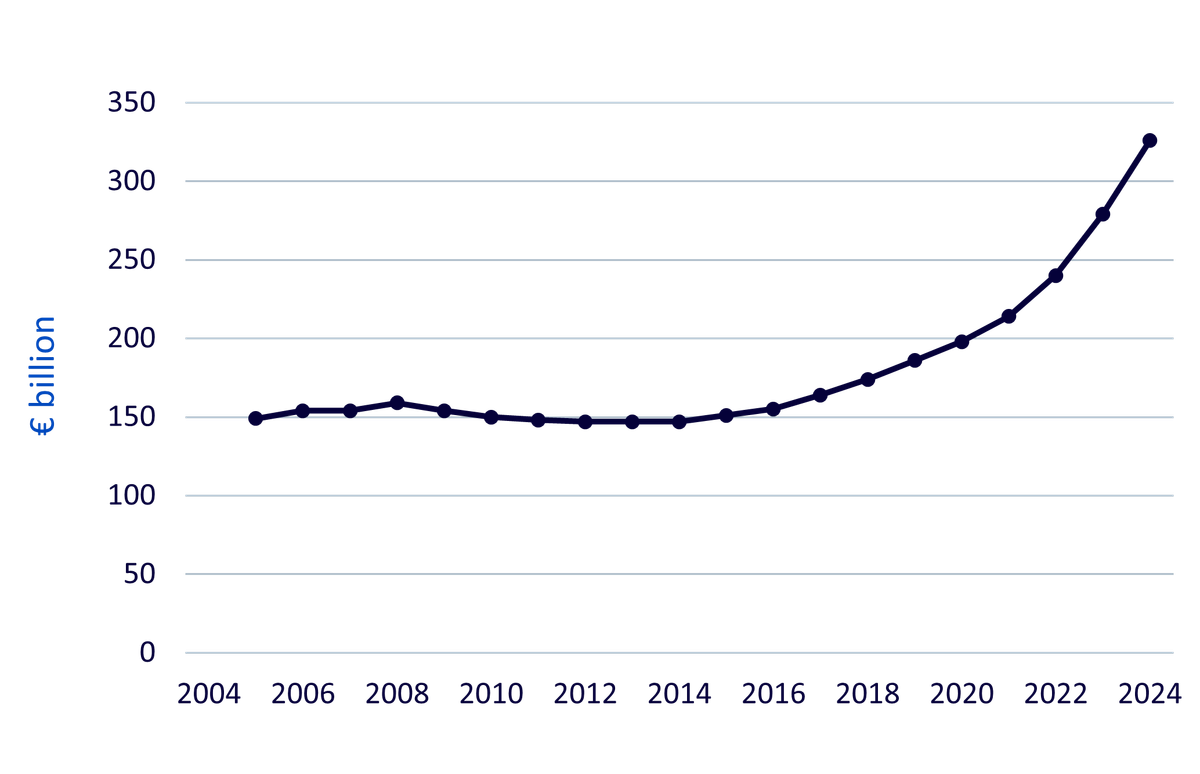
Source: European Defence Agency, data sourced in July 2025. https://www.consilium.europa.eu/en/policies/defence-numbers/
Decades of underinvestment in defence and reliance on the US will take time to reverse. But strengthening defences and pursuing greater autonomy is no longer optional. European countries are responding by boosting defence spending, deepening political coordination, and developing homegrown defence technology.
Companies like Helsing, which recently demonstrated its autonomous software flying a Gripen fighter3, show how quickly European defence tech is advancing. Political deals such as the Kensington Treaty between Germany and the UK underline how shared security concerns are overcoming past friction. Meanwhile, NATO’s4 new target of 5% of GDP for defence spending by 2035 will require financial innovation. Europe may draw on its experience with Covid bonds to collectively fund its ambitious defence plans.
Fragmentation in fossil fuel markets in a world with rapidly rising energy needs has given nuclear a new lease of life. From advanced reactors in the US to the UK’s selection of Rolls Royce’s SMR design, governments are moving quickly. Markets are watching closely as developers like Oklo promise deployment as early as 2027.
Large reactors are also returning. Meta and Microsoft have both struck long-term deals to support nuclear plants for their data centres, while France and the US are planning major capacity additions. China’s fivefold growth in nuclear over the past 15 years shows how this can be achieved. Other countries are taking note.
Microsoft20-year agreement with Constellation for nuclear energy from Three Mile IslandAmazonMultiple deals to secure small modular reactors | GoogleDeal with Kairos Power to secure multiple small modular reactors in the early 2030sMeta20-year agreement with Constellation for nuclear energy from the Clinton Clean Energy Centre |
|---|
Source: World Nuclear News, 2024, 2025.
Tech giants are racing to lock in nuclear energy for their data centres. At the same time, companies like Palantir are bringing AI into reactor construction to slash delays and cost overruns. Nuclear is fast becoming both a strategic and a tech story.
Cyberattacks are becoming a weapon of statecraft. The July attack on Microsoft’s SharePoint servers, which also hit the US nuclear weapons agency, showed how geopolitical conflict is spilling into the digital realm. NATO now includes cybersecurity in its expanded defence spending goals, and organisations are increasingly alert to threats from state-sponsored groups.
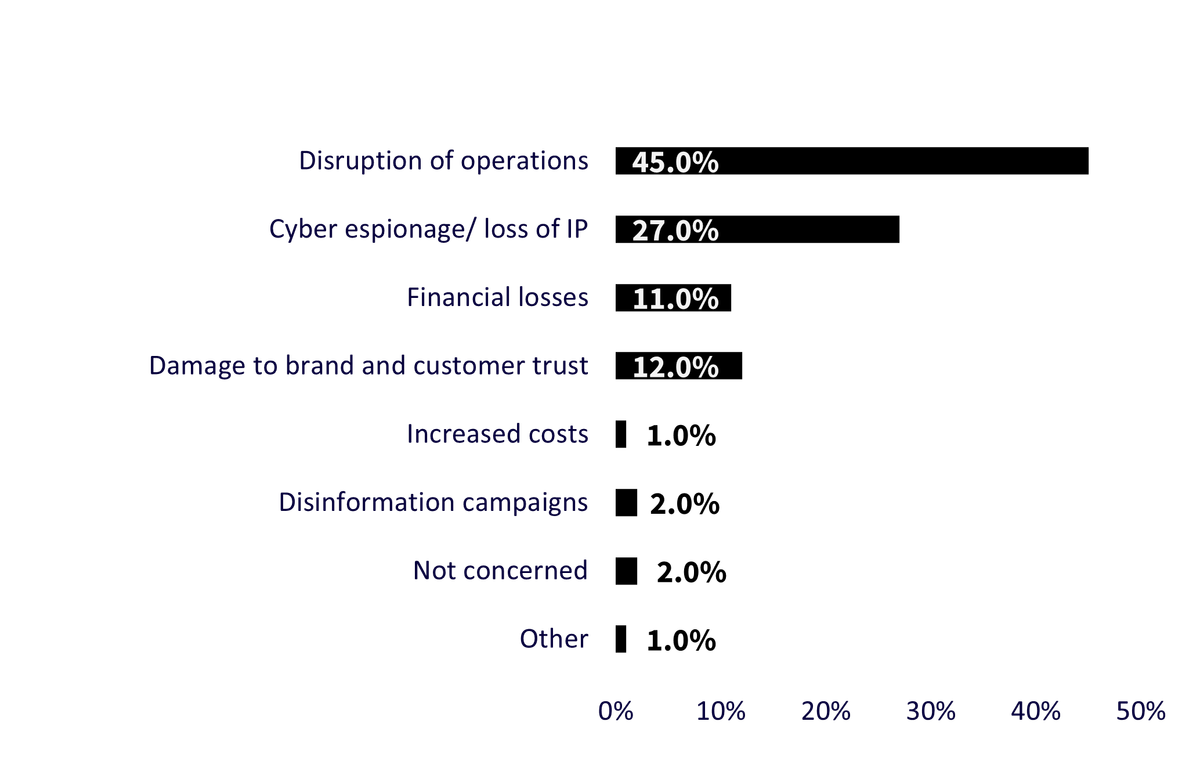
Source: World Economic Forum Global Cybersecurity Outlook 2025. Survey results for Chief Information Security Officers worldwide. Note, IP is intellectual property
With the International Monetary Fund (IMF) warning that cybercrime could cost the world $23 trillion by 20275, the stakes are clear. A Team8 survey of Chief Information Security Officers shows that in 2025, despite budgetary constraints, more than half of organisations are raising their cybersecurity spending. Fragmentation has made cyber risk systemic, and the investment response is only likely to grow.
Rare earth elements sit at the heart of military, clean energy, and digital technologies. China controls nearly 70% of mining and almost 90% of processing6, making them a strategic vulnerability for rivals. US companies are already pivoting away from Chinese supply, with Apple shifting to MP Materials, but refining capacity remains a bottleneck.
Countries are investing heavily to build alternative supply chains. Canada, Australia, and Japan are scaling up projects, and the US is leading the Minerals Security Partnership to build new supply chains. This is not just diversification but strategic realignment, and the coming years will likely see new supply networks emerge outside of China’s orbit.
The weaponisation of the financial system, from cutting Russia off SWIFT to growing BRICS alternatives, is challenging the US dollar’s dominance. In response, the US has moved to regulate and legitimise stablecoins, turning them into a potential tool of financial influence. Backed by Treasuries and cash-like assets, stablecoins can reinforce demand for the dollar while extending its reach into digital markets.
At the same time, tokenisation is scaling. Over $25 billion in assets are now live on blockchains7, with institutions embracing the efficiency of real-time settlement and lower transaction costs. In a fragmented world, blockchain adoption is becoming not just an economic choice, but a geopolitical one.
The risks that dominated global thinking in 2021 were about shared challenges like climate change and the global pandemic. By 2025, the conversation is shaped by conflict, polarisation, and fragmentation.
Yet fragmentation is also creating powerful investment themes. Europe is rearming, nuclear is resurging, cybersecurity is being securitised, supply chains for critical minerals are shifting, and blockchain is entering the financial mainstream. The tectonic shifts in global politics will inevitably move markets. These five themes could drive investor interest as that happens.
For WisdomTree’s full Market Outlook, please click here.
1World Economic Forum Global Risk Report 2021
2World Economic Forum Global Risk Report 2025
3FT, July 2025
4The North Atlantic Treaty Organization
5SentinelOne, International Monetary Fund (IMF), July 2025.
6Barrons, Jan 2025.
7RWA.xyz | Analytics on Tokenized Real-World Assets as of 21 July 2025

Director, Research
@MobeenTahirWTMobeen is a member of WisdomTree’s research team where he focuses on a wide range of asset classes to offer strategic and tactical insights to our clients on global markets and investment products. Before joining WisdomTree in December 2018, Mobeen worked at Willis Towers Watson as an investment consultant advising institutional clients as well as their in-house fund business on asset allocation and portfolio construction with his research focus being equity and multi-asset smart beta. Mobeen has a BSc (Hons) in Accounting and Financial Management from Loughborough University and an MSc in Accounting and Finance from the London School of Economics and Political Science. He is also a CFA Charterholder.

