


The most powerful rock on earth: why uranium is making a comeback
Published 18 March 2025

Key Takeaways
Imagine flying over the Australian Outback. Below, the land stretches endlessly—rugged, orange, and seemingly lifeless. But beneath the surface lies something powerful enough to light up entire cities. It’s not oil, gas, or coal. It’s a rock. And just one kilogram of it contains hundreds of thousands of times the energy in one kilogram of coal1. The rock is uranium.
For decades, uranium has fuelled the world’s most potent energy source: nuclear power. Yet, its journey has been anything but smooth, marked by booms, busts, and controversy. Now, as the world races to secure sustainable energy sources, uranium is back in the spotlight.
What’s driving this renewed interest? What does the future hold? And how can investors tap into this opportunity?
Uranium: a highly energy-dense material
Uranium’s energy density is unparalleled. One kilogram of uranium produces 3.9 million megajoules of energy, compared to just 24 megajoules from coal. This is because uranium is fissile—it sustains a nuclear chain reaction, generating immense energy. In contrast, fossil fuels like oil and gas rely on simple combustion, yielding far less energy.
Figure 1: Uranium’s energy density vs other fuels (megajoules/kg)
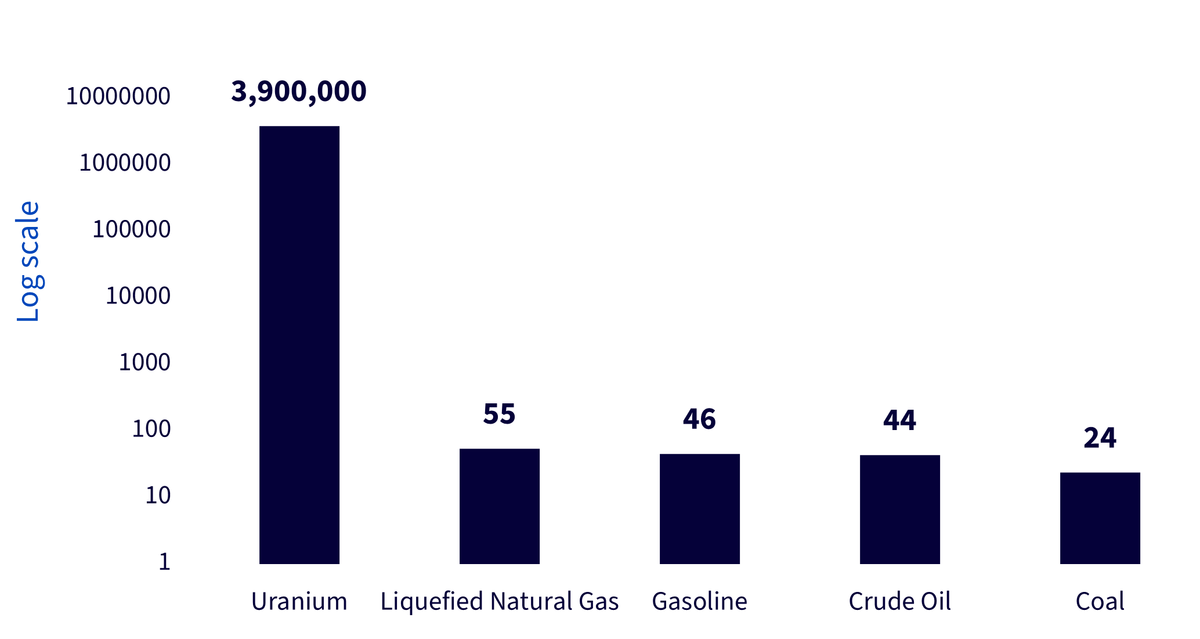
Source: Visualcapitalist, Energy Education, World Nuclear Association, 2023.
The supply gap is widening
Uranium is the essential raw material for nuclear power, and several factors are driving demand growth:
- Renewed political support – since 2022, nuclear energy has been classified as “green” under the EU Taxonomy framework, recognising its role in achieving net-zero emissions by 2050. This marks a major shift in policy2.
- Rising Energy Demand – artificial intelligence (AI), data centres, and cryptocurrencies are consuming more power, forcing companies and governments to seek sustainable solutions.
- Advancements in small modular reactors (SMRs) – small modular reactors offer scalable, decentralised nuclear power. Tech giants like Google and Amazon have already signed agreements to use SMRs for their data centres.
Figure 2: The uranium supply gap is expected to widen
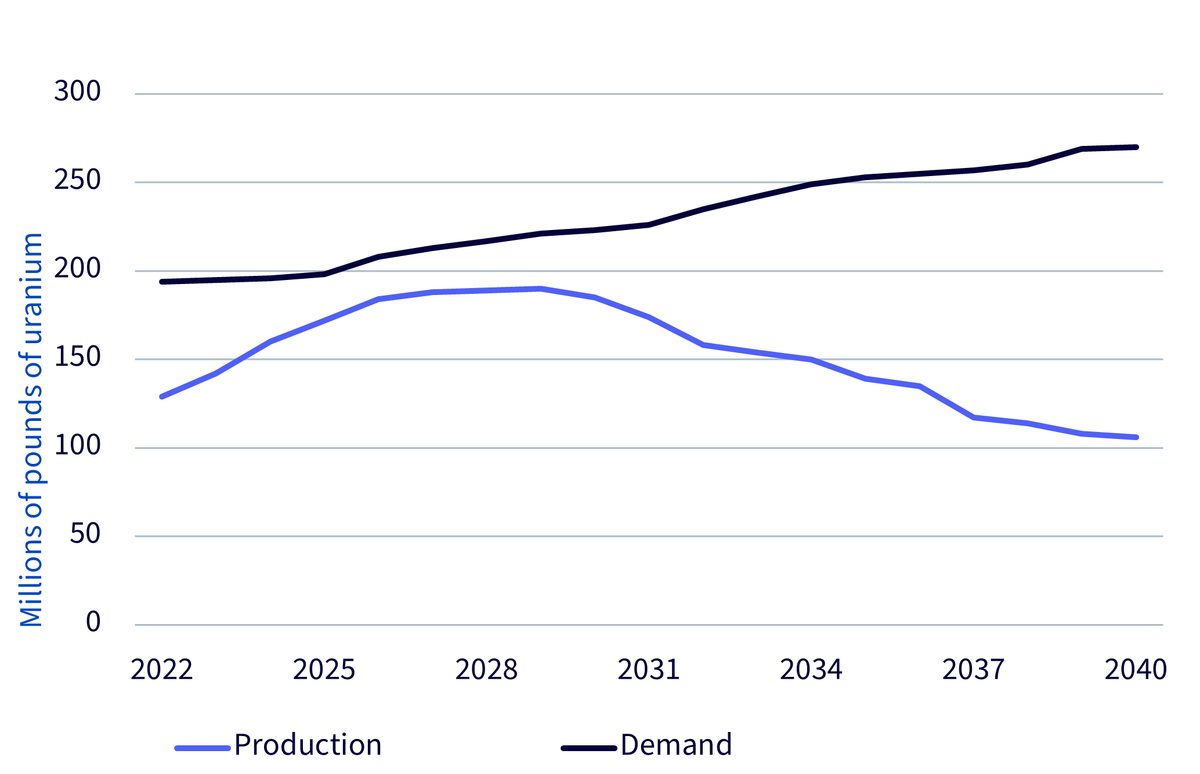
Source: Visualcapitalist, UxC, December 2023. Forecasts from 2023 and onwards. Forecasts are not an indicator of future performance and any investments are subject to risks and uncertainties.
While demand is surging, supply remains constrained. For years, low prices discouraged new mining investment. Now, with demand accelerating, supply is struggling to keep up. Given that new uranium mines take 10–15 years to become operational3, a significant supply deficit is expected, likely supporting higher prices in the coming years.
Conclusion: uranium resources are abundant but underutilised
The World Nuclear Association’s 2021 estimates show that uranium resources are plentiful, with the top 10 countries holding the largest reserves:
Figure 3: World Nuclear Association’s 2021 uranium resource estimates
Country | Tonnes (U) | % of world |
|---|---|---|
Australia | 1,684,100 | 28% |
Kazakhstan | 815,200 | 13% |
Canada | 588,500 | 10% |
Russia | 480,900 | 8% |
Namibia | 470,100 | 8% |
South Africa | 320,900 | 5% |
Niger | 311,100 | 5% |
Brazil | 276,800 | 5% |
China | 223,900 | 4% |
Source: World Nuclear Association, May 2024.
However, uranium production remains highly concentrated. In 2022, the top producers were:
Figure 4: Uranium top producers in 2022
Country | Tonnes (U) |
|---|---|
Kazakhstan | 21,227 |
Canada | 7351 |
Namibia | 5613 |
Australia | 4553 |
Uzbekistan (est.) | 3300 |
Russia | 2508 |
Niger | 2020 |
China (est.) | 1700 |
India (est.) | 600 |
Source: World Nuclear Association, May 2024.
Kazakhstan alone accounted for 43% of global uranium production in 2022, followed by Canada (15%) and Namibia (11%). While uranium resources are abundant, production must expand to meet rising demand. As nuclear energy adoption grows, uranium mining will play an increasingly crucial role in securing global energy stability.
Uranium is making a comeback, and with its unmatched energy density and growing demand, it presents a compelling opportunity for investors looking to capitalise on the future of nuclear energy.
1 Visualcapitalist, Energy Education, World Nuclear Association, 2023.
2 European Commission, 2022.
3 International Energy Agency.
About the contributor

Mobeen Tahir
Director, Research
@MobeenTahirWTMobeen is a member of WisdomTree’s research team where he focuses on a wide range of asset classes to offer strategic and tactical insights to our clients on global markets and investment products. Before joining WisdomTree in December 2018, Mobeen worked at Willis Towers Watson as an investment consultant advising institutional clients as well as their in-house fund business on asset allocation and portfolio construction with his research focus being equity and multi-asset smart beta. Mobeen has a BSc (Hons) in Accounting and Financial Management from Loughborough University and an MSc in Accounting and Finance from the London School of Economics and Political Science. He is also a CFA Charterholder.