
BTCW LN
WisdomTree Physical Bitcoin

Published 7 August 2025

Director, Digital Assets Research

Senior Associate, Quantitative Research

As inflation proves persistent, sovereign debt escalates, and institutional trust wanes, investors are reassessing hard assets. Gold has long been the inflation hedge of choice, but bitcoin has emerged as a credible digital challenger.
Bitcoin and gold: 3 model forecasts for 2030 and beyond paper introduces a disciplined, scenario-based framework to forecast the future valuations of both assets to 2030 and beyond.
Since 1970, global money supply has exploded from under $1 trillion to $180 trillion – a 180x expansion. This tidal wave of fiat creation, fuelled by loose monetary policy and perpetual bailouts, has outpaced real growth and eroded long-term purchasing power.
As a result, hard money assets – those that cannot be easily printed or manipulated – have gained traction. Gold, with its 5,000-year track record, remains the traditional hedge. But bitcoin has joined the conversation, offering a verifiably scarce, decentralised, and digital alternative.
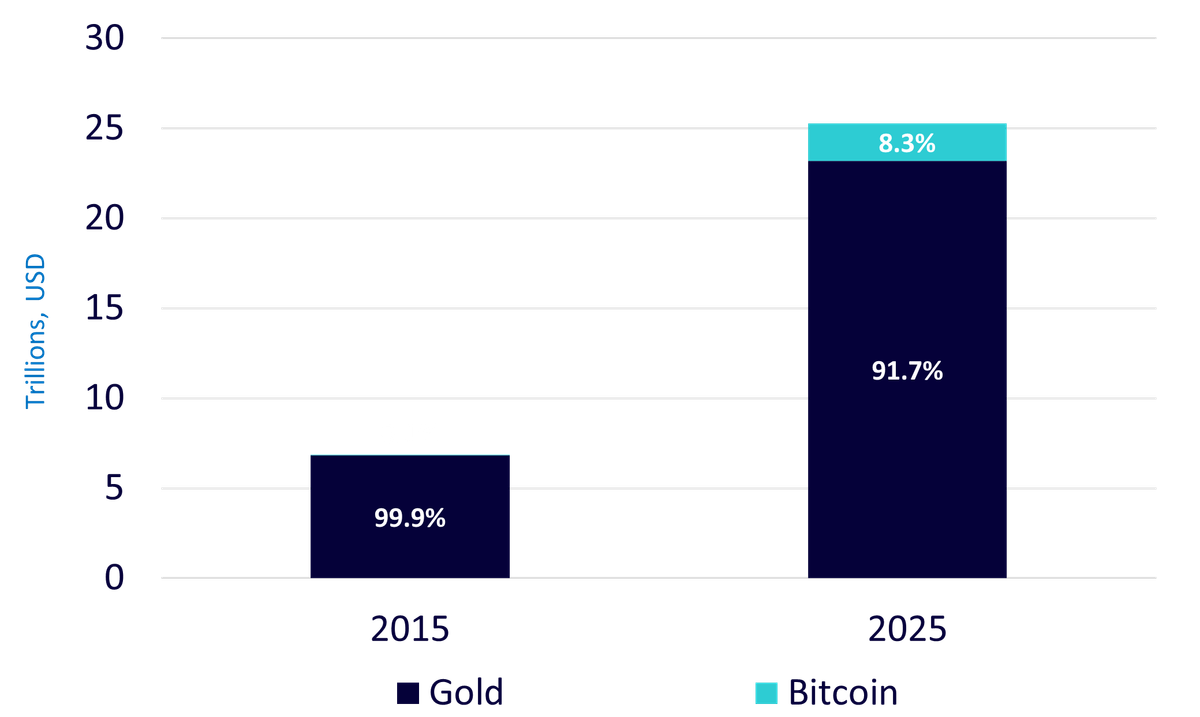
Together, bitcoin and gold now account for approximately 14% of global money, with bitcoin commanding around 8% of the hard money basket. This suggests a growing institutional and retail pivot toward assets resistant to monetary dilution.
To assess the future value potential of these assets, we introduce a simple, yet disciplined valuation model grounded in monetary dynamics. The model estimates future market capitalisations and subsequent prices for bitcoin and gold based on four core variables:
This framework is captured in the formula:
Pricebitcoin = M x H x B / Sbitcoin
Where M is the total money supply, H is the portion allocated to hard assets, B is bitcoin’s share of that hard asset pool, and Sbitcoin is bitcoin’s circulating supply. The gold price can be calculated similarly by replacing B and Sbitcoin with (1-B) and Sgold.
We model three future scenarios for money supply growth and its implications for bitcoin and gold prices.
These assumptions drive three distinct trajectories for bitcoin and gold, which we summarise below.
Figure 2: Model results
Scenario | Asset | 2030 Price | 2030 CAGR | 2050 Price | 2050 CAGR |
|---|---|---|---|---|---|
Deflationary case | Bitcoin | $120K | 2% | $213K | 2.7% |
Gold | $3K | -2% | $4.7K | 1.4% | |
Base case | Bitcoin | $250K | 18% | $658K | 7.4% |
Gold | $4K | 3.7% | $9.1K | 4.2% | |
Inflationary case | Bitcoin | $500K | 35% | $1.9M | 12.1% |
Gold | $5.5K | 11% | $18.8K | 7.2% |
Bitcoin and gold serve distinct yet complementary roles in an investment portfolio. Gold offers historical legitimacy and stability, while Bitcoin offers programmable scarcity and asymmetric upside potential. Together, they offer a multifaceted shield against fiat debasement and systemic shocks.
The structural reality of modern monetary policy turbocharges the case for these hard money assets. With central banks locked into expansionary frameworks, assets that sit outside the fiat system stand to benefit – bitcoin disproportionately so in high-inflation scenarios.
From a practical standpoint, incorporating even modest allocations to bitcoin and gold can enhance a portfolio’s resilience and optionality, particularly in an increasingly inflation-prone and politically unstable macro regime.
This is not just theory. The paper delivers a transparent, data-driven valuation framework across multiple money supply growth paths. It avoids overhyped predictions and presents realistic scenario analysis rooted in monetary history. More importantly, it positions bitcoin not as a rogue asset but as part of a strategic hard money framework that aligns with long-term wealth preservation goals.
For institutions serious about safeguarding capital amid fiscal erosion and monetary overreach, this paper delivers the blueprint. Do not just react – position. Read Bitcoin and gold: 3 model forecasts for 2030 and beyond and future-proof your asset allocation strategy.
1Each year, the mining growth rate is multiplied by 0.95, and therefore the growth rate decays by 5%. Historically, gold has been mined at a rate between 0.5% and 1.5% of supply. Current levels are closer to the latter rate, but World Gold Council estimates depleting below ground supply that aligns with reduced mining production in the years to come.

Director, Digital Assets Research
Dovile Silenskyte is a director of digital assets research at WisdomTree. Before joining WisdomTree in May 2024, Dovile worked as an index equity product strategist at BlackRock. Currently, she is responsible for conducting analyses for in-house digital assets publications and assisting the sales team with client queries about products and markets. Dovile holds an MSc in Finance from Texas A&M University – Commerce, and she is also a chartered financial analyst (CFA).

Senior Associate, Quantitative Research
Blake Heimann joined WisdomTree in 2020 and, in his current role as Senior Associate, supports the creation, maintenance, and reconstitution of our indices. Blake began his career in finance in 2017 as an Analyst at TD Ameritrade, and later a Quantitative Analyst with focuses on research and development of machine learning applications in finance. Blake has bachelor’s degrees in Mathematics and Economics from Iowa State University, as well as his Masters in Computer Science at Georgia Tech, with a specialization in Machine Learning. He is currently pursuing a Masters in Finance from the London School of Economics.

Head of Commodities and Macroeconomic Research, WisdomTree Europe
@NiteshShahWTNitesh Shah is a seasoned financial professional with over 24 years of experience in research and investment strategy. As Head of Commodities & Macroeconomic Research at WisdomTree Europe, he leads market analysis and insights across asset classes, with a focus on commodities and exchange-traded products. Previously, he held roles at Moody’s, HSBC Investment Bank, The Pension Protection Fund, and Decision Economics, building expertise in market analysis and strategy. Nitesh earned a master’s degree in International Economics and Finance from Brandeis University and a bachelor's in Economics from the London School of Economics. His insights are frequently featured in financial media, and he is a sought-after speaker at industry events. He also hosts the ‘Commodity Exchange’ podcast, where he discusses trends shaping global markets. Passionate about guiding investors, Nitesh provides actionable insights to help them navigate complex financial landscapes.